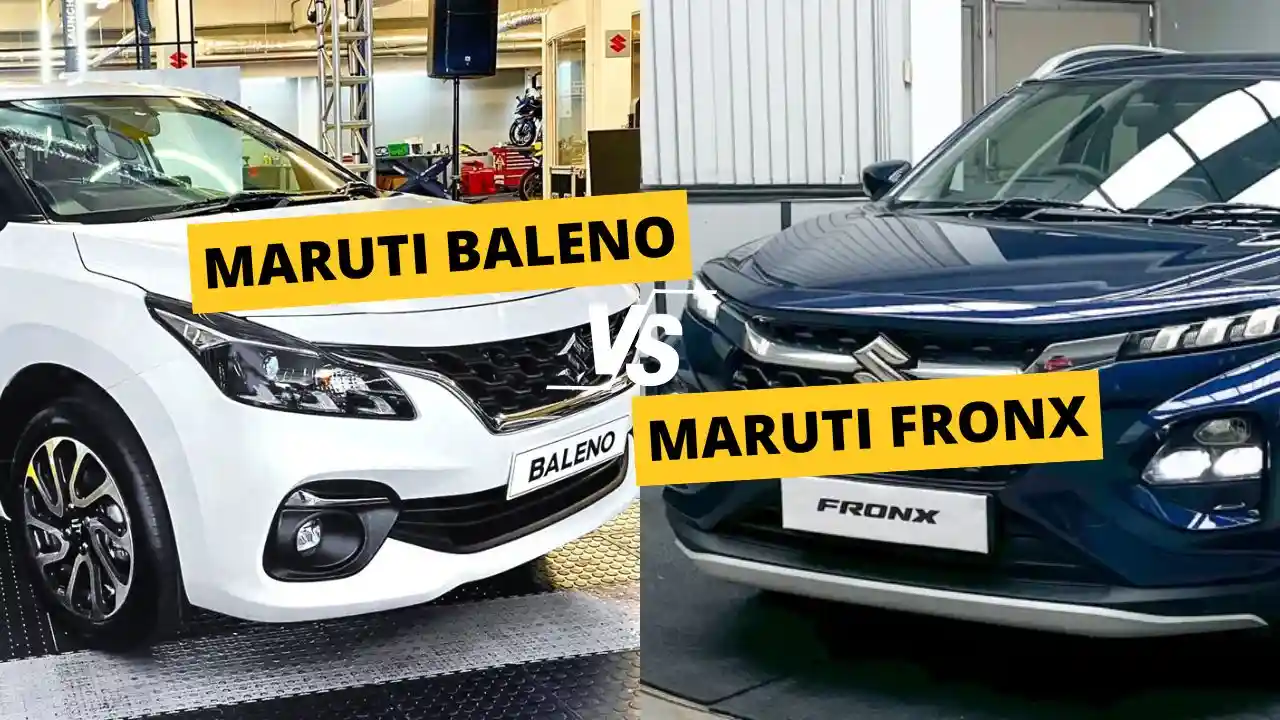

Comparison of Maruti Baleno vs Maruti Fronx is quite popular among Indian customers who seek a premium hatchback or rather a crossover in ₹7-13 Lakh range. Both the cars are underpinned by Maruti Suzuki’s Heartect platform and also get the same 1.2-litre petrol motor with CNG options as well. There are numerous common interior parts and features as well.
But these two vehicles are made for slightly different purposes. Viariant Models Baleno is a premium hatchback, Fronx is a crossover looking high ground clearance with SUV design on board. Maruti Baleno vs Maruti Fronx comparison is based on data of December 2025 provided by Maruti Suzuki, CarDekho, and CarWale to compare the pricing, size, performance, features comfort & convenience of your budget vehicle and gives you an estimate for the cost for ownership on your chosen car.
- Pricing: Baleno Offers Better Value at Entry Level
- Dimensions and Practicality: Fronx Has SUV Appeal
- The Engine, Performance and Mileage: Almost the same with Fronx Turbo Option
- Design and Styling: Maruti Baleno vs Maruti Fronx
- Features: Similar Kits with Minor Variations
- Safety: Strong Packages in Both
- Ownership and Service: Maruti’s Network Advantage
Pricing: Baleno Offers Better Value at Entry Level
Pricing of Maruti Baleno ranges from a starting price of ₹6.70 lakh (ex-showroom) for the Sigma variant, which is no more premium as compared to the Fronx. The Sigma version of the Maruti Fronx is priced from ₹7.51 lakh (ex-showroom). At the top end, Baleno Alpha is priced at approximately ₹9.96 lakh while the Fronx Alpha turbo rises to about ₹13.04 lakh.
The cost difference of about ₹0.8-1.5 lakh is primarily because the Fronx is being marketed as a crossover, and it also comes with an optional turbo-petrol engine. On-road prices in the Delhi now average between ₹91,10 lakh for the Baleno and ₹1012 lakh for the Fronx, depending on RTO charges and insurance. If you’re a buyer in search of better value for cheaper costs, the Baleno might be more up your alley; if SUV-inspired design is right up your street, the Fronx may well be worth spending that bit extra.
Dimensions and Practicality: Fronx Has SUV Appeal
Both the cars have similar wheelbase of 2,520mm so rear seat space should be pretty much same. In dimensions, the Fronx is 3,995 mm long, (1,765 mm wide and 1550mm tall) with a ground clearance of 190 mm. The Baleno is 3,990 mm long, 1,745 mm wide and stands 1,500 tall (170 mm above the ground).
The extra height and ground clearance of the Fronx make it easier to drive on bad roads and speed breakers. It also provides a more elevated feel in the cockpit, which many shoppers like. Boot space is nearly identical as well, with the Baleno again edging out at 318 litres compared to Fronx’s 308 litres. Both vehicles can accommodate five adults with headroom and legroom of these are large enough to be comfortable daily for family use.
The Engine, Performance and Mileage: Almost the same with Fronx Turbo Option
Both cars offer identical 1.2-litre K-Series Dual Jet petrol engine which makes 88 bhp and 113 Nm of torque. The engine can be paired with a 5-speed manual gearbox or an AMT automatic as well. CNG variety is also there and churns out around 77 bhp.
ARAI mileage stats:
- Petrol: 21.79 kmpl (manual), 20.01 kmpl (AMT)
- CNG: for Baleno and almost same for Fronx
In actual driving scenarios, the petrol unit will return between 18–20 kmpl and CNG will deliver from 25–28 km/kg. The Fronx is also powered by a 1.0-litre Boosterjet turbo-petrol engine that makes 99 bhp and 148 Nm of torque. This is quicker and more powerful sounding, especially at highway speeds, but the fuel economy takes a small hit compared to the regular petrol.
Design and Styling: Maruti Baleno vs Maruti Fronx
The Maruti Fronx gets the SUV-ish styling bits like high ground clearance, and roof rails as well as a bold front grille. It just looks more rugged and has a stronger road presence. Baleno has a more premium hatch look with sleeker lines and cleaner appearance.
It looks a bit more elegant and sporty, especially in lighter tones. Both car wear LED headlamps and posher, bigger wheels in the higher iToros but the Fronx is a more immediately distinctive presence on the road due to its taller metamorphosis.
Features: Similar Kits with Minor Variations
Inside the cabin, both cars offer very similar features. These range from a 9-inch touchscreen infotainment system with wireless Android Auto and Apple CarPlay, Arkamys sound system and cruise control to connected car tech on top trims.
The Fronx comes with some extras such as a head-up display and a 360-degree camera in the Alpha trim. The Baleno, however, has a slight edge in boot space for some trims. Both vehicles offer automatic climate control, push-button start and keyless entry from mid-spec models up.
Safety: Strong Packages in Both
Both the Baleno and Fronx offer good safety equipment for their segment. Top-end trims are equipped with six airbags, ABS with EBD, electronic stability program (ESP), hill-hold assist and ISOFIX child seat mounts.
The Baleno has already fared well in Global NCAP crash testing. Given the Fronx is based on the same architecture it’s anticipated to deliver similar safety although official classifications may differ depending on which variant that you opt for.
Ownership and Service: Maruti’s Network Advantage
One major advantage of both cars is Maruti Suzuki’s wide service network, with more than 4,000 service centers across India. Maintenance is minimal around ₹5,000–7,000 per year and resale value is high.
The warranty for both vehicles is 2 years, or up to 40,000 km, and can be extended for more coverage at an additional cost. It is all about preference: Maruti Baleno vs Maruti Fronx While making a choice between Maruti Baleno and Marutifronx, it becomes tricky since both the cars vary in terms of aesthetics. For those who want more mileage, a lower price and regular hatchback comfort, there’s the Baleno.
And the Fronx is more appropriate for consumers looking for a crossover look, higher ground clearance, and an available turbo engine. The two cars are good compact cars and both are very fuel-efficient while being reliable and suitable to Indian conditions. You really ought to test drive one so you can see how high it sits, the ride comfort (so good) and just get a feel for driving position.