
Hoping for a steady government job that brings authority, respect, and good prospects? Many people aim to become income tax officer because the job offers real influence in tax administration, a good salary, and clear promotion prospects.
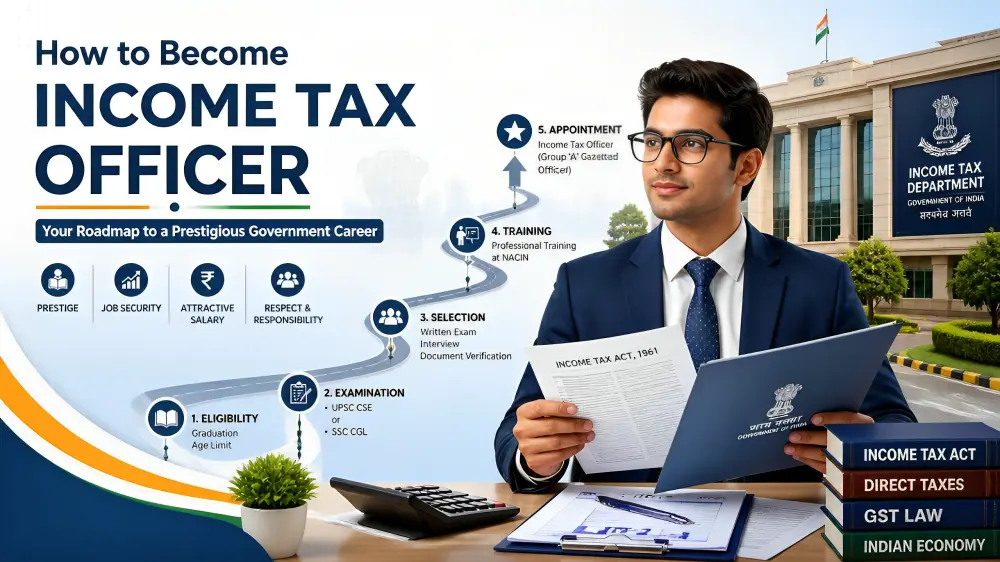
Here’s something many overlook: there’s no direct exam to become an Income Tax Officer (ITO). You can’t just apply for “Income Tax Officer” through an open exam. Instead, you start at a lower position and work your way up, or you join at a higher rank through the UPSC.
This guide explains both realistic routes in simple language, with the latest 2026 eligibility, process, salary, and practical tips.
- Who is an income tax officer?
- Eligibility Criteria (Common for Both Routes)
- Route 1: SSC CGL → Income Tax Inspector → Promotion to Income Tax Officer (Most Common Path)
- Route 2: UPSC Civil Services Examination → Indian Revenue Service (IRS – Income Tax)
- Job Profile and Daily Work of an Income Tax Officer
- Salary and Benefits (2026 Approximate Figures)
- Career Growth Path
- Practical Tips to Succeed
Who is an income tax officer?
An Income Tax Officer is a Group B gazetted officer in the Income Tax Department under the Central Board of Direct Taxes (CBDT), Ministry of Finance.
Income Tax Officers deal with checking tax forms, sending out notices, doing investigations, and helping enforce tax rules. They report to higher-ups like assistant commissioners and are important in finding tax cheats and making sure people follow the rules.
Eligibility Criteria (Common for Both Routes)
- Education: Bachelor’s degree in any stream from a recognised university. Final-year students can usually apply for the written stages.
- Nationality: Indian citizen.
- Age Limit (approximate for 2026 cycles; check official notice):
- SSC CGL route: 18 to 30 years (as on the cutoff date, usually 1 August).
- UPSC CSE route: 21 to 32 years.
- Age Relaxation: 3 years for OBC, 5 years for SC/ST, and higher for PwBD and other categories as per government rules.
- Physical standards apply for some inspector-level posts (height and chest measurements for males/females).
Route 1: SSC CGL → Income Tax Inspector → Promotion to Income Tax Officer (Most Common Path)
This is how most officers become income tax officers.
1. Clear the SSC Combined Graduate Level (CGL) Examination
Conducted every year by the Staff Selection Commission.
- Tier 1: Computer-based objective test (reasoning, quantitative aptitude, English, general awareness).
- Tier 2: Advanced computer-based papers (including quantitative, English, computer knowledge, and data entry speed tests where required).
- Document verification and final merit list.
2. Choose “Inspector of Income Tax, CBDT” as a high preference while filling post preferences.
3. Join as an Income Tax Inspector (Group B, non-gazetted, Pay Level 7, basic pay starts at ₹44,900).
4. Complete probation and pass the Departmental Examination for Inspectors.
5. To become income tax officer, you need to work for a certain number of years, pass the Departmental Exam for Income Tax Officers, and wait for openings in your group. It typically takes many years (often between 5 and 9, depending on where you are and how well you perform) to get promoted.
Tip: Rank high in SSC CGL, so you get preferred postings and better chances of faster growth.
Route 2: UPSC Civil Services Examination → Indian Revenue Service (IRS – Income Tax)
This is the direct Group A entry.
- Appear for the UPSC Civil Services Examination (Prelims → Mains → Personality Test/Interview).
- Secure a good rank and choose Indian Revenue Service (Income Tax) during service allocation.
- Join as Assistant Commissioner of Income Tax (Group A, Pay Level 10; basic pay starts at ₹56,100).
This rank is already above Income Tax Officer. After training at LBSNAA and the National Academy of Direct Taxes (NADT), you start higher in the hierarchy.
Job Profile and Daily Work of an Income Tax Officer
- Scrutinising income tax returns
- Issuing notices and conducting hearings
- Assisting in search and seizure operations
- Handling TDS, assessment, and recovery work
- Field enquiries and investigation support
- Maintaining records and ensuring compliance with the Income Tax Act
The work mixes desk jobs and field duties. It demands integrity, analytical skill, and the ability to handle pressure.
Salary and Benefits (2026 Approximate Figures)
- Income Tax Inspector (entry via SSC CGL): Basic ₹44,900 (Level 7). In-hand salary is roughly ₹60,000–₹80,000+, depending on city (DA, HRA, TA).
- Income Tax Officer (after promotion): Basic starts at ₹47,600 (Level 8). In-hand is usually higher, around ₹70,000–₹95,000+ in metros.
Extra advantages consist of DA (updated often), HRA or government housing, healthcare, travel leave, pension/NPS, and other government benefits.
Career Growth Path
SSC CGL route:
Inspector → Income Tax Officer → Assistant Commissioner → Deputy Commissioner → Joint Commissioner → higher ranks.
UPSC route:
Assistant Commissioner → Deputy Commissioner → Joint Commissioner → Additional/Principal Commissioner → Chief Commissioner level.
Promotions are based on seniority, available positions, exams, and how well you do your job. Those who perform well and pass exams sooner can advance more quickly.
Practical Tips to Succeed
- Start preparation early for SSC CGL or UPSC with a clear study plan.
- Focus on Quantitative Aptitude, Reasoning, English, and General Awareness for CGL. For UPSC, build strong current affairs and answer-writing skills.
- Prefer the Income Tax Inspector post high in your SSC CGL choice list.
- After joining, take departmental exams seriously — they decide how fast you become an ITO.
- Maintain a clean record and strong performance for smoother promotions.
- Stay updated with official notifications on ssc.gov.in and upsc.gov.in.
Strong Summary and Final Recommendation
To become income tax officer, one common way is to pass the SSC CGL exam, start as an income tax inspector, and then advance through work experience and internal exams. Another respected route is to pass the UPSC CSE and get into the Indian Revenue Service (Income Tax) at a higher level.
Whether you choose one path or the other, dedication, steadiness, and honesty really pay off. Be sure to look at the new official announcements each year. Things like age limits, job openings, and exam formats might change a bit.
For graduates or those in their last year, it’s a great time to start getting ready for SSC CGL or UPSC. By putting in effort, planning wisely, and being patient with promotions, you can create a respected and fulfilling career in the Income Tax Department. Pick the path that suits you best and go at it step-by-step. With determination, success is within reach in this career.