
Want to have more say over your time, earnings, and the kind of work you do? Many people choose to become a freelancer for exactly these reasons. As a freelancer, you offer your skills straight to clients on your own terms, instead of being a regular employee. You get to set your prices, pick your jobs, and choose your working hours and location.
Lately, freelancing has taken off in a big way. Millions of talented people in the U.S. and around the globe are now working for themselves, adding a lot to the economy. There’s strong demand for experts who can get results, especially those who are great with modern tools. This guide helps you with simple steps to kick off and grow a steady freelance career, whether you’re leaving a full-time job or just starting with little background.
- What does it mean to become a freelancer?
- Benefits of Freelancing
- Popular Freelance Skills and Niches in 2026
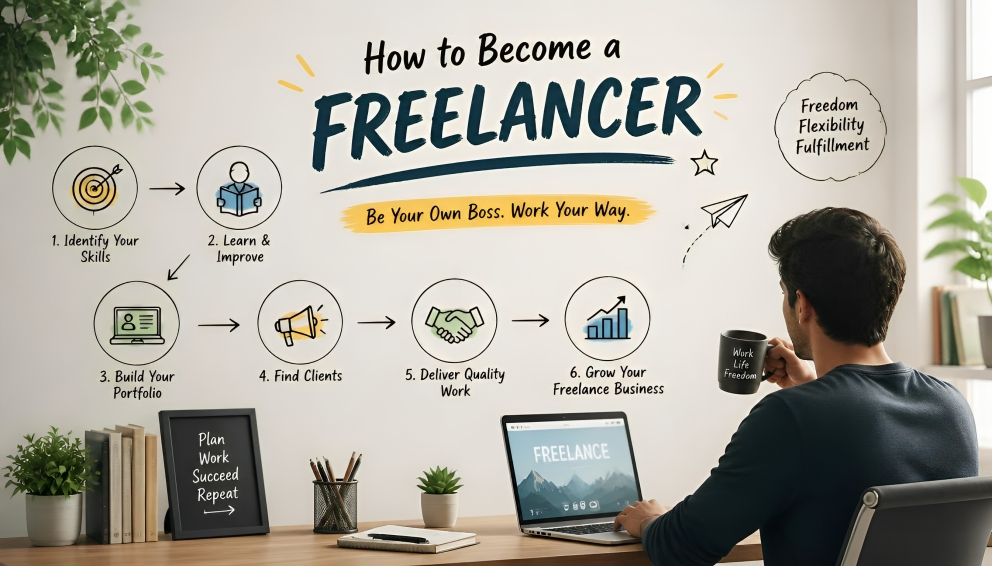
- Step-by-Step Guide to Become a Freelancer
- Best Platforms to Find Freelance Work
- How to manage finances and taxes
- Common Mistakes to Avoid
- Tips for Long-Term Success
- Latest Trends Shaping Freelancing
What does it mean to become a freelancer?
A freelancer works for themselves, offering their skills to clients on a project-by-project basis. You’re not employed by a company, so you manage your own taxes, marketing, client interactions, and daily tasks. Freelancers often work in areas like writing, design, development, marketing, virtual assistance, consulting, and more recently, AI.
Freelancing isn’t like a regular job. It’s flexible but also demands good business skills. You have to find clients, do great work, manage finances, and prepare for slow times. Seeing freelancing as running a small business from day one helps you do well in the long run.
Benefits of Freelancing
Freelancing offers several clear advantages:
- Flexibility—Choose your hours and often your location.
- Income potential—Skilled freelancers can earn more than in comparable employed roles once they establish rates and a client base. Many full-time independents report strong earnings, with a growing number reaching six figures.
- Variety — Work with different clients and projects instead of the same role every day.
- Skill growth — You control which skills you develop and can adapt quickly to market demand.
- Autonomy — Decide which projects align with your values and strengths.
There are downsides like uneven income at first, handling your own benefits and taxes, and needing solid self-motivation.
Popular Freelance Skills and Niches in 2026
Demand is highest for specialised, outcome-focused services. Popular areas include:
- Content writing, copywriting, and SEO content
- Graphic design, UI/UX, and branding
- Web development and no-code solutions
- Digital marketing, social media management, and email campaigns
- Virtual assistance and project coordination
- Video editing and AI-assisted creative work
- AI integration, prompt engineering support, and specialised AI tools
Narrowing your offer helps. Instead of “I do marketing,” try “I create email sequences that increase conversions for e-commerce brands.” Specialisation makes you easier to find and hire.
Step-by-Step Guide to Become a Freelancer
Follow these practical steps to move from idea to paid work.
1. Choose and Validate a Marketable Skill
Start by listing skills you have or can quickly pick up. Look at job listings to see what people are asking for. Test your abilities by doing a small paid job or sample project. Stick to offering one main service at first so you don’t get overwhelmed.
2. Define Your Ideal Client and Offer
Figure out who benefits most from your skills and what problem you solve for them. Write a simple offer: “I help [type of client] get [specific result] through [your service].” This clarity makes your proposals and marketing better.
3. Build a Portfolio (Even Without Paid Clients)
Create 3–5 strong samples. Options include:
- Speculative projects for imaginary or dream clients
- Personal or volunteer work
- Redesigns of existing public materials
- Case study-style write-ups of past results (even from employed roles)
Show the problem, your process, and the outcome. Quality matters more than quantity.
4. Set Professional Rates
Calculate a sustainable rate that covers:
- Desired take-home pay
- Taxes and self-employment contributions
- Business expenses (software, equipment, insurance)
- Nonbillable time (marketing, admin, learning)
Check market rates for your skill and experience. Beginners often charge less to get reviews and increase rates later. Base your pricing on the project or value instead of just hourly, which works well if tools help you work faster.
5. Handle the Business Basics
- Register as a sole proprietor or equivalent in your location if required.
- Open a separate business bank account.
- Prepare simple contracts that cover scope, payment terms, revisions, and timelines.
- Set up invoicing and basic bookkeeping tools.
- Understand your tax obligations and set aside money from every payment.
These steps protect you and make you look professional to clients.
6. Create an Online Presence
Set up profiles on relevant platforms along with a basic website or LinkedIn page. Use a clear photo and a strong headline, and focus on results. Keeping your profiles consistent builds trust.
7. Find Your First Clients
Start with a mix of approaches:
- Send personalized proposals on job platforms.
- Create clear “gig” listings where clients browse and buy.
- Reach out to your existing network.
- Share useful content and engage on LinkedIn.
- Ask for referrals after every successful project.
Stay active – many freelancers find work early by sending focused proposals every day for a few weeks. Work on getting positive reviews and testimonials first.
8. Deliver Excellent Work and Build Relationships
Communicate well, meet deadlines, and go the extra mile when you can. After completing projects, ask for reviews and keep in touch with good clients. Repeat business and referrals often become your best sources of work.
Best Platforms to Find Freelance Work
Popular options in 2026 include:
- Upwork—Strong for longer contracts and high-value work; proposals required.
- Fiverr — Good for packaged services; clients come to your listings.
- LinkedIn—Excellent for high-value direct relationships and personal branding (no platform commission on deals you close yourself).
- Contra and similar platforms — lower or zero commission models focused on portfolio-driven connections.
- Niche sites or direct outreach for specialised skills.
Freelancers often use multiple platforms. Newbies usually kick things off on bigger sites to get reviews and build up some steam before moving to direct clients where they can earn more.
How to manage finances and taxes
It’s important to keep a close eye on what you earn and spend. Put aside some money from every pay cheque for taxes. Having a backup fund for slower times is a good idea too. Once your earnings are steady, consider looking into basic insurance and retirement savings. Tools that help with invoicing, tracking your hours, and managing accounts can make things much easier.
Common Mistakes to Avoid
New freelancers frequently:
- Underprice their work and attract the wrong clients.
- Work without written contracts
- Take on too many projects at once and compromise quality.
- Neglect marketing until work dries up
- Ignore taxes and cash flow planning
- Fail to set clear boundaries around availability and scope
Addressing these early prevents costly setbacks.
Tips for Long-Term Success
- Continuously improve your skills, especially those involving AI tools that increase efficiency and value.
- Focus on results and client outcomes rather than just hours worked.
- Build systems for proposals, onboarding, and delivery so the business runs more smoothly.
- Maintain a pipeline of opportunities even when busy.
- Review rates regularly as your experience and results grow.
- Prioritise client relationships—happy clients lead to referrals and steady work.
Latest Trends Shaping Freelancing
AI is really shaking things up. There’s a growing need for freelancers who can effectively use AI for video, content, design, and specialised tech projects. Clients are on the lookout for experts who can show real results. Platforms are changing too, focusing more on bigger projects. Building your personal brand and nurturing direct client relationships are still great ways to succeed alongside using marketplaces.
Final Thoughts and Recommendation
Learning how to become a freelancer is realistic for most people who have a marketable skill and the willingness to treat the work like a business. Start by picking one specific service, show you’re good at it, set up the basics, and keep looking for clients. At first, the key isn’t perfect prep but sticking with proposals and doing a great job.
It’s a good idea to start freelancing while you still have another income source. Use the first few months to get reviews, tweak your service, and find the right price. Once you have some good projects and a few clients, you can decide if you want to do more or make freelancing your main thing. With focus, good habits, and consistent effort, freelancing can be a flexible and satisfying way to make money.