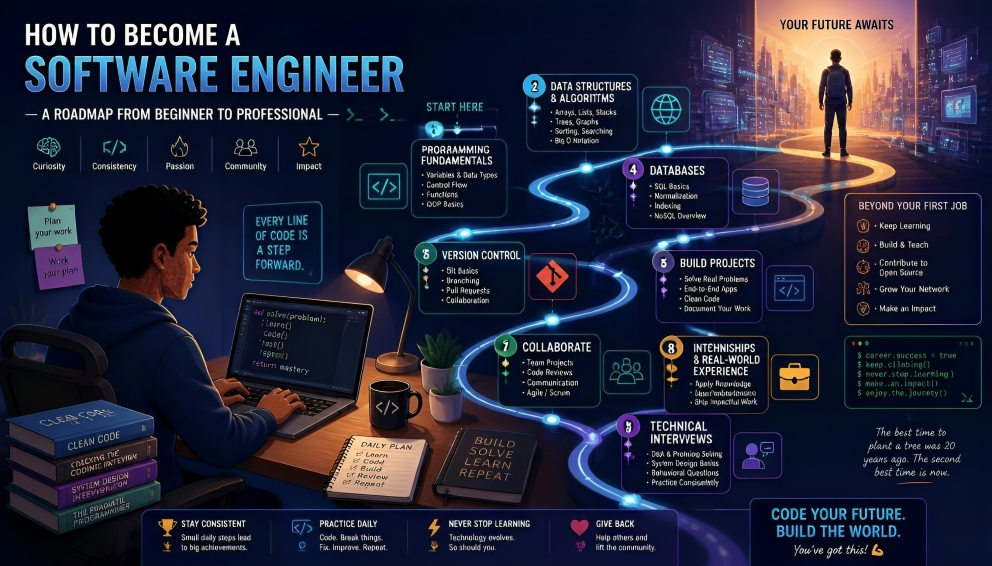

Choosing a career as a software engineer can be highly rewarding. The job combines creativity with good pay and remains sought after, even with evolving technology. This guide explains how to become a software engineer, whether you have a degree in computer science, are switching fields, or are just beginning. It discusses real paths, essential skills, the current job market, and the practical steps to help you land a job in 2026.
- What does a software engineer actually do?
- Why become a software engineer?
- Do you need a degree to become a software engineer?
- Three main paths to get started
- Step-by-step guide: How to become a software engineer
- Essential skills employers look for in 2026
- Latest trends shaping the field
- Practical tips for success
- Final summary and recommendation
What does a software engineer actually do?
Software engineers are the people who create, develop, check, and look after the software and systems we use daily. They work on things like web apps, mobile apps, company tools, cloud services, and more.
Everyday tasks often mean writing tidy code, teaming up with designers and product managers, checking others’ code, fixing issues, and making systems better. You find yourself solving problems and talking more than just coding. Nowadays, many jobs also work with AI tools to create or check code.
Why become a software engineer?
This job comes with good pay and plenty of opportunities to advance. Data from the U.S. Bureau of Labor Statistics shows that software developers earn a median yearly salary of about $138,000. More experienced engineers can make a lot more. Job prospects are expected to stay promising in the coming years.
Along with salary, this job offers flexibility with options to work remotely or in a hybrid setup. It’s mentally engaging and lets you switch between different fields like finance, healthcare, entertainment, and education. Plus, you can create practical products that help people.
Do you need a degree to become a software engineer?
Getting a bachelor’s degree in computer science or something similar is still the most typical way, especially for entry-level positions at big companies. But it’s not the only option anymore.
These days, lots of successful engineers got their start from coding bootcamps, learning on their own, or jobs like QA and IT support. Employers are paying more attention to what you can actually do rather than where you studied. Having solid projects, a tidy GitHub profile, and the skills to ace interviews are what count the most.
Three main paths to get started
1. Traditional Degree Path (4 years)
Getting a degree in computer science or software engineering gives you a solid base in things like algorithms, systems, and theory. Plus, it can lead to internships that might turn into job offers. This path is great if you can study full-time and want many long-term choices.
2. Coding Bootcamp (3–12 months)
Bootcamps quickly teach skills for the workforce. The best ones concentrate on a specific stack like JavaScript/React or Python, include hands-on projects, and offer career help. Prices are usually between 10,000 and 20,000. Since quality differs, check the results before choosing.
3. Self-Taught Path (6–18 months of consistent effort)
This option is both flexible and affordable. Use free or cheap resources that offer some structure, create projects, and show off your skills with a public portfolio. To succeed, focus on being disciplined and completing real projects instead of just doing tutorials endlessly.
Step-by-step guide: How to become a software engineer
Step 1: Choose and Master One Programming Language
Start with either Python or JavaScript.
- Python is beginner-friendly and widely used in backend, data, and AI work.
- JavaScript (plus TypeScript later) is essential for web development.
Start with the essentials: variables, loops, functions, data structures, and a bit of object-oriented ideas. Make sure to practise every day by creating small programmes on your own instead of just watching videos.
Step 2: Learn Core Computer Science Concepts
Learn about data structures like arrays, linked lists, trees, and hash maps, along with algorithms such as searching, sorting, and recursion. Practise using sites like LeetCode or ones like it. It’s also good to know Git for handling versions, basic SQL for working with databases, and how the web operates, including HTTP and APIs.
Step 3: Build Real Projects
Watching tutorials isn’t all you need. Try building 3 to 4 real projects that address real needs and make them available for others. You could create a full-stack task manager with login features, a basic online store, or a tool that uses AI. Share your work on GitHub. If you’re aiming for a full-stack position, make sure your projects highlight your skills in both frontend and backend work.
Step 4: Gain Practical Experience
Try finding internships, open-source projects, freelance work, or even tackling some in-house projects at your job. Working on open-source or helping local groups create tools can really grow your teamwork skills and give you some good references.
Step 5: Prepare for Interviews and Apply
Practice coding problems, learn the basics of system design, and prepare your personal stories. Refresh your résumé to feature your projects and results you can measure. Connect with others using LinkedIn, local meetups, or through referrals. Keep applying and see rejections as a chance to learn.
Essential skills employers look for in 2026
- Strong proficiency in at least one language and related tools
- Understanding of data structures, algorithms, and system design
- Git and collaborative workflows
- Ability to write clean, tested, maintainable code
- Familiarity with cloud basics (AWS, Azure, or similar) and databases
- Growing importance of AI fluency—knowing how to use tools like GitHub Copilot effectively and critically evaluate AI-generated code
Soft skills are important as well: being able to communicate clearly, solve problems under pressure, and pick up new tech fast.
Latest trends shaping the field
AI is shifting how software engineers work daily, rather than taking away their jobs. Many routine coding tasks are now done by tools, so employers look for people with good judgement, systems thinking, code review skills, and the knack for designing solid systems. It’s harder to get entry-level jobs nowadays, but there’s still a strong demand for senior positions and roles that mix software engineering with AI knowledge.
Specialities like backend systems, cloud infrastructure, security, and AI application development are still in strong demand. While remote work is still an option, it’s not as widespread as it used to be a few years back.
Practical tips for success
- Consistency beats intensity. Code a little every day rather than cramming.
- Focus on finishing and shipping projects instead of collecting certificates.
- Learn to read and debug other people’s code—this is a huge part of real jobs.
- Use AI tools as assistants, not crutches. Always understand and verify what they produce.
- Track your progress publicly (GitHub, blog, or LinkedIn) to stay accountable and visible.
- Join communities for feedback and support.
Final summary and recommendation
Learning how to become a software engineer is achievable for anyone willing to put in the effort, no matter their background. The best path involves concentrating on the basics, creating a few well-crafted projects, working with others to gain experience, and getting ready for interviews. Having a degree can be helpful, but what’s most important is showing you have real skills.
Today, begin by selecting a language and creating a simple program. Find an approach that suits you, stick with it for 6-18 months, and aim to deliver projects that show your abilities. If you develop practical skills and get used to tools like AI, there are still good chances in this field. By showing your abilities clearly and putting in the work, you can become a software engineer and have a steady career.