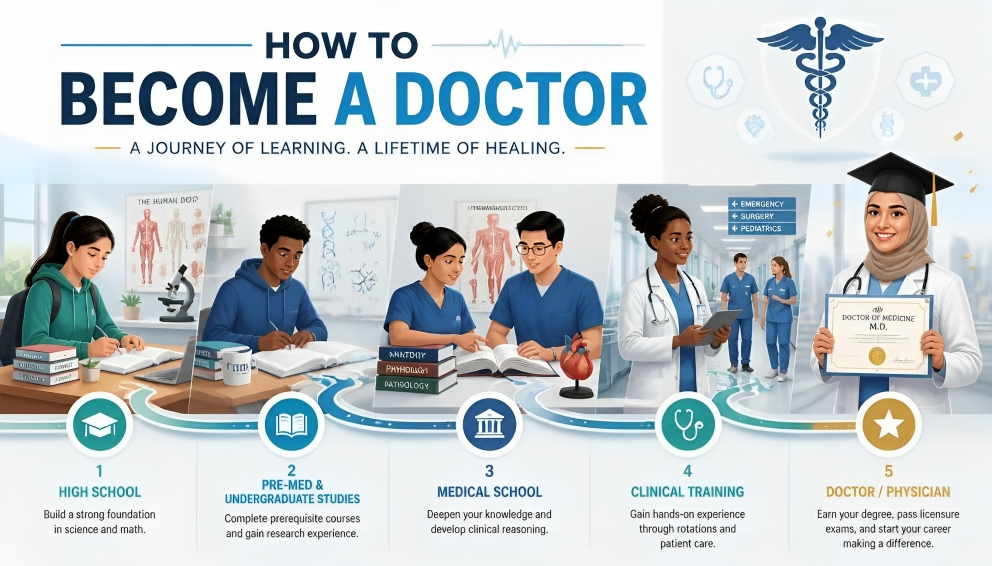

In India, being a doctor is a highly respected and fulfilling career choice. It requires commitment, good grades, and thorough training over several years. The process is straightforward and overseen by the National Medical Commission (NMC). If you’re passionate about helping people and want to join the medical field, this guide explains exactly how to become a doctor in India – from completing Class 12 to obtaining full medical registration.
- Who can become a doctor in India?
- Step 1: Complete Classes 11 and 12 with the Right Subjects
- Step 2: Appear for and Qualify NEET-UG
- Step 3: Participate in Counselling and Secure an MBBS Seat
- Step 4: Complete the MBBS Course (5.5 Years)
- Step 5: Obtain Permanent Medical Registration
- Optional but common next step: postgraduate specialisation
- Practical tips for aspiring doctors
- Career opportunities after becoming a doctor
Who can become a doctor in India?
To start the process, you must meet these basic eligibility criteria set by the NMC and National Testing Agency (NTA):
- Pass Class 12 (or equivalent) with Physics, Chemistry, Biology/Biotechnology, and English as core subjects.
- Secure at least 50% aggregate marks in Physics, Chemistry, and Biology (PCB) for General/EWS categories. Reserved categories (SC/ST/OBC) need 40%, and certain PwD categories need 45%.
- Be at least 17 years old on or before 31 December of the year of admission. There is no upper age limit.
- Qualify the National Eligibility cum Entrance Test – Undergraduate (NEET-UG).
People from India, NRIs, OCIs, PIOs, and foreigners can take the NEET-UG exam, but seat assignments vary by quota.
Step 1: Complete Classes 11 and 12 with the Right Subjects
Focus on physics, chemistry, and biology. NCERT books are key for NEET prep. Try to grasp concepts well instead of just memorising. Lots of students start concentrated NEET coaching in Class 11 or 12.
Step 2: Appear for and Qualify NEET-UG
NEET-UG is the single national entrance exam for all MBBS, BDS, and AYUSH seats in India. The NTA conducts it, usually once a year.
Key details of the exam:
- Mode: Pen-and-paper (OMR-based)
- Duration: 3 hours
- Total questions: 180 (Physics 45, Chemistry 45, Biology 90)
- Marking: +4 for correct answers, –1 for incorrect answers
- Maximum marks: 720
The syllabus follows the Class 11 and 12 NCERT guidelines. Regular practice with past papers and mock tests is important. Usually, the qualifying percentiles are around the 50th for General/EWS and the 40th for reserved categories.
In recent cycles, more than 11 lakh candidates have made it to counselling for about 1.1-1.4 lakh MBBS seats across the country.
Step 3: Participate in Counselling and Secure an MBBS Seat
After NEET results, counselling takes place in two main streams:
- All India Quota (15%) and central institutions (AIIMS, JIPMER, deemed universities, etc.): Handled by the Medical Counselling Committee (MCC) at mcc.nic.in.
- State Quota (85%): Managed by respective state counselling authorities.
If you’re eligible, make sure to sign up on both platforms. Choose your college preferences wisely, considering your rank, category, and what you want. There are several rounds from July to October, including mop-up and stray vacancy rounds.
You can’t legally get an MBBS seat in India without a valid NEET-UG score.
Step 4: Complete the MBBS Course (5.5 Years)
After you get into a medical school approved by the NMC, you start the MBBS programme.
Structure of the course:
- 4.5 years of academic and clinical study following the Competency-Based Medical Education (CBME) curriculum.
- 1 year of compulsory rotating medical internship (CRMI) in departments such as Medicine, Surgery, Obstetrics & Gynaecology, Paediatrics, Community Medicine, and others.
When you’re doing your internship, you learn by working directly with patients while being supervised. Once you finish this successfully, you get a provisional registration certificate to practice under supervision.
Step 5: Obtain Permanent Medical Registration
When your internship ends, you should apply for permanent registration with the State Medical Council or use the NMC portal. Once you’re listed in the medical register, you can legally work as a doctor in India. Practising without this registration is against the law.
Optional but common next step: postgraduate specialisation
Most doctors continue studying to become specialists. After MBBS and internship, appear for NEET-PG (conducted by the National Board of Examinations in Medical Sciences). Successful candidates pursue:
- MD (Doctor of Medicine) or MS (Master of Surgery) – usually 3 years
- DNB (Diplomate of National Board) – equivalent pathway
- Later super-specialisation (DM/MCh) if desired
NEET-PG remains the primary gateway as of 2026 (the proposed National Exit Test, or NExT, has been deferred).
Practical tips for aspiring doctors
- Start NEET preparation early and treat NCERT as the primary resource.
- Maintain physical and mental health—medical training is demanding.
- Research college fees, bond requirements (common in many government seats), and infrastructure before locking choices.
- Stay updated only through official websites: nta.ac.in, nmc.org.in, and mcc.nic.in.
- Consider the long-term commitment: From Class 11 to independent practice typically takes 7.5 years or more if you specialise.
Career opportunities after becoming a doctor
Registered MBBS doctors have a variety of options. They can work in government or private hospitals, clinics, research, or public health. They may also start their own practice. Specialists usually make more money and have more specific career goals. Some doctors work in rural areas due to required service or join the medical services in the armed forces.
Summary
In India, become a doctor is a well-organised and competitive journey. It starts with good Class 12 scores in PCB, then passing NEET-UG, followed by 5.5 years of MBBS with an internship, and getting registered. Many choose to specialise further through NEET-PG to gain more knowledge.
Success comes from steady effort, careful planning, and bouncing back from setbacks. Each year, countless students reach this dream. If you’re eager to pursue medicine, begin soon, keep your eye on official advice, and move forward gradually. Earning that white coat and the chance to help others makes it all worthwhile.