
Helping people deal with mental health issues is a valuable goal. In India, become a therapist takes specific steps and planning due to its regulated process. The term “therapist” is commonly used, but it usually refers to clinical psychologists, counselling psychologists, or counsellors. The requirements vary depending on which path you take.
This guide lays out the different ways to learn today, what you need to register, practical steps to take, and what you can realistically expect, helping you make smart choices.
Understanding the different roles
Before starting, clarify the title you want to hold.
- Clinical Psychologist: Assesses, diagnoses, and treats mental health conditions using psychological methods. This title is regulated. You need an RCI-recognised professional qualification and registration on the Central Rehabilitation Register (CRR).
- Counsellor / Counselling Psychologist: Focuses on guidance, emotional support, life transitions, relationships, and milder distress. These roles fall under the National Commission for Allied and Healthcare Professions (NCAHP) Act, 2021. Registration requirements are being implemented through state or central registers (rules notified in 2026; full systems were still rolling out in late 2026).
- Psychiatrist: A medical doctor (MBBS + MD/DNB Psychiatry) who can prescribe medication. This is a different medical pathway and is not covered here.
To use the title of a clinical psychologist and legally offer diagnosis and treatment, you need to be registered with RCI. Just having a master’s in psychology isn’t enough for clinical practice rights.
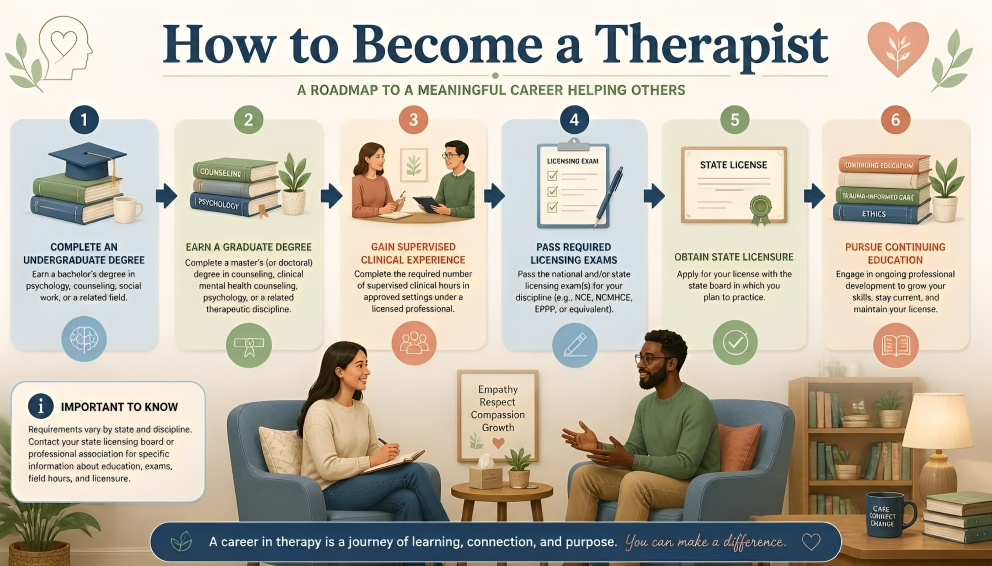
Step-by-step path to become a therapist (clinical psychology focus)
A clear and well-known way to do independent clinical work is to follow the clinical psychology path. Here is the typical sequence in 2026:
1. Complete Class 12 (any stream)
Psychology is helpful but not mandatory at this stage. Instead, aim for good grades overall and work on your English skills.
2. Bachelor’s Degree in Psychology (3 or 4 years)
Consider getting a BA or BSc in psychology from a university approved by the UGC. With the National Education Policy, many universities now offer four-year honours courses that can give you a strong base. Try to maintain at least a 55% overall score, though higher is better for future opportunities. Get involved by volunteering, attending workshops, or doing internships in mental health settings.
3. Master’s Degree in Psychology (2 years)
Get an MA or MSc in Psychology, Clinical Psychology, Applied Psychology, or Counselling Psychology from a recognised university. It’s better to choose full-time courses since part-time or distance learning options might not be accepted for future clinical training. Aim for a score of 55% or more.
4. RCIR Recognised Professional Clinical Training (usually 2 years)
This is the critical licensing stage. Options recognised by the Rehabilitation Council of India include:
- M.Phil in Clinical Psychology (still offered at many centres)
- Master in Clinical Psychology (M.Clin.Psy. or equivalent RCI-approved master’s)
- Professional Diploma in Clinical Psychology
- Psy.D in Clinical Psychology (at select institutions)
These programmes are full-time, intensive, and include extensive supervised clinical work (often 1,000+ hours). Seats are limited (a few hundred nationally each year). Admission usually requires an entrance exam and interview. Leading institutions include NIMHANS (Bengaluru), IHBAS (Delhi), CIP and RINPAS (Ranchi), and a growing list of RCI-approved centres across states.
Always verify the specific programme and institution appear on the current RCI-recognised list before applying, as approvals are time-bound.
5. Register with the Rehabilitation Council of India.
Once you finish an RCI-approved programme, you can sign up on the Central Rehabilitation Register. You need to register to work as a clinical psychologist. This registration usually lasts for a while, and you’ll need to renew it with more education points.
6. Gain Supervised Experience and Build Practice
Most people begin working in hospitals, clinics, NGOs, or under the guidance of experienced professionals. Over time, they explore other paths like private practice, teaching, research, corporate wellness, or special fields such as child psychology, trauma, neuropsychology, and forensic psychology. Extra certifications in therapies like CBT, DBT, or EMDR can boost skills and job prospects.
If you’re focusing on counselling instead of clinical diagnosis, start with a good master’s degree, get supervised practice, follow ethical rules, and register with NCAHP if you can. It’s important to keep learning throughout your career.
Key skills and qualities needed
Education is necessary but not sufficient. Effective therapists develop:
- Strong listening and empathy
- Emotional resilience and self-awareness
- Ethical judgement and confidentiality
- Cultural sensitivity (especially important in India’s diverse contexts)
- Clear communication and boundary setting
- Commitment to lifelong learning
Gaining hands-on experience through things like internships, case discussions, and personal therapy really helps develop these skills.
Time, Cost, and Realistic Expectations
After finishing Class 12, it usually takes about 7 to 9 years to complete the entire clinical path. RCI seats are in high demand. Costs can differ a lot depending on where you study. Government institutes are cheaper, while private ones cost more. Some training centres offer stipends.
Entry-level or hospital jobs offer modest starting salaries, which increase with experience, location, special skills, and working privately. The need for mental health experts is growing because of more awareness and support from policies like the Mental Healthcare Act 2017 and the effects of the pandemic. However, there aren’t many fully trained clinical psychologists available.
Practical tips for success
- Verify every programme’s current RCI status on the official Rehabilitation Council of India website.
- Track NCAHP developments if your goal is counselling rather than clinical practice.
- Build a strong academic record early; marks matter for competitive entrances.
- Seek supervised clinical exposure at every stage.
- Network with practising professionals and join relevant associations.
- Consider personal therapy—it supports both personal growth and professional insight.
- Stay updated on regulatory changes, as frameworks (especially NCAHP) continue to evolve.
Challenges to Anticipate
There aren’t many spots available, the training takes a long time, and the job can be emotionally tough. Plus, dealing with RCI and the new NCAHP rules is challenging. Setting clear goals and making realistic plans can help handle all this.
Summary and Final Recommendation
To become a therapist in India with the strongest legal and professional backing, start by earning a bachelor’s and master’s degree in psychology. After that, enrol in a clinical training programme recognised by the RCI, and make sure to get your CRR registration. To practice counseling, getting a solid master’s degree along with some supervised work is the way to go. It’s also good to stay updated with the newest NCAHP rules.
First, decide if your goal is to diagnose and treat health issues or to focus mainly on providing counselling and support. Look into RCI-approved programmes carefully, give importance to hands-on practice, and keep learning all the time. India has a big need for mental health care, and skilled, ethical professionals can really help. Make plans thoughtfully, check reliable sources often, and move forward with solid facts instead of guesses.