
Want a job where you can see the world and help travellers stay safe and comfy? Become a flight attendant could be your path to an exciting career all about people in the airline industry. Flight attendants, or cabin crew, represent the airline up in the air. They keep passengers safe, provide great service, and manage tasks ranging from medical emergencies to everyday cabin chores.
Every year, many people apply for this job. It lets you travel, the schedule gets more flexible as you gain experience, and you get to collaborate with different teams. Getting there is tough, but with the right prep, it’s definitely doable. Here’s a handy guide that’s based on airline standards and data from the U.S. Bureau of Labor Statistics.
What does a flight attendant do?
Flight attendants are first and foremost safety professionals. Their core responsibilities include:
- Conducting preflight safety checks and briefings
- Demonstrating emergency equipment and procedures
- Assisting passengers during boarding, turbulence, and medical situations
- Serving food and beverages
- Managing cabin order and handling customer concerns
- Coordinating with pilots and ground staff
They fly on routes across the country or abroad, often at unusual times like nights, weekends, and holidays. This job needs good communication, staying calm in stressful moments, and truly caring about customers.
Basic Requirements to Become a Flight Attendant
Airlines set their own standards, but most share common minimums (especially major U.S. carriers as of late 2026):
Education
To work as a flight attendant, you typically need a high school diploma or GED. Some airlines might like it if you’ve taken college classes in hospitality, communications, tourism, or learned a new language. Having a degree isn’t usually needed, but it might give you an edge.
Age
Major airlines usually need you to be at least 21 years old to start training. But some regional airlines are okay with applicants who are 18 or 20.
Work Authorisation and Passport
To work for the airline, you need to have the legal right to work in that country. Usually, you’ll also need a passport that’s valid for at least 12-18 months and has blank pages, especially if you’re flying internationally.
Physical and Medical Standards
- Vision correctable to at least 20/40
- Ability to pass a medical evaluation
- Reach or height standards that allow safe access to overhead bins and emergency equipment (examples include a combined vertical and horizontal reach test or arm reach measurements around 80–82 inches / 203–212 cm, depending on the airline)
- Ability to lift luggage, push heavy beverage carts, and fit securely in a jump seat
Background and Screening
Every candidate goes through a detailed background check, along with fingerprinting and drug testing. Having a clean record is important.
Customer Service Experience
Airlines usually prefer candidates with 1-2 years of experience in jobs where you interact with people, like in hospitality, retail, restaurants, call centres, teaching, or healthcare. This kind of experience shows you have the people skills needed for the job.
Grooming rules are pretty strict. Tattoos on the face, neck, hands, or anywhere the uniform doesn’t cover are usually not allowed. It’s important to look professional and stick to the uniform rules.
Step-by-Step Guide: How to Become a Flight Attendant
Here is the practical path most successful candidates follow:
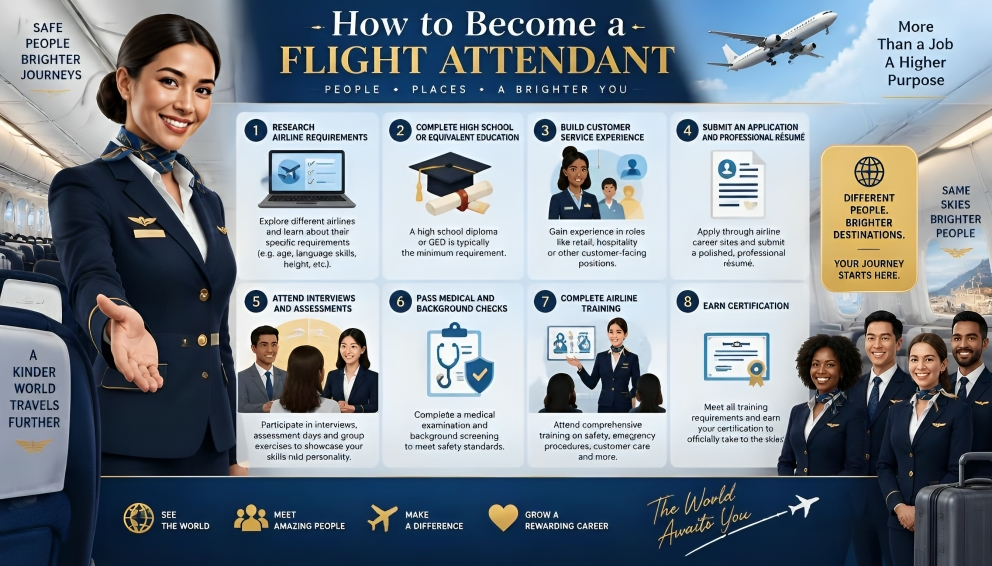
1. Meet the minimum requirements.
Make sure you meet the age, education, passport, and fitness requirements of the airlines you want to apply to. It’s a good idea to sort out your passport early since processing can often take longer than expected.
2. Build relevant experience
Get a job where you help people. Look for tasks where you need to solve problems, calm things down, or work with others. Write down stories from these experiences to share during interviews.
3. Monitor airline hiring windows.
Big airlines don’t hire all the time; they open up job applications just a few times a year. Check the career pages for Indigo, Air India, SpiceJet, Southwest, Alaska, Frontier, and smaller regional airlines. Set up alerts and get your paperwork ready ahead of time.
4. Submit a strong application.
Make sure your résumé shines by focusing on customer service accomplishments, language abilities, and any safety or first aid certifications like CPR or BLS. Take your time with online assessments to do them well.
5. Prepare for the multistage interview process.
Get ready for online tests, video interviews, and group events that could be in person or virtual. Airlines like to ask about your behaviour. Use the STAR method (Situation, Task, Action, Result) to talk about dealing with tough customers, handling stress, or being a team player.
6. Complete airline training and earn certification.
If chosen, you’ll go to the airline’s first training course, which usually lasts from 3.5 to 7 weeks, based on the airline. You’ll learn about emergency steps, how planes work, first aid, service rules, and company guidelines. First, you need to pass both written tests and practical exercises, including practice flights. Once you finish these, the airline tells the FAA about your training, and you get a Certificate of Demonstrated Proficiency. You must have this certificate to work as a flight attendant on planes with at least 20 seats.
7. Begin flying and build seniority.
When new employees join, they typically begin on an on-call basis at a designated base. As they gain seniority, they get better control over their schedules, enjoy higher pay, and have more choices in routes.
Training Details and What to Expect
Airline training is all about safety and is very thorough. You learn about getting out of planes quickly, putting out fires, surviving in water, handling medical issues, keeping things secure, and managing passengers. Some training programmes offer places to stay and meals and maybe a small allowance, though the pay can differ depending on the airline. Once you finish training, you gain initial flight experience under supervision before flying solo.
Every year, you need to refresh your training to keep your certification and stay up-to-date with procedures.
Salary, Benefits, and Career Outlook
The U.S. Bureau of Labor Statistics says that as of May 2025, flight attendants made about $63,580 a year on average. Beginners usually earn less, often in the low-to-mid $30,000s before adding in overtime, boarding pay, and per diem. On the other hand, experienced attendants at big airlines can make more, sometimes over 80,000-100,000 with seniority, international trips, and extra pay.
Typical benefits are health insurance, retirement plans, travel perks for the employee and their family, and paid time off that increases the longer you stay. Job growth is expected to be around 9% up to 2035, which is quicker than usual, thanks to travel demand and retirements.
Practical Tips for Standing Out
- Gain multilingual skills if possible—languages such as Spanish, Mandarin, French, or Arabic are valuable on international routes.
- Practise reach and physical fitness in advance.
- Research each airline’s culture, routes, and bases so your answers feel specific.
- Maintain a professional online presence.
- Be ready to relocate to a crew base.
- Stay flexible with scheduling and travel during the early years.
Challenges to Consider
The job requires working odd hours, being away from home, dealing with physical stress, jet lag, and challenging passengers. During the first years, having a reserve status can lead to unpredictable shifts. The competition is intense, with only a small fraction of applicants getting in. Training is tough, and not everyone finishes it.
Even with the challenges, lots of flight attendants find joy in their work because of the folks they meet, the destinations they visit, and the important role they play in making sure passengers stay safe.
Final Takeaway
Become a flight attendant is a clear process, but it takes serious preparation, determination, and a focus on passengers. Start by meeting the basic criteria, gaining hands-on experience in customer service, and applying smartly when airlines are hiring. Finish the airline’s training course successfully, and you’ll get the certification to kick off your career above the clouds.
If you’re driven by helping others, love staying safe, and enjoy a bit of adventure, starting with reserve flying might be a special and rewarding career for you. Look into the airlines that fit your goals, get well-prepared, and start by visiting their job pages. If you’re ready, the chance is there for you.