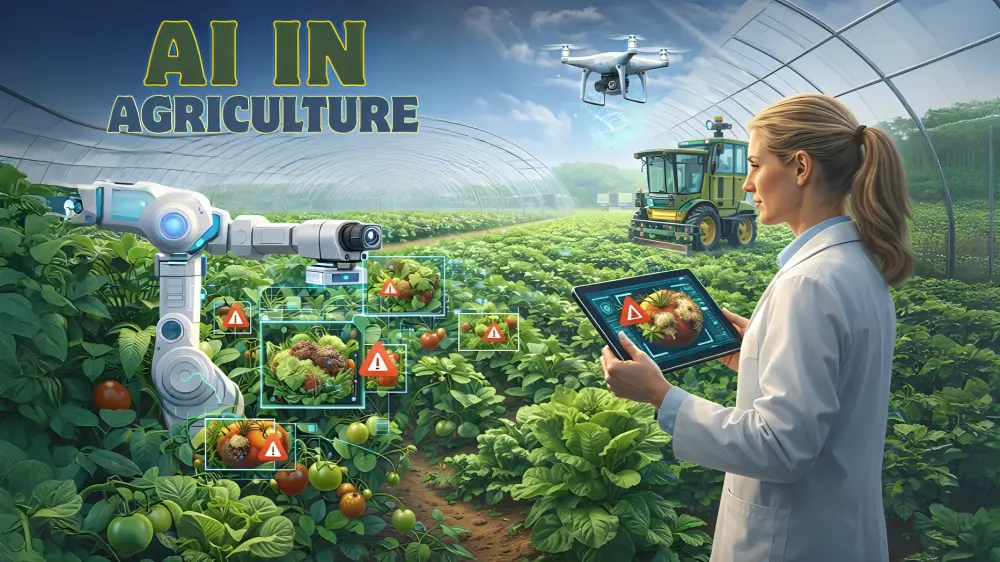

Pretend that a farmer can check the smartphone and see exactly which patches of their field are dry; they notice an outbreak that reaches their neighbours or even send out a robot to harvest with inch accuracy. This isn’t science fiction—it’s the reality of AI in agriculture today. With a growing global population and the climate challenges we face, artificial intelligence is changing traditional agriculture into a smart, efficient, and sustainable industry.
The Rise of Precision Farming
At the heart of this transformation is precision agriculture, where artificial intelligence (AI) analyses huge amounts of data from sensors, drones, satellites and Internet of Things (IoT) devices for real-time decision-making. Farmers are no longer treating entire swaths of their fields the same but managing crops like bluefin tuna at the plant or square-metre level.
Machine learning algorithms recognising unique patterns from satellite imagery and drone footage detect small variations in the health of growing plants through vegetation indices (for instance, NDVI) powered by AI. This allows you to detect nutrient deficiencies, water stress, pests, or diseases often before they are seen with the naked eye.
Key Applications Transforming Farms
Crop Monitoring and Disease Detection
Multispectral cameras and AI vision systems mounted on drones zoom across fields, snapping high-resolution images that algorithms immediately interpret. They detect weeds, pests or infections and suggest specific solutions by preventing extensive use of pesticides. It is now being harnessed in areas such as the National Pest Surveillance System (NPSS) in India for real-time advisories that would help prevent crop losses.
Yield Prediction and Resource Optimization
The yield forecasting is done by AI models that are trained on the historical data, weather conditions, soil conditions, and the current state of the crops. This enables farmers to schedule harvests, storage management, and marketing decisions. AI-driven irrigation technologies adapt water consumption to soil moisture and weather predictions in real-time, using less water in areas short on the precious resource.
Autonomous Machinery and Robotics
You name it, self-driving tractors, AI-guided sprayers, and robot harvesters are moving from hype to the field. To fill the labour gap, firms are implementing systems that plant, weed and harvest with little human intervention. In 2026, more than 60% of large farms are anticipated to adopt AI-based predictive platforms.
Soil and Climate-Smart Insights
With the ability to aggregate information from ground sensors and weather stations, AI allows for hyper-local recommendations on fertilisation, planting times and crop types. Among advanced solutions, some offer carbon capture and climate resiliency tracking.
Benefits: Efficiency, Sustainability, and Profitability
The advantages are compelling. AI improves agricultural production while reducing input costs so farmers can achieve more with less fertiliser, water, fuel and pesticides. Benefits for the environment include a reduction in chemical runoff, decreased greenhouse gas emissions, and improvement of soil health. Economically, it helps increase profitability and builds resilience against climate variability.
AI tools like mobile advisory apps and satellite-based insights that are accessible to smallholder farmers, in turn, democratise high-tech farming and possibly address food security on a global scale.
Challenges and Considerations
However, adoption can prove difficult, even in the wake of such tremendous promise. The high initial investment of technology services, data privacy risks, and reliance on stable internet and digital knowledge could prevent even some larger farms from taking part. Right frequent consideration needs to be paid towards integration with existing equipment and adaptability of AI models across a wide range of climates and crops. Achieving these benefits for all will require responsible development, transparent data governance, and enabling policies (such as the recently published USDA AI Strategy).
Looking Ahead: The Future of Farming
The world market for AI in agriculture research shows strong growth through to 2030, underpinned by the combination of developments in generative AI for advisory, agentic AI for autonomous farm operation, and integration with robotics and biotechnology. More innovations coming around the corner, such as farm digital twins and edge AI with real-time processing in remote areas, should drive even greater efficiencies.
Summary
AI in agriculture is a big change towards mastering food manufacturing in a sustainable mode. This necessary goal will be reached by way of embracing data-driven insights, automation, and precision techniques, giving farmers the ability to create productivity goals for a growing world while making our planet start speaking more breath. The secret is that the future of farming is not harder work—it is savvier work. With the evolving climate, rapid technological advancements, and machine learning tools to augment human expertise, the combination of best practices with an artificial intelligence-driven role will be necessary for a sustainable and resilient food supply system capable of meeting world needs.
FAQ’s
Q1. How is AI important in agriculture?
Ans. AI is revolutionising agricultural practices as it endorses techniques of precision farming practised through smart sensors monitoring crops and detecting diseases, drones being used for site-scanning, mapping and data collection, optimising irrigation and fertiliser usage whilst predicting yield accurately. It automates the harvesting process and minimises wastage by bridging this gap, thus increasing productivity while supporting sustainable practices for a more efficient, greener future of food.
Q2. Which AI is best for agriculture?
Ans. Grok, by xAI, and Gemini, by Google, use real-time insights and provide straightforward, actionable insights covering crop planning, pest management, soil health and sustainable farming. Bias-free, orientated towards outcome goals, simple-to-use—just what the farmer would ask for, like smart and straightforward assistance.
Q3. Can AI replace farmers?
Ans. No, AI will never completely replace farmers. Farmers provide the essential human judgement, local knowledge, and ability to adapt to nature’s uncertainty, while it powers smarter tools such as crop monitoring, weather predictions, and automated harvesting. The farm of the future is a collaborative one: AI supercharges productivity, but the farmer is still at the centre of agriculture.