
Generating more natural speech from text never used to be as simple a process. It took a professional studio, a voice actor recording, and a healthy budget. An AI voice generator can create human-sounding narration, character voices, or transactional audio in just a few minutes. These tools have emerged as an integral part of a content creator, marketer, educator, and developer retrieving quality voice scripting – all without the usual costs or wasteful delays.
This guide briefly describes what AI voice generators are, lessons on how they work and their main benefits, current winners in the industry, common use cases, future trends, and direct steps to take while selecting and using them.
- What is an AI Voice Generator?
- How Does an AI Voice Generator Work?
- Key Benefits of Using an AI Voice Generator
- Main Features and Types
- Leading AI Voice Generators in 2026
- Real-World Applications
- Latest Trends in 2026
- How to Choose and Use an AI Voice Generator Effectively
- Ethical and Practical Considerations
What is an AI Voice Generator?
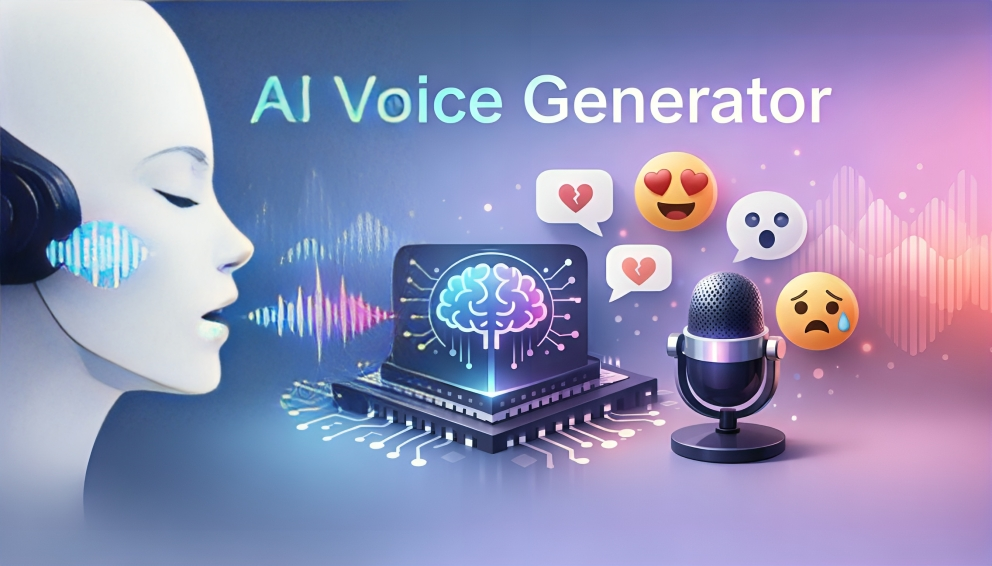
It is software that converts written text into spoken audio using AI to generate voice. Modern systems do much more than robot-texting the speech. They study language, context, emotion, and also timing so speech sounds natural, expressive, and human.
Most of the tools can be used in various languages and accents. Most also include voice cloning, which reconstructs a digital copy of an actual person based on a short audio sample (with their consent). Sophisticated models can imbue nuance with emotion, adjust speed or pitch, and may even support multi-speaker conversations.
How Does an AI Voice Generator Work?
These systems rely on deep learning models trained on vast amounts of speech data. The process typically works like this:
- You input text (or upload a script).
- The model analyses the words, sentence structure, and any style instructions you provide.
- It generates audio by predicting natural speech patterns, including pauses, emphasis, and intonation.
- You can refine the output with controls for emotion, speed, or pronunciation before installing the file.
More recent 2026 models, such as ElevenLabs’ Eleven v3, can also accept audio tags that allow you to specify additional instructions for the performance (such as marking a line as whispered or excited). Real-time, where speech is processed at very low latency as required by live agents/interactive applications.
Key Benefits of Using an AI Voice Generator
- Speed and cost savings — Generate professional narration in minutes instead of waiting for recordings or studio sessions.
- Consistency — Maintain the same voice across long projects such as courses, series, or product lines.
- Scalability — Create content in multiple languages or update scripts quickly without re-recording.
- Accessibility — Turn written material into audio for people who prefer listening or have reading difficulties.
- Creative flexibility — Experiment with different voices, tones, and styles without hiring multiple talents.
- Integration — Many tools connect with video editors, learning platforms, chatbots, and APIs for automated workflows.
Main Features and Types
Modern tools usually combine several capabilities:
- Text-to-speech (TTS) — Core function of turning scripts into audio.
- Voice cloning — Instant clones from short samples or higher-fidelity professional clones from longer recordings.
- Emotion and style control — Adjust tone, energy, or performance notes.
- Multilingual support — Generate speech in dozens of languages while preserving accent or speaker identity in some systems.
- Real-time generation — Low-latency models for conversational agents and live applications.
- Studio and editing tools — Built-in timelines, multi-track support, and collaboration features in platforms aimed at teams.
Leading AI Voice Generators in 2026
Quality has improved dramatically, and the “best” choice depends on your needs rather than a single ranking. Based on current independent testing and practical use:
- ElevenLabs stands out for overall naturalness, expressive control, and voice cloning quality. Its Eleven v3 model ranks near the top of major benchmarks for realism and supports 70+ languages.
- Cartesia leads in ultra-low latency, making it strong for real-time voice agents.
- Murf AI offers a polished studio interface well suited to marketing videos, e-learning, and team collaboration.
- Google Gemini TTS provides high quality at competitive cost and integrates well with Google tools.
- OpenAI models excel in reasoning-aware conversational voice and agent applications.
- Hume Octave focuses on emotional expressiveness.
- Other solid options include Speechify for accessibility and reading, plus various open-source or self-hosted models for developers who need full control.
Most platforms have free tiers, but these are limited in terms of volume and often prohibit commercial use. Make sure to verify the pricing (at time of writing) and also the commercial rights and credits needed.
Real-World Applications
Creators and businesses use these tools in many practical ways:
- Content and media — podcasts, YouTube narration, audiobooks, and video voiceovers.
- Education and training — Online courses, corporate learning modules, and accessible audio.
- Marketing and sales — Product demos, ads, explainer videos, and personalized messages.
- Customer experience — Interactive voice agents for support, booking, or information.
- Localisation — Dubbing or translating content while keeping a consistent brand voice.
- Entertainment and games — Character dialogue and interactive storytelling.
Latest Trends in 2026
Several developments are shaping the field:
- Agentic voice systems that can handle full conversations and take actions rather than simply reading scripts.
- Lower latency for real-time applications, with some models under 100 milliseconds.
- Better emotion and prosody so speech feels performed rather than synthesised.
- Cross-lingual cloning that preserves a speaker’s identity across languages.
- Stronger focus on ethics and compliance, including consent requirements for cloning and labelling rules under regulations such as the EU AI Act.
- Integration with broader AI workflows, including video generation and conversational agents.
How to Choose and Use an AI Voice Generator Effectively
Follow these practical steps:
- Define your main use case (narration, cloning, real-time agents, multilingual content, etc.).
- Test free tiers with a sample of your actual script to compare naturalness and control.
- Check commercial licensing, language support, and any required attribution.
- Look for API access or integrations if you need automation.
- Start with clear, well-punctuated scripts. Add performance notes where the tool supports them.
- Review and edit the output—small adjustments to pacing or emphasis often improve results.
- Keep original recordings of any cloned voice and document consent.
Best practice for this kind of work would be using the same scripts, varying the voices, and a mixture of AI audio combined with light human editing. If the plan is to have some kind of branding or a long-term project, always do proper cloning with straightforward usage rights.
Ethical and Practical Considerations
Voice cloning also brings some serious questions to mind about consent, deepfakes, and abuse. They only allow you to clone if they are granted permission and then offer the option of detection or watermarking. Explicitly request permission before cloning a voice, mark synthetic audio where appropriate, and do not use it deceptively. Advancing regulation means that staying up to date on the latest legal developments protects both creators and audiences.
Summary
An AI voice generator has whittled its way out of creative experiment and into the realm of a useful everyday tool. By 2026, top-of-the-range systems provide voice that is frequently indistinguishable from human recordings in short- and medium-form compositions, while those production speeds, consistency on every read, and multi-language coverage do not begin to compare with traditional methods.
For most creators who are looking for the best option and flexible cloning, ElevenLabs still makes a great first stop. The Murf Studio workflow is preferred by teams focused on marketing or e-learning. If you are building agents to interact with real-time systems, consider low-latency alternatives like Cartesia or OpenAI’s dialogue models. Play around with some tools, use your own material, check those licenses, and keep your scripts simple.
The technology has rapidly advanced further. When used mindfully, it liberates creators/brands to create more audio content at scale and allows humans to focus on the ideas and stories that matter most.