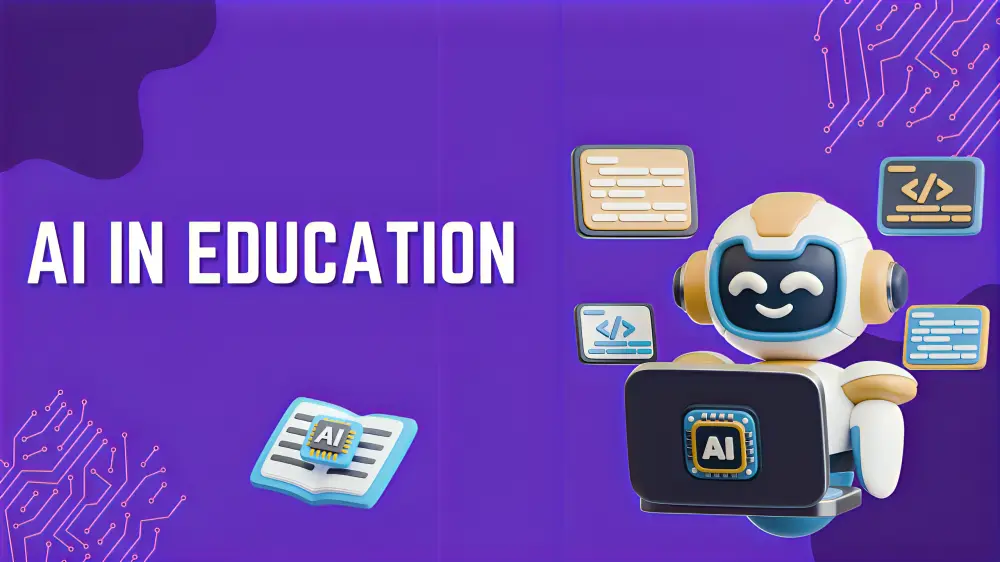

Think about a classroom in which each student has lessons that are right on the mark for their interests, strengths, and pace. Where teachers have virtual assistants that can take care of all the mundane tasks, allowing them to focus on mentoring and inspiring. Now this is not science fiction—it is the quickly changing state of AI in education today.
By 2026, will AI still be a distant-looking add-on emerging on the edges of learning and education? AI is changing what we teach, how we learn and prepare for the future — from personalized tutoring to automated administrative assistants. Main applications, benefits, challenges, and future of this are covered in this article.
The Rise of Personalized Learning
The delivery of hyper-personalised experiences is one of the most exciting features of AI in education. Conventional, one-size-fits-all education tends to lose some students along the way while boring others. AI changes that by analysing individual learning behaviours in real time.
Adaptive platforms – say, Khanmigo (from the creators of Khan Academy) as well as models supported by Google Gemini – consistently serve you as an always-on tutor. They adapt difficulty, deliver immediate feedback and explanations, and target practice. The results are exciting: students in certain programmes scored approximately 10% better when using AI chatbots, while others finished their tasks up to 40% faster.
In 2026, there is an emergence of “specialised educational intelligence” that moves learning from passive consumption (reading or watching) to active, interactive engagement. AI has the potential to write personalized lesson plans, test students with quizzes based on their knowledge level, or even simulate an environment and respond to its input, broadening access in fields like STEM.
Empowering Educators and Streamlining Operations
Instead of taking away teachers, what AI is actually doing is enhancing them. A common use case related to lesson planning, generating classroom materials, creating assessments, and giving feedback. MagicSchool AI, Brisk Teaching and NotebookLM are tools that help teachers save hours on repetitive tasks.
This efficiency enables greater focus on the most important components: building relationships, promoting creativity, and responding to individual student needs. AI can help administrative teams with scheduling, data analysis to identify at-risk students, and even drafting communications as well. Reports indicate that adoption rates are high—86% of education organizations use generative AI, for example—which may foreshadow greater institutionalisation.
Enhancing Accessibility and Inclusivity
AI, which is borderless, supports a diverse learner. Real-time translation, text-to-speech, captioning, and adaptable interfaces for students with disabilities or learning in non-native languages are some of the features that support them. Interactive tools, as the gamified platforms are referred to, offer high engagement across age levels and abilities.
Challenges and Ethical Considerations
There are some important caveats, but nevertheless, the promise of AI in education is there. Privacy of data and security are primary, as systems handle sensitive student information. Without careful management, algorithms can perpetuate and amplify inequalities. Heavy dependence on AI can lead to a decline in critical thinking skills, loss of human interaction and creativity, which are still very much needed.
The other issues are the digital divide (making sure everyone has equal access), teacher training, and academic integrity. In response, policymakers and institutions are reacting with fresh AI guidelines, professional development programmes, and even university-wide AI literacy initiatives.
Looking Ahead: Trends for 2026 and Beyond
In 2026, reductions in organisational noise, net zero choices about LLM-agnostic tools (working across multiple models), and AI as co-designers: everything from learning pathways right into career/college selection. Global commitment is also evidenced by initiatives like the OECD’s focus on generative AI as well as government programmes promoting education in AI.
The AI in education market is expected to see explosive growth as optimism reigns responsibly.
A Balanced Future Powered by AI
AI in education is a unique opportunity to improve learning more effectively, equally and creatively than ever before. When we acknowledge its strengths alongside tackling its shortcomings, educators, students and policymakers can build systems that truly prepare young people for an AI-enabled world.
The key is balance: using technology to enhance the connection between people and helping creativity, but not to replace it. As we innovate further, what remains in our goal is to ensure every learner achieves their full potential. Education of the future não é só uma ferramenta mais inteligente, é um humano mais sábio e inspirado dele usando.
FAQ’s
Q1. What are the 5 pillars of NEP?
Ans. The 5 pillars of NEP 2020 are access (education for all), equity (inclusive support), quality (excellent learning), affordability (no financial barriers), and accountability (responsible systems). Together, they form the integrated Indian education system of this brand and plan for the future.
Q2. What are 5 advantages of AI in education?
Ans. AI Impact on Education: AI personalises learning for every student. Instant feedback with smart tutors. Wider accessibility for special needs. Auto-grading & assessment support teachers. Engaging interactive tools to gain curiosity and retention among students.
Q3. What is the 5-3-3-4 system in NEP?
Ans. The 5-3-3-4 system in NEP 2020 is India’s new school structure replacing the old 10+2 model. It covers ages 3-18 in four playful, age-appropriate stages: Foundational (5 years) for basics & play; preparatory (3 years); Middle (3 years) for exploration; and Secondary (4 years) for greater skills & choices. Flexible, holistic, and fun!