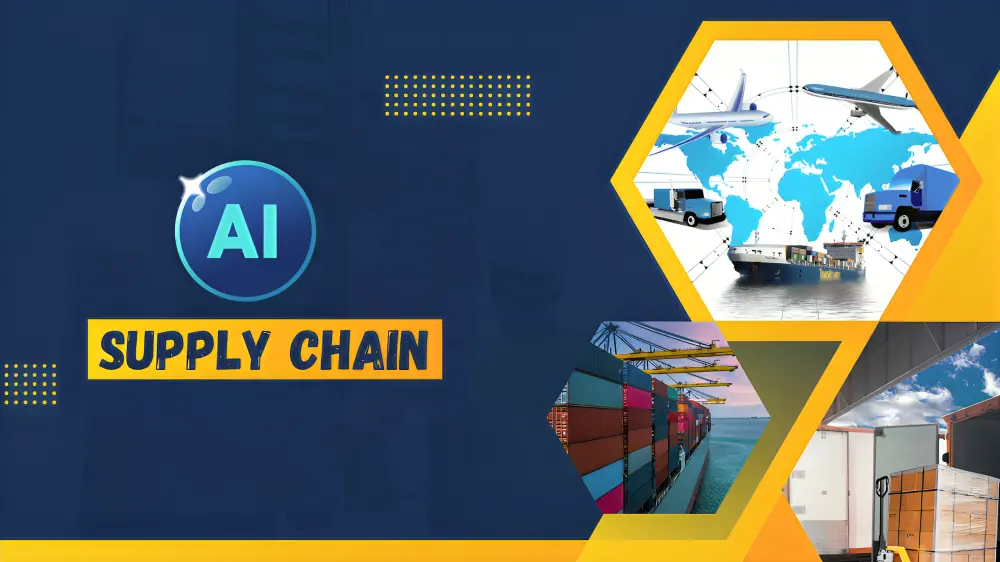

Supply chains are the backbone of global commerce, expertly moving goods from raw materials all the way to finished products. However, with increasing interruptions such as geopolitical challenges, climate impacts, and variable demand, they become increasingly complex. Enter AI, which is disrupting the way organizations plan, source, manufacture, and deliver. In this article, we will shed light on AI in supply chain operations: its working, productivity enhancement, real-life use cases, and the future of artificial intelligence.
Understanding AI in Supply Chain Management
‘AI in supply chain’ means using technologies such as machine learning, predictive analytics, and generative AI alongside systems that exhibit agentic behaviour to optimise processes across the end-to-end value chain. Contrary to off-the-shelf software solutions, where the outcomes follow binary logic, AI relies upon trained datasets of historical records, real-time information from sensors, market data, and other external variables to provide intelligent recommendations or even act autonomously.
This transition allows businesses to evolve from reactive firefighting to intelligent operations. AI, with its multitude of use cases for applications from demand forecasting to route optimisation, delivers visibility whilst minimising waste and building resilience.
Key Applications and Benefits
AI delivers tangible value across the supply chain:
- Demand Forecasting and Inventory Management: AI analyses historical sales, seasonal patterns, weather, and economic signals for highly accurate predictions. This minimises stockouts and overstock, optimising inventory levels. Early adopters have seen inventory improvements of up to 35%.
- Logistics and Route Optimisation: Tools like UPS’s ORION system use AI to determine efficient delivery paths, saving millions of miles and reducing fuel consumption annually.
- Predictive Maintenance: Sensors and AI monitor equipment health in warehouses and factories, predicting failures before they occur. This boosts uptime and cuts maintenance costs.
- Risk Management and Resilience: AI-powered control towers provide real-time visibility, detecting disruptions like port congestion or supplier issues early. They enable rapid rerouting and sourcing adjustments.
- Procurement and Supplier Management: Agentic AI assists in sourcing, evaluating suppliers, and negotiating while improving collaboration.
These rewards comprise reduced operational costs, faster decision-making, fewer mistakes and less waste, increased revenue growth (up to 61% for top AI adopters), and improved sustainability with optimised routes and resource usage.
Latest Trends in 2026
As of 2026, AI in supply chains is moving beyond pilots to embedded, scalable solutions. Key developments include the following:
- Connected Intelligence and Agentic AI: Mature organizations are linking AI across procurement, planning, finance, and other systems for autonomous ecosystems. Agentic AI handles complex tasks with increasing autonomy.
- Generative AI Adoption: By 2028, generative AI is expected to manage about 25% of KPI reporting, streamlining insights and responses.
- Digital Skills Evolution: Roles are shifting toward tech-literate professionals who combine human judgement with AI insights.
The AI supply chain market is expected to witness an impressive growth rate of about 40.4% CAGR between 2022 and 2031, rising in value by approximately $58.55 billion within the next decade, a clear indicator of sweeping transformation.
Real-World Examples
- UPS: Its AI routing system has dramatically cut mileage and emissions while improving delivery times.
- IBM: Implemented a cognitive supply chain that saved $160 million in costs and maintained 100% order fulfilment during the COVID-19 pandemic through rapid adjustments.
- Unilever: Used AI control towers for better demand responsiveness and reduced stockouts across global operations.
These examples demonstrate the measurable return on investment in efficiency, cost savings, and resilience that AI can deliver to supply chain use cases.
Challenges to Consider
While promising, adoption comes with hurdles:
- High initial costs for technology, integration, and training.
- Data quality and unification issues across fragmented systems.
- Change management and workforce upskilling needs.
- Concerns around bias, governance, security, and building trust in AI recommendations.
Successful organizations start with well-defined pilots, build data foundations optimally, and retain the human in the loop for scenarios where ethical or contextual impact is required.
The Road Ahead
Supply chains are going to be smarter, more autonomous, and more resilient in the future. Automation of operational activities profoundly impacts how organisations—supported by AI, IoT, and digital twins—will run operations faster, more sustainably, and with a customer focus (sooner, not later). Human-AI collaboration will continue to be paramount, harnessing the best of what technology can deliver in accuracy with human creativity and ethics.
Summary
AI in supply chain is no longer a tool of the future; it has turned into an inevitable existence that focuses on enhancing efficiency, innovation, and strength during uncertainty. Use of predictive insights, automation, and real-time intelligence to shape resilient business capability that navigates disruptions, enables cost reduction & provides sustainable value. The companies willing to build smart supply chains around real AI today are those that will dominate the supply chains of tomorrow—smarter, stronger, and more resilient than ever.
FAQ’s
Q1. How can AI be used in supply chains?
Ans. AI Makes Supply Chains Smarter And Smoother! It accurately predicts demand, optimises delivery routes, manages inventory in real-time, and detects risks proactively. This lowers costs, curtails waste, accelerates shipments, and creates resilient operations—allowing businesses to achieve efficiency dynamically.
Q2. Which AI tool is best for supply chain management?
Ans. There is no perfect one-size-fits-all AI tool; it depends on what you are looking for. Blue Yonder is recognised for strong machine learning (ML)-based supply chain planning, forecasting, and execution capabilities powered by AI optimisation algorithms. Lots of companies also love Kinaxis, or o9 Solutions, for real-time visibility and scenario planning. Try demos! Start with your priorities (inventory/risk…).