
Today, if you have an online business, you’ll be competing on speed, customisation, and how efficiently you run your business. Your customers will want immediate answers, personalized recommendations based on what they are looking for, and a seamless shopping experience. You cannot compete with manual processes. This is where AI tools for ecommerce come in. AI tools can help you automate many repetitive tasks that would normally take hours to complete; understand your customers’ buying behaviours; produce higher-quality content; and convert more of the people who visit your site into paying customers.
In 2026, AI has transitioned from an experimental technology for the majority of retail businesses into a functioning element of everyday business processes. This guide will help explain what types of AI exist, why those AI types are important, what kinds of AI are currently being used, trends in AI use within the industry, and ultimately how to begin utilising AI to enhance business processes.
What are AI tools for Ecommerce?
AI tools for ecommerce are computer programs that apply AI, machine learning, and/or generative models to support online retailers. AI tools can analyse data; create content; forecast consumer demand; customise user experiences; and manage customers’ requests with little human involvement.
Modern AI tools learn from store data, customer actions, and market signals. They change over time. For example, chatbots answer order questions. Other tools suggest products. Some write product descriptions. Others predict what inventory you need.
You can use these tools with platforms like Shopify, WooCommerce, BigCommerce, and Amazon seller tools. Many have free or cheap plans. This makes them good for small, medium, and large stores.
Key Benefits of Using AI Tools for Ecommerce
Retailers that adopt AI report clear improvements across the business:
- Higher conversion rates through personalized recommendations and smarter search.
- Lower support costs as chatbots and agents handle routine tickets automatically.
- Faster content creation for product pages, ads, and emails.
- Better inventory decisions that reduce stockouts and overstock.
- Improved customer experience with 24/7 responses and relevant offers.
- Stronger marketing results via predictive segmentation and optimised send times.
Real-world results often include double-digit lifts in average order value or revenue per visitor when personalisation and support tools are used well. AI-referred traffic from platforms like ChatGPT and Google AI tools has also grown rapidly and frequently converts at higher rates than traditional search traffic.
Main Types of AI Tools for Ecommerce
AI tools are practical and come in various categories. Most stores focus on a couple of key areas rather than tackling everything at once.
Customer Support and Chatbots
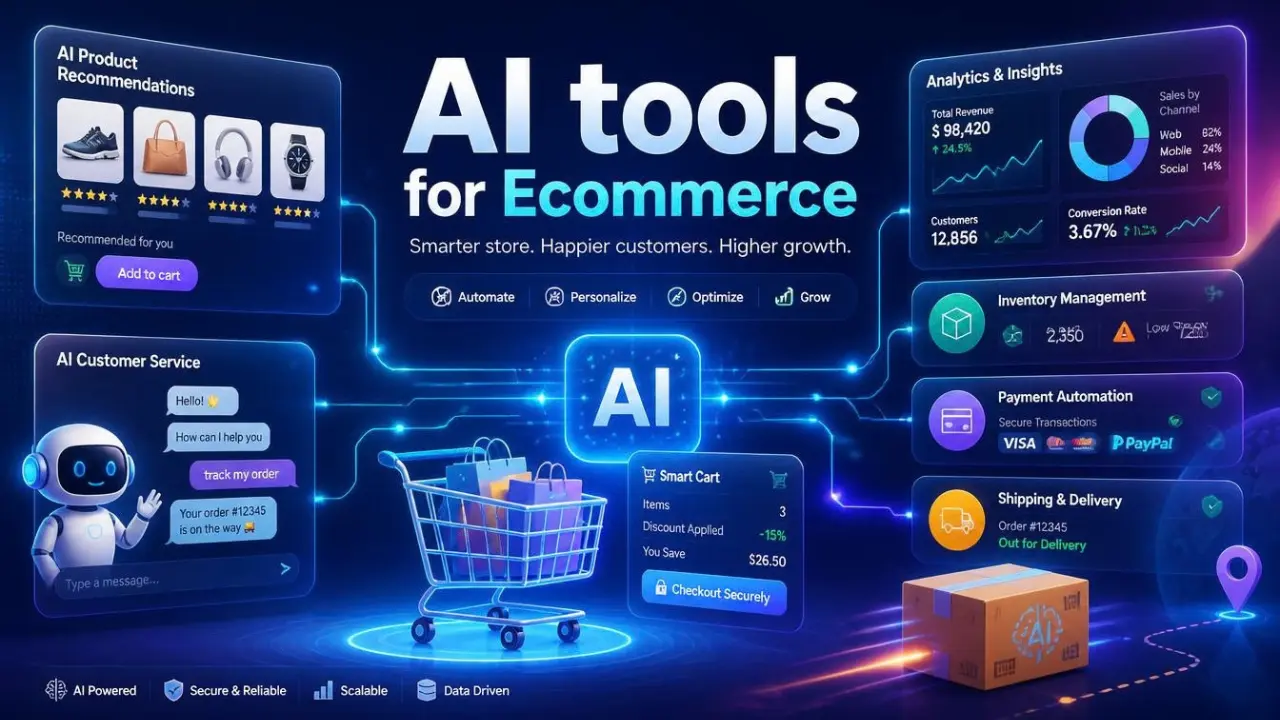
AI agents help with questions about orders, shipping, returns, and products. When things get tricky, they refer issues to humans. Popular choices include Gorgias, Tidio (Lyro), Intercom Fin, and tools built into platforms. The best ones handle a lot of queries without needing help from staff and connect well with order details.
Personalisation and Product Recommendations
These tools match the right products to the right shopper using browsing history, past buys, and live behaviour. Solutions like Rebuy, Nosto, and Dynamic Yield manage recommendations, cart suggestions, and ideas after a purchase. Personalisation is a major factor in boosting revenue.
Content Creation and Merchandising
Generative AI creates product descriptions, meta titles, ad copy, and email subject lines. Shopify Magic and Sidekick naturally take care of many tasks for Shopify stores. Jasper supports high-volume or specific brand writing. AI tools for product photography, like Photoroom, make clean lifestyle images without the need for studio setups.
Search and Discovery
AI site search understands simple language. It works better than keyword matching. We use tools like Algolia and special ecommerce search to get better results. These tools lower the chance of no results showing
Marketing Automation
Email and SMS tools with AI, like Klaviyo, help us. They find the best time to send messages. They make subject lines. They group people by behaviour. They start message flows based on what people do. This brings more clicks and sales.
Analytics, Attribution, and Forecasting
Tools like Triple Whale tell us which ads make sales. Inventory tools like Prediko guess how much stock we need. They tell us what to order. This helps us spend money and manage stock better.
Amazon and Marketplace-Specific Tools
Amazon sellers use tools like Helium 10. These tools help with keyword research, listing improvements, and ad automation.
Latest Trends Shaping AI Tools for Ecommerce in 2026
The contemporary commercial landscape is characterised by several transformative developments. A notable trend is the emergence of agentic commerce, wherein artificial intelligence agents undertake the tasks of researching, comparing, and completing purchases autonomously on behalf of consumers. This shift has led to a significant increase in traffic from generative AI sources to retail websites, with such visitors demonstrating enhanced conversion rates.
Hyperpersonalisation techniques have evolved beyond mere basic recommendations, advancing towards customised offers and content tailored to individuals. In conjunction with this, there is an expansion in voice and omnichannel support, integrating both chat and phone communication. Notably, advancements in native platform AI, particularly within Shopify, have minimised the reliance on multiple third-party applications. Furthermore, predictive inventory management and fraud detection systems have witnessed improvements in accuracy and accessibility.
Stores leveraging structured, machine-readable data exhibit superior performance in both traditional search methodologies and innovative AI-driven discovery processes.
How to Choose and Implement AI Tools for Ecommerce
Follow a practical sequence rather than buying tools first.
- Identify the biggest bottleneck—support volume, low conversion, slow content production, or inventory issues.
- Check platform compatibility (Shopify, Amazon, etc.) and existing data integrations.
- Start with free or trial tiers of one or two tools. Measure results against clear metrics such as ticket deflection rate, average order value, or conversion rate.
- Train the tools with accurate product data, policies, and brand voice. Review outputs regularly, especially in the early stages.
- Expand only after proving value. Keep the stack lean to avoid overlapping costs and complexity.
- Maintain human oversight for brand voice, complex decisions, and customer relationships.
Successful enterprises often initiate their strategies with native platform AI integration, bolstered by robust marketing tools and effective support chatbots.
Best Practices for Getting Results
- Keep product data accurate and complete. AI performs only as well as the information it receives.
- Set clear escalation rules so customers can always reach a person when needed.
- Test and measure continuously. Track specific KPIs before and after implementation.
- Respect privacy and compliance rules when using customer data.
- Combine tools thoughtfully—AI support plus personalisation often compounds results.
- Update prompts, knowledge bases, and models as your catalogue and policies change.
Real-World Applications
A mid-sized fashion store utilising the Shopify platform may integrate several technologies to optimise operations. Shopify Magic is employed for crafting product descriptions, Klaviyo is utilised to create personalized email flows, Rebuy is implemented for cart recommendations, and Gorgias is used for customer support. These applications collectively have the potential to enhance conversion rates, increase order values, and reduce the time required for staff intervention.
An Amazon seller specialising in private-label products typically combines Helium 10 for research and listing optimisation with AI-driven creative tools for advertising purposes. Meanwhile, a multichannel brand often augments support and marketing tools with analytics and forecasting, thereby enhancing overall efficiency.
Final Summary and Recommendation
AI tools for ecommerce have evolved from peripheral experiments to indispensable systems for competitive online retail environments. When carefully selected and executed with accurate data and clear objectives, these tools facilitate improvements in sales, operational efficiency, and customer satisfaction.
To prioritise implementation, one should first address areas that experience significant friction or revenue loss. Initial efforts should focus on well-integrated, established tools that align with the current platform. It is essential to evaluate the outcomes, make necessary adjustments, and gradually broaden the scope of AI application. By 2026, businesses that regard AI as a practical ally rather than a fleeting trend are likely to lead the industry.
To initiate this transformation, it is recommended to audit a single, impactful process during the current week – such as support ticket management, product page performance, or email flow optimisation – and experiment with a pertinent AI solution. A harmonious combination of enhanced customer experiences and streamlined operations can be realised by any ecommerce enterprise willing to take this proactive and concentrated approach.