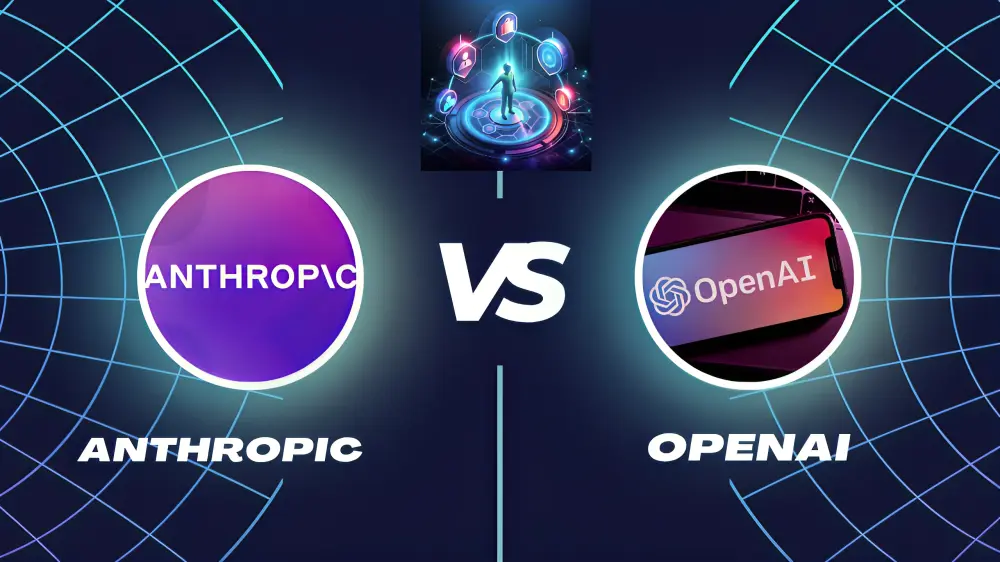

Amid a high-stakes dash to develop the safest, most powerful, and most transformative AI there is, the contest between Anthropic vs OpenAI emerges as one of tech’s more riveting rivalries. These two San Francisco labs have deep ties to OpenAI’s founding and are now among the cutting edges of frontier AI models, enterprise adoption, and responsible development. With massive valuations, rocket ship revenue growth, and non-stop upgrades to the models behind the software, this competition is driving breakthroughs with implications for businesses, developers, and consumers alike.
Origins and Core Philosophies
Anthropic was established in 2021 by former OpenAI executives, like Dario and Daniela Amodei, who departed because of worries over the speed of development and safety priorities. The company is all in on constitutional AI — a framework that integrates robust ethical guidelines directly into the models to make them helpful, honest, and harmless. Funded by Amazon (which is a significant investor) and Google, Anthropic’s mantra emphasises thoughtful, safety-conscious scaling to strong but controllable systems.
OpenAI, which was founded in 2015 as a nonprofit and later evolved into a capped-profit model, is headed by Sam Altman and closely partnered with Microsoft. It prioritises speedy iteration, wide accessibility, and monetisation — transforming state-of-the-art AI into products that millions use every day. The philosophy aims for fast deployment to capture value and drive progress, tempered by continuing alignment and safety research.
This shared history fuels a deeply personal Anthropic vs OpenAI dynamic, where divergent perspectives on speed versus caution are shaping their respective paths.
Leadership, Scale, and Business Momentum
Anthropic has a laser focus on the Claude family and is cultivating an enterprise identity. By early 2026, it had explosive growth: annualised revenue apparently reached $14 billion in February (an annual increase of up to about 400%), and projections suggest revenues for the year of between $26 and $40 billion. Valued at nearly $380 billion following recent rounds of funding, Anthropic has won major integrations with cloud partners and is securing a remarkable proportion of new enterprise business.
OpenAI continues to be the leader on the broad platform level, since ChatGPT is its flagship consumer product that is now branching out into APIs, business tools, and agentic workflows. It has raised significant funding (rumoured $110 billion rounds driving valuation closer to $730–850 billion), and its overall revenue estimates are much higher (~$20–30 billion annualised by early 2026). The Microsoft integration gives it unparalleled distribution in productivity suites.
Both face intense competition, but Anthropic’s momentum in corporate adoption—winning ~70% of head-to-head new business matchups per recent indices like Ramp’s March 2026 AI report—highlights a shifting landscape.
Flagship Models and 2026 Breakthroughs
The competition runs hot in their new Frontier releases.
The Claude family from Anthropic is out front with safety-oriented, long-horizon performance:
- Longest task-completion horizons per METR estimates (up to 14+ hours at 50% reliability per METR estimates), making Claude Opus 4.6 (February 2026) the best for sustained agentic tasks. It rules in coding (top on Terminal-Bench), financial reasoning, cybersecurity investigations, and high-order knowledge work.
- Claude Sonnet 4.6 (Feb-26) has near Opus quality at superior efficiency, 1M token context, and robust computer-use features.
- Pros consist of dependable first-pass results, diminished hallucinations, and capabilities such as agent teams and even PowerPoint integration.
OpenAI’s GPT series emphasises versatility and agentic autonomy:
- GPT-5 (August 2025), followed by almost monthly releases. 4 (March 2026)—that is claimed to be the most powerful frontier model for commercial use. It will pull in powerful reasoning, coding (through GPT-5.3-Codex lineage), and tools for spreadsheets, documents, and software environments.
- Variants like GPT-5.4 Reasoning (for deep reasoning) and GPT-5. 4 Pro (extreme performance) do best where there are lengthy sequences of actions with built-in “thinking” modes.
- It enables desktop agents capable of broad multimodal tasks such as generating functions that summarise any input in seven different languages.
Head-to-Head: Key Differences in 2026
Anthropic vs OpenAI boils down to complementary strengths:
- Safety & Reliability vs. Speed & Breadth: This approach allows Anthropic to prioritise not just constitutional safeguards but production-ready outputs that require less iteration. OpenAI is great at consumer-scale rapid feature rollouts and ecosystem breadth (millions of ChatGPT users).
- Enterprise Momentum: In 2026, Claude wins most new business deals due to its low-risk appeal to conservative organisations. OpenAI leads in consumer-to-enterprise transition and vertical specialists tools (e.g. coding agents, etc.)
- Performance Nuances: Benchmarks show tight races—Claude Opus 4.6 often tops long-horizon and finance tasks; GPT-5.4 shines in integrated agentic workflows and broad reasoning. Markets and prediction platforms give Anthropic an edge in general rankings and OpenAI in coding/math specialisation.
- Commercial Approach: We’ll see how OpenAI pushes aggressive monetisation (ads, broad access), while Anthropic focuses on premium productised, controlled enterprise partnerships.
Neither rule all users; they benefit from pressing harder.
Challenges and the Path Forward
The rivalry includes public friction (like disputes over Pentagon contracts and different military AI approaches) as well as massive infrastructure investments. Both struggle with talent competition, compute and alignment problems as they push models towards more agentic capabilities. But the competition is speeding up safety research, lowering costs, and driving new use cases across sectors.
Summary
Anthropic vs OpenAI is more than a rivalry—it’s a dynamic force driving AI into the future—in 2026 and beyond. Anthropic trains safety-first, enterprise-trusted intelligences that are masters of performance on complex, long-running tasks with few errors, while OpenAI supplies Swiss army knives of fast-evolving tools that drive everyone from everyday productivity to wild Vetr agentic systems. Collectively, they’re not just competing; they’re lifting the whole field—creating AI that’s been more capable, accessible, and responsibly used.
For businesses, developers, and the just plain curious, this showdown means one unequivocal payoff: Accelerated progress toward technology that will be smarter and safer for us all. The next breakthrough could come tomorrow — stay awake, because the future is being written right now.
FAQ’s
Q1. Is Anthropic AI better than OpenAI?
Ans. As of March 2026, neither Anthropic’s Claude nor OpenAI’s ChatGPT is clearly better overall — it depends on what you want. Claude excels in cognitive reasoning, writing complex code, working with extremely long documents, and crafting nuanced answers that prioritise safety, frequently winning head-to-head benchmarks on technical and enterprise tasks. ChatGPT, on the other hand, excels in terms of speed (since it has powered most programs that play around with natural language processing), multimodal capabilities (generating images and video-based understanding/generation), seamless integrations, and everyday versatile use. The best thing to do is still to try both free versions yourself and see which one works better for you.
Q2. Will Anthropic overtake OpenAI?
Ans. Not for another 2–3 years. OpenAI is an order of magnitude ahead in user base, revenue, brand, and ecosystem momentum. Anthropic has built great, safer models and is growing rapidly — but catching up to OpenAI’s scale would take almost perfect execution on Anthropic’s part and several major miscalculations from OpenAI.
Q3. Who is OpenAI’s biggest competitor?
Ans. OpenAI’s lead competitor is Google (through its Gemini models and the work of subsidiary DeepMind), because of huge resources, integration with search, and top-tier AI. Also, strong close contenders are Anthropic (Claude) for reasoning and safe focus, and xAI (Grok) for cutting-edge. ChatGPT remains the market leader.