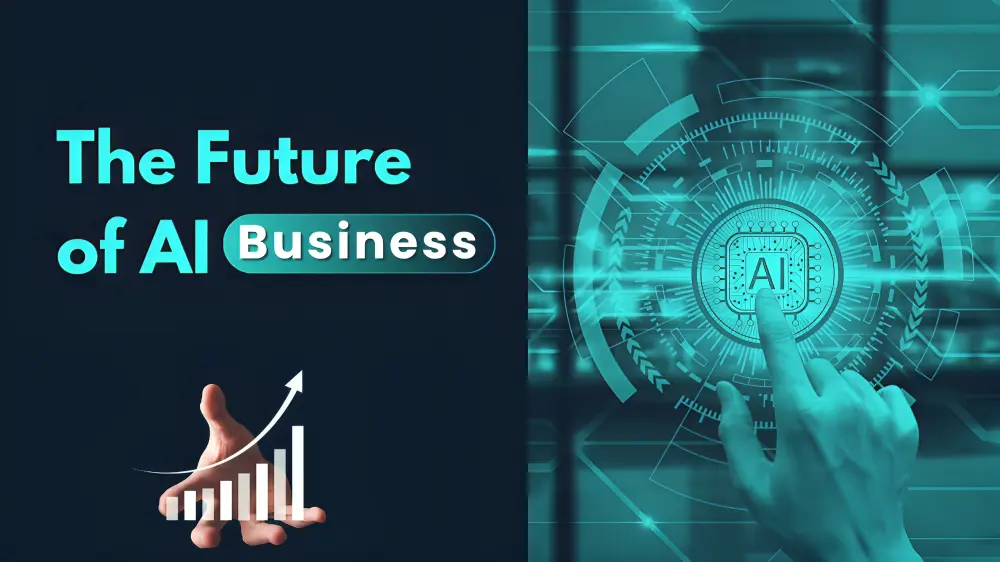

The Future of AI in Business is unfolding right now, transforming how companies operate, innovate, and compete in an increasingly intelligent world. As we pass through 2026, AI has transitioned from the experimental pilot space to a primary driver of enterprise value, and organisations’ attention is turning towards measurable ROI, agentic systems, and responsible scaling. Companies that embrace this shift are reaping productivity gains, improved customer experience, and faster decision-making—while those who hesitate risk falling behind.
The current state of AI adoption in business
AI adoption is at a turning point. Recent surveys reveal that over 88 percent of organisations currently employ the use of AI across at least one business function, a huge increase compared with previous years. Generative AI usage hovers at around 65.79% across functions, and the number of workers with access to sanctioned AI tools is spiking, by often 50% or more in a single year.
Many businesses are still moving past chatbots and simple automation. In 2026, the focus is on deployment at production scale — the number of organisations with 40%+ AI projects in production is predicted to double within months. Enterprise spending on AI infrastructure and tools continues to grow, with global AI market estimates in the hundreds of billions. This momentum reflects a growing confidence—more than 90% of businesses say they’re seeing measurable results from AI initiatives.
Key Trends Shaping the Future of AI in Business
Several exciting developments are defining how AI integrates into operations this year and beyond.
Agentic AI and Autonomous Workflows
Agentic AI models—systems that reason, plan, and act independently across complex tasks—are being rapidly realised. By 2026, companies will be using AI agents for everything from customer support and sales pipeline management to supply chain optimisation and IT troubleshooting. These agents act as digital teammates, managing multistep processes with little human intervention. Gartner estimates that 40% of enterprise apps will have task-specific AI agents by the end of 2026, a jump from less than 5% the previous year. Early adopters have achieved reductions of 60–80% in routine task times, enabling their employees to dedicate more time to higher-value work.
Multimodal and Integrated AI Systems
Modern AI now seamlessly computes over text, images, video, audio, and even physical data. This multimodal capability drives richer applications, like AI that evaluates customer videos for sentiment, produces tailored marketing copy, or mimics potential supply chain pathways in vivid detail. The most advanced tools from top labs are embedding these capacities inside everyday business platforms, making AI more intuitive and powerful.
Vertical and Industry-Specific AI
Generic models are being replaced by specialised “vertical AI” that is tailored to sectors such as healthcare, finance, manufacturing, and retail. Meanwhile, AI speeds up drug discovery and helps develop personalised treatment plans in healthcare. In finance, it improves fraud detection and assesses risk better. These targeted solutions bring speedier ROI by addressing specific pains that some industries share.
Physical AI and Robotics Integration
Adoption of physical AI (embodied systems combined with robotics) is high and climbing — estimates show usage approaching 80% of companies over the next two years. Such a trend drives smarter warehouses, improved autonomous quality control for manufacturing, and even assisted field operations with AI.
Efficiency and ROI Focus
Following years of experimentation, 2026 signals a “disciplined march to value”. Leaders are developing enterprise-wide AI strategies with specific benchmarks linked to financial impact, operational improvements, and workforce productivity. AI isn’t just about innovation anymore — it’s about measurable business outcomes.
Transformative use cases across Industries
The future of AI in business shines brightest in practical applications:
- Customer experience: Autonomous agents handle enquiries 24/7, personalise interactions, and even manage complex resolutions, boosting satisfaction while cutting costs.
- Operations and Supply Chain: AI predicts disruptions, optimises inventory in real time, and automates logistics planning.
- Marketing and Sales: Generative tools create targeted campaigns, while agents qualify leads and nurture relationships at scale.
- Human Resources and Workforce: AI streamlines recruiting, provides personalised employee training, and offers insights into productivity and well-being.
- Finance and Compliance: Realtime anomaly detection, automated reporting, and risk forecasting reduce errors and regulatory burdens.
The companies embedding AI into core workflows are seeing transformational impacts, and a significant share of them report revenues tied directly to such technologies.
Challenges and Considerations for Responsible Adoption
While opportunities abound, thoughtful implementation is essential. Key hurdles include:
- Talent and skill gaps: Organisations need strategies to upskill employees and attract AI-savvy talent.
- Data Quality and Integration: Success depends on clean, accessible data and seamless system connectivity.
- Ethics, Governance, and Regulation: Bias mitigation, transparency, and accountability are nonnegotiable. The EU AI Act and similar frameworks coming into full force in 2026 will emphasise risk-based oversight, especially for high-stakes uses. Businesses are prioritising ethical AI practices to build trust and avoid pitfalls.
- Security and Cost Management: As AI scales, so do concerns around data privacy, cybersecurity, and infrastructure expenses. Hybrid and efficient models help balance performance with sustainability.
Leaders who see governance as a driver of strategy—not a box to tick—place their organisations in the best position for long-term success.
Preparing for the Road Ahead
To thrive in the future of AI in business, companies should:
- Develop a top-down AI strategy with clear ROI metrics.
- Invest in agentic and multimodal capabilities while starting with high-impact use cases.
- Foster a culture of continuous learning and ethical innovation.
- Partner with reliable platforms and monitor evolving regulations closely.
The move to “AI factories” and agentic enterprises suggests that AI is now foundational infrastructure, the way cloud computing or the internet was before it.
Summary
The future of AI in business is bright, practical, and profoundly transformative. In 2026, AI wouldn’t just be a useful tool; it would become the step-partner that enhances efficiency, fuels imagination, and yields actual dollar savings across enterprises. The ethical, skills, and regulatory challenges are real, but organisations that embrace this adoption in a considered and responsible way will have one of the most powerful competitive advantages. The businesses that win will regard AI not as a fad, but as an integral DNA strand for innovation, growth, and resilience in an intelligent future. It’s time to act—and your next breakthrough may require you to do so.
FAQ’s
Q1. Which 3 jobs will survive AI?
Ans. The three jobs most likely to outlast A.I. are caregivers, skilled tradespeople (plumbers and electricians), and creative strategists. Human empathy, hands-on physical labour, and original soulful ideas are still hard for A.I. to fully supplant. Sure, AI can help; it cannot really touch your heart, solve a physical-world problem with tools, or read souls and frame an idealistic thesis.
Q2. Which jobs will be gone by 2030?
Ans. By 2030, many day-to-day jobs will disappear because of AI and automation: data entry, basic customer support, telemarketing, factory assembly, truck driving, and simple accounting. But new jobs will also be created in areas like AI management, creative tech, caregiving, and sustainability. Expand and build on your human skills to succeed.