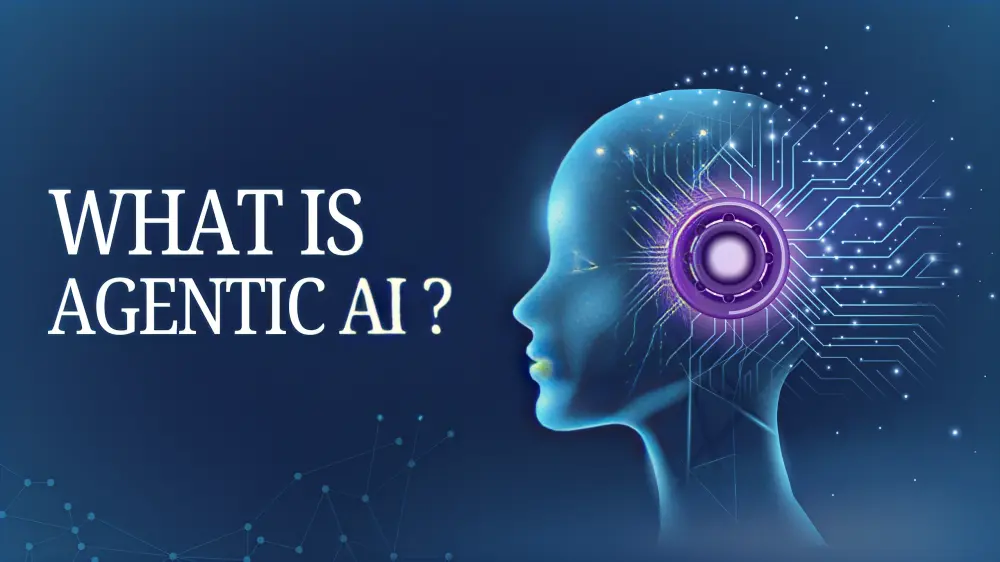

In this AI fest of the world, one frequently asked question is, “What is agentic AI, and why is everyone so excited about it in 2026?” Unlike traditional chatbots that respond passively to prompts, agentic AI marks a powerful step toward autonomous systems that understand goals, make choices, plan steps, and take actions (with minimal human oversight)—using genuine digital teamwork.
Understanding the Basics: What is Agentic AI?
So, what is agentic AI in the most general terms? It refers to AI systems that exhibit actual “agency”—the ability to sense their environment, reason about hard-to-pin-down goals, carry out multistep tasks, adjust based on what results, and learn from them.
These systems work via iterative perception-reasoning-action (PRA) loops. Rather than waiting for someone to give detailed instructions each time, an agentic AI would know how to take a high-level task (such as “plan my business trip for under $2,000”) and break it down into subtasks: researching flights, consulting calendars with another person if needed (“I see that your wife is busy on the 12th; would you like me to look for bookings around this date instead?”), and booking hotels and making adjustments based on price spikes—all the while utilising tools such as APIs, browsers, or software interfaces.
This is a distinctly different approach from prior AI generations. Generative AI (such as vanilla ChatGPT) is great at generating stuff on demand, but this is where its capabilities end. Agentic AI takes it a step further by actively doing the work.
How Agentic AI Differs from Traditional AI
Traditional AI and generative tools are typically reactive:
- They respond to specific prompts.
- They handle one-off tasks, like summarising texts or creating images.
- Human intervention is required at every step or for every correction.
In contrast, agentic AI is proactive and autonomous:
- It maintains persistent context across long workflows.
- It uses tools (such as web browsers, code editors, databases, or even computer interfaces) to act in the real world.
- It reasons, plans, executes, evaluates results, and iterates if needed.
- It can collaborate on multi-agent systems, where specialised agents work together like a digital team.
For example, while a traditional AI might draft an email, the agent’s system could research who you’re sending it to, tailor content based on recent meetings with them, send it off, log responses, and follow up autonomously.
Key Capabilities That Make Agentic AI Powerful
Modern agentic systems in 2026 demonstrate impressive features:
- Autonomous Reasoning and Planning: Breaking complex goals into manageable steps and adapting when obstacles arise.
- Tool Use and Orchestration: Seamlessly connecting to external services, APIs, or even controlling desktop applications (as seen in systems like Anthropic’s Computer Use or similar capabilities in OpenAI and Google models).
- Learning and Adaptation: Improving from feedback and maintaining memory of ongoing projects.
- Multi-Agent Collaboration: Frameworks now support teams of agents—one for research, another for analysis, and a third for execution—handling everything from supply chain optimisation to software development.
The latest innovators are pushing these frontiers. Practical deployments are now being enabled with OpenAI’s GPT5 series and agent tools, Google’s Gemini agentic features, and Anthropic Claude advances (including strong coding agents). Standards such as the Model Context Protocol (MCP) are helping interoperability, enabling agents from different providers to communicate fluidly.
Real-World Applications and Impact in 2026
- Agentic AI is already moving from pilots to production across industries:
- Business and Productivity: Automating workflows like customer support resolution, financial reporting, or entire project management cycles.
- Software Development: Agents that write, test, debug, and deploy code with human-level oversight have reduced dramatically.
- Retail and Logistics: Real-time inventory management, dynamic pricing, and personalised customer journeys.
- Healthcare and Science: Assisting with diagnostics, research coordination, or administrative tasks.
According to Gartner and industry reports, by the end of 2026, a large percentage of enterprise applications will include agentic capabilities, and most organisations will scale multi-agent systems for improved productivity. The result? More expedient procedures, less manual, hands-on work, and humans liberated for creativity and strategy.
But challenges remain—ensuring that as these systems become more autonomous, they are reliable, safe, ethically used, and well governed. Responsible development with robust oversight is key.
Summary
Agentic AI marks a radical breakthrough from past assistants that simply respond to questions and perform manual tasks to autonomous digital counterparts who can actively chase and attain highly complex goals.
It allows AI to plan, act, and iterate on tasks with little human intervention by combining advanced reasoning, seamless tool usage, and adaptive execution. In 2026 and beyond, this evolution will pave the way for major productivity gains across industries while encouraging even deeper rethinking of human-AI collaboration. Going forward, embracing agentic AI will enable both individuals and organisations to flourish in this new age of proactive intelligence.
FAQ’s
Q1. Is ChatGPT an agentic AI?
Ans. No, ChatGPT is not really agentic AI. It’s a powerful conversational model that reacts to prompts but has no intrinsic goals, planning, or real-world agency. Developers are training AI on data through the end of October 2023. ChatGPT needs constant human direction.
Q2. Who are the big 4 AI agents?
Ans. OpenAI’s Operator, Anthropic’s Claude Computer Use, Google’s Project Astra, and the xAI Grok Agent are four examples of Big 4 AI agents. Leading AI agents today, these advanced systems can crawl the web and apps autonomously to perform elaborate tasks on your behalf.
Q3. What is the difference between LLM and agentic AI?
Ans. An LLM (Large Language Model) is similar to an intelligent book that responds with trained information when asked. Agentic AI is a type of LLM with “superpowers”—it can autonomously plan, use tools, take actions, and achieve goals, like an industrious assistant that makes things happen.