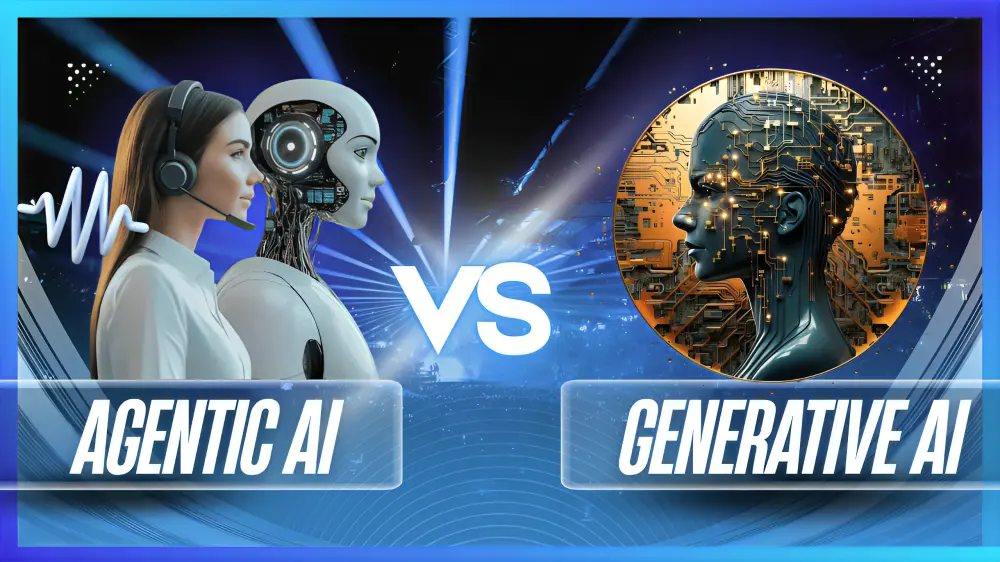

Agentic AI vs generative AI is perhaps one of the biggest paradigm shifts in artificial intelligence. Generative AI has already stunned the world with its creative prowess. Still, agentic AI is pushing the limits of systems that can plan, act, and achieve complex goals toward greater autonomy. To clarify both technologies, this extended guide explains what they mean, how they will be applied in 2026, and whether there are any benefits or future trends associated with them.
What is Agentic AI?
Agentic AI makes generative foundations and lands, but it also acts; it can plan, use tools (including software), and think up new ideas to pursue — like a human agent or animal. These systems are goal-orientated—chopping goals into steps, using tools (APIs, web browsers, or databases), monitoring feedback loops, and iterating until the completion of the desired task.
Key Characteristics:
- Goal-orientated: You provide a high-level objective (e.g., “Optimise our inventory for next quarter”), and the agent plans, executes, monitors, and adjusts.
- Proactive and adaptive: It works through a multi-step process, reasoning it out beforehand before performing code; handles exceptions; and learns through outcomes.
- Tool integration: Interacts with outside systems to carry out real-world actions like sending emails, updating records, or handling transactions.
In essence, generative AI creates; agentic AI does.
What is generative AI?
Generative AI is a model that generates new content (text, images, code, music, and videos) based on learned representations from a huge training dataset. Systems such as GPT models, DALL-E, and other similar tools generate novel outputs that imitate human creativity in response to specific user prompts.
Key Characteristics:
- Prompt-driven: It excels at single-turn or iterative responses.
- Creative powerhouse: Good for email writing, visual designing, report summarising or code snippet writing.
- Reactive nature: It sits back and waits for the human operator to tell it what to do next, then fires off its output without taking any more independent action.
Generative AI has made productivity much easier and quicker — content generation! Still, generation is usually where it ends: humans read and refine evaluated actions with the outputs.
Real-World Applications and Examples
Generative AI shines in:
- Content marketing (blog posts, social media)
- Software development (code suggestions)
- Creative industries (art, music, design)
Agentic AI powers transformative use cases in 2026:
- Customer Service: Autonomous agents handle enquiries, process refunds, escalate complex issues, and update records without constant human input.
- Sales and Marketing: Agents qualify leads, personalise outreach, schedule meetings, and track campaign performance.
- Enterprise Operations: Supply chain agents monitor inventory, predict disruptions, reorder stock, and reroute shipments.
- Healthcare and IT: Agents analyse data, flag anomalies, and trigger responses in real time.
- Personal Productivity: Vacation-planning agents that research options, book flights/hotels, and manage itineraries.
Frameworks such as LangGraph, CrewAI, AutoGen, and new services from OpenAI, Google, and Anthropic have made creating these agents possible.
Benefits, Challenges, and the Road Ahead
The benefits of agentic AI include greater speed, hours per day, scalability, and the ability to perform complex multi-step workflows, which means less human work on boring, repetitive tasks.
Challenges remain for both:
- Generative AI often hallucinates or requires heavy oversight.
- Agentic systems need robust guardrails, transparency, and human supervision for high-stakes decisions to mitigate risks like errors in autonomous actions.
The two technologies will be converging probably by 2026: agentic platforms are going to combine with generative models, delivering content on the fly and getting reasoning, memory, and tools on top of those models. This hybrid approach is the future of AI in business and everyday life.
Future Outlook: Trends Shaping 2026 and Beyond
- Hybrid Systems: Generative + Agentic working seamlessly.
- Multi-Agent Orchestration: Teams of agents collaborating like human departments.
- Agentic Commerce and Personal Agents: AI handling shopping, travel, or personal finance autonomously.
- Physical AI Integration: Agents controlling robots and real-world actions.
- Democratisation: Low-code/no-code platforms making agent building accessible to non-developers.
Agentic AI is busting wide open, and there are strong property projections for even stronger growth with increases in reliability.
Summary: Embracing the Agentic Future
Agentic AI vs generative AI is not a competition but an evolution. Generative AI was making creation more accessible, while agentic AI is making execution more accessible. It will be the organisations that transition from “thought” to “action”—those who will win using a strategy of combining both aspects: generative power for ideas and agentic intelligence for results.
Goodbye to an age where AI is a passive assistant, and hello, reliable digital coworkers. Recognising these differences now can prepare you more for tomorrow’s world of ordered, automated, and optimised possibilities. If you are a business leader, developer, or just someone curious about agentic systems, then this article can help you understand why the creation of these systems accelerates our ability to reach outputs that have never before been possible.
FAQ’s
Q1. Is ChatGPT agentic AI or generative AI?
Ans. ChatGPT is generative AI at its core. It excels at creating human-like text, ideas, and conversations based on patterns in data. While it can act somewhat “agentic” (using tools or following steps), it doesn’t truly plan, decide, or act autonomously like real agentic AI. Think: creative writer, not an independent doer.
Q2. What is the main difference between GenAI and agentic AI?
Ans. GenAI creates content—writing texts or drafting shots from your prompts. Agentic AI takes this further: it is like a goddamn clever soldier who plans, decides, uses tools, and works without supervision until the work is done.
Q3. Who is the father of generative AI?
Ans. Ian Goodfellow is widely regarded as the “Father of Generative AI”.
In 2014, he invented Generative Adversarial Networks (GANs)—the revolutionary technology that taught machines to produce realistic images, art, music, and so on. Today, the generative AI revolution is powered by his elegant idea.