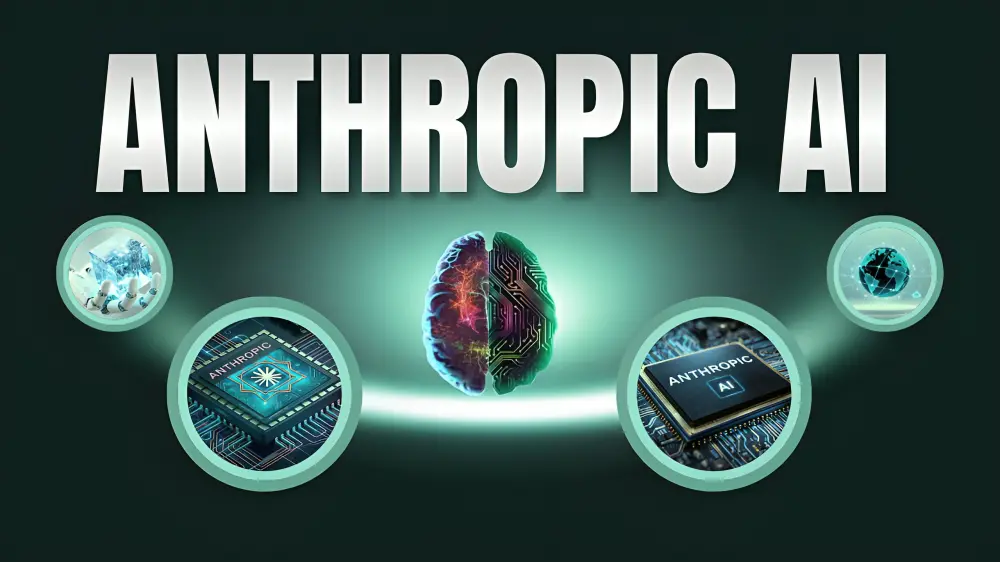

Anthropic AI has rapidly emerged as one of the most influential players in the artificial intelligence space. Built with principles of safety and responsibility in mind, the company engineers advanced AI systems that are helpful, truthful, and aligned with human intentions. Anthropic has emerged as a standout for its principled approach to building socially beneficial AI technology with the least possible risk as AI inexorably reshapes industries and daily life.
The Origins and Mission of Anthropic
In 2021, Anthropic was founded by a team of ex-OpenAI researchers and executives, among them CEO Dario Amodei and his sister Daniela Amodei. Key Points: The founders departed OpenAI over differences of opinion on the speed at which issues should be addressed and on the need to prioritise safety alongside capability. Anthropic has long been marketed as an AI safety and research company that purposefully focused on building reliable, interpretable, and steerable AI systems from the outset.
Anthropic is a public benefit corporation (PBC), which means that even its bylaws ensure that it is focusing on the long-term good of society. The mission of the company is to avoid “extremely bad outcomes” for the world while keeping it in line with a transition to “transformative AI”. Which basically means create models for the best performance and reduce causing harm, such as minor ethical issues. Anthropic builds transparency, resistance to misuse, and direct human readability into how AI will behave.
One of the cornerstones of this approach is constitutional AI—an innovative training strategy developed by the company itself. Constitutional AI uses a set of vague principles—what might be called a “constitution”—to align the model, primarily guided by human feedback. These principles give incentives for the AI to be helpful and harmless while allowing honesty and careful reasoning. This was a work in progress, having been updated to include more extensive feedback and improve values for responsible AI development.
Meet Claude: Anthropic’s Flagship AI Family
Core to what Anthropic sells is Claude, a collection of large language models that are intelligent, safe, and designed with humanity in mind. Claude models power the Claude.ai platform, with an AI marketplace available via APIs, enabling individuals, developers, and enterprises to access it.
Claude comes in different tiers tailored to various needs:
- Haiku models focus heavily on speed and efficiency, making them great for quick tasks like summaries or basic questions.
- Sonnet models are more performance-cost-effective in professional workflows and coding & reasoning.
- Opus is the frontier tier: it provides state-of-the-art, death-defying skills for intricate challenges, high-level coding, agentic activities, and multi-step projects.
The Update History of Claude Opus: 1- ChatGPT4 – Big steps on software engineering, agentic coding, vision & long-running complicated tasks (April 2026). Users say it is more consistent, better at following instructions, and getting the hard work done with minimal supervision. The Claude 4 series and the Sonnet 4.6 model have already created new horizons in coding and career uses.
Claude really stands out due to its personality and safety features. Compared to some peers, Claude is more thoughtful and nuanced (certainly less prone to hallucination). Gracefully rejects harmful requests and offers explanations on demand. Embedding artefacts (for collaborative creation of documents, code, or designs), computer use capabilities, and the ability to integrate with tools make it even more useful for real-world productivity.
Commitment to AI Safety and Responsible Development
Anthropic AI stands out for its absolute focus on security and safety. The company properly invests in research on making AI more interpretable—understandable both by researchers and users, who can determine why the model behaves how it does. Constitutional AI, for example, uses different approaches to reduce the need for labour-intensive human labelling while providing additional harmlessness.
Models of the company are released with system cards documenting capabilities, safety test results, and deployment decisions. It also joins public conversations about AI risks, such as their misuse in autonomous weapons or surveillance. This principled position has come to some notable discussions at times, e.g., the ban of certain government applications, indicating that compromises on safety cannot be made for short-term profits, as Anthropic would see it.
Anthropic partners with other organisations, policymakers, and academic institutions to promote industry-wide standards. They provide reports on the economic index for Claude, which gets into its actual use cases and implications in real economies, as well as productivity gains.
Growth, Funding, and Enterprise Adoption
Anthropic has experienced explosive growth. The company said that the revenue run rate topped $30 billion by early 2026, fuelled by demand for Claude from businesses. More than 1,000 enterprise customers now use it with an annual spend exceeding $1 million, and adoption is expanding rapidly in industries including software development, finance, healthcare, and manufacturing.
Major partnerships fuel this expansion. Anthropic partners with cloud providers — Amazon Web Services (AWS), Google Cloud, and Microsoft Azure. And of course, you have the recent deal with Google and Broadcom to lock in several gigawatts of next-gen massive compute capacity to scale. Valuations have skyrocketed – reportedly to $380 billion or more from funding rounds in 2026 (with even higher numbers also discussed and a potential IPO by the end of this year) due to strategic investments from tech giants and venture firms.
Enterprise features: Claude Code for programming assistance, agent teams for advanced workflows, customisable plugins, and integration with tools like Google Workspace or DocuSign. When using Claude, companies can do things like coding automation, cybersecurity, operations enhancement, and creativity enrichment. Firms such as Accenture, Infosys, and others are helping enterprises transition from AI pilots to deployment at scale through those partnerships.
Although Anthropic emphasises safety, it has also endured controversy over government use cases. However, it has made impressive enterprise market share gains to position itself as a leader among competitors.
Looking Ahead: Innovation and Challenges
Anthropic is still exploring frontier research areas such as longer-horizon agents, more capable multimodal (text and vision, etc.) capabilities, and more autonomous systems. Initiatives like Claude Design and partner network expansions are indicative of a shift toward generative AI that “does the work” instead of simply supporting it.
Companies also consider some social dimensions by studying user expectations and economic implications, among other things. If Anthropic succeeds in following through on major infrastructure investments and continuous model iterations to responsibly scale this AI output,
Intense competition, expensive computing power required, and navigating complex regulatory landscapes are some of the challenges facing researchers in these areas. Balancing rapid innovation with safety will be critical as capabilities progress.
Summary
Anthropic AI is a serious, principled voice in AI. It provides what’s both transformative and trustworthy by building state-of-the-art models like Claude and obsessively pursuing safety & interpretability. With AI driving the next revolution of industry and society, Anthropic is a key player in ensuring that advanced technology leads to improvements in life for all by adopting a balanced approach to the training of software that combines reliability with capability. Claude is a preview of responsible AI, whether you’re a developer, a business leader, or an inquisitive user exploring it as you read this.
FAQ’s
Q1. Is Anthropic better than ChatGPT?
Ans. No, Anthropic (Claude) is not always better than ChatGPT. In terms of safety, informative responses, and writing quality, it is doing better. When it comes to creativity, speed, real-time knowledge, and a fun personality, ChatGPT mostly wins. Both are great; choose based on your requirements. Try both!
Q2. How is Anthropic different from OpenAI?
Ans. Constitutional AI: Anthropic pursues safe and reliable AI with exceptionally strong ethical guardrails. Compared to OpenAI, which emphasises speed of innovation and generalisation, Anthropic leans more cautiously with what it releases into the world, focusing on transparency and minimising harmful outputs.