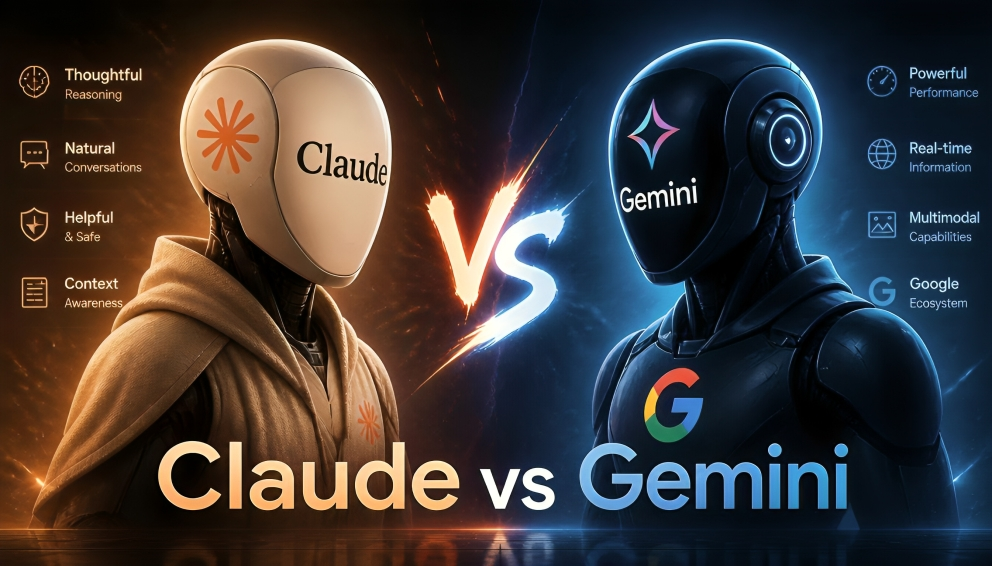

Deciding between Claude and Gemini is arguably one of the most pragmatic choices for a professional, developer, writer, or user to face in 2026. Both models are at the frontier of their capabilities as large language models, but in different respects. This Claude vs Gemini comparison details their relative strengths and weaknesses, pricing, real-world performance, and best use cases to help you determine which tool works best for your workflow.
Anthropic’s Claude (with flagship models such as Opus 4.8 and the newer Opus 5 line) is a cap-driven model with careful reasoning, excellent writing and coding performance. Gemini (driven by 3.1 Pro and speedy Flash variants) focuses on multimodal capability, tight integration with the Google ecosystem, and value for money. Neither is better in all scenarios—the choice that will serve you best depends on what you need to do.
Quick Overview of Claude vs Gemini
Anthropic develops Claude, which emphasises designing Claude to be safe, helpful, and reliable. This is where it excels, taking care of any kind of long development writing, detailed analysis, task-based coding, and instruction following explicitly. It includes features such as Projects (so you can have persistent context across related work) and Claude Code, which makes it popular with developers and knowledge workers.
Gemini comes from Google DeepMind and benefits from Google’s vast data and product ecosystem. It handles text, images, video, and audio natively in many cases. Real-time access to Google Search, seamless integration with Gmail, Docs, Drive, and Android, plus strong performance on abstract reasoning benchmarks, make it a versatile generalist.
Key Features Comparison
| Aspect | Claude (Anthropic) | Gemini (Google) |
| Flagship Models | Opus 4.8 / Opus 5, Sonnet variants | Gemini 3.1 Pro, 3.5/3.6 Flash |
| Context Window | Up to 1 million tokens | 1 million standard (higher on some tiers) |
| Coding Strength | Leads many SWE-bench style tests | Strong but often trails Claude on hard coding |
| Writing Quality | Excellent long-form, natural tone | Competent, efficient summaries |
| Multimodal | Strong vision; limited native video/audio | Native video, audio, image understanding & generation |
| Ecosystem | API-first, Projects, Claude Code | Deep Google Workspace, Search, Android |
| Real-time Information | Limited without tools | Native Google Search grounding |
| Pricing (Consumer) | Pro: ~$20/month, higher Max tiers | AI Plus from ~$5, AI Pro ~$20, Ultra higher |
Data reflect publicly available capabilities and price trends as of mid-2026. Please cross-check with the official sites for the current details, as exact scores and prices get updated with new releases.
Performance: Coding, Writing, Reasoning, and Multimodal Tasks
Coding and Agentic Work
Claude competes at the highest level on real software engineering benchmarks such as SWE-bench variants. Fewer broken multi-file edits, better long-horizon agent behaviour, and stronger results generally when using Claude Code (and tools like it). Gemini remains competitive with everyday coding and has a long context for entire codebases, but Claude is currently beating all of them in complex multi-step engineering tasks.
Writing and Analysis
Claude generates fluent, human writing in longer contexts with greater coherence and far less boilerplate copy. Usually favoured for reports, edits, communication with clients, and all other content needing to feel human or very specific. When retrieving up-to-the-minute information, Gemini shines through for summaries, emails, and structured outputs.
Reasoning and Knowledge
The models are good at both. Gemini has always made a strong showing on archetypal pattern recognition and some science benchmarks. Claude has a tendency to be better at slow, complex analytical reasoning and instructions over long contexts.
Multimodal Capabilities
Gemini has one of the most enviable advantages at all. Gemini is better for analysing recordings, making visuals, or working with mixed media because it natively handles video and audio along with image generation and understanding. Claude does a great job with images, but Gemini in 2026 is on a different level for video and audio.
Pricing and Value in 2026
This means that the consumer plans for each start around the $20 mark get solid paid access (Claude Pro and Google AI Pro). Compared to Gemini, you can enter with AI Plus at a lower cost and usually get more generous free-tier use of capable Flash models. Among the different API offerings, Gemini models are typically cheaper per token, while Claude’s higher-tier Opus models charge a premium that many justify by better performance on challenging tasks.
Users who will be using it heavily should check usage limits. Claude Max, for example, massively boosts capacity (with a small storage or tool bonus), while Gemini Ultra tiers open up higher limits across the board along with some premium video features like Veo.
Ecosystem and Daily Workflow Integration
Gemini feels the most native if all your work takes place inside Google Workspace—Gmail, Docs, Sheets, Drive, or Calendar. It can access and interact with your documents without much overhead and take advantage of live search. Claude also works well with APIs and third-party tools, plus powerful projects for structuring different client or topic contexts. A typical cross-platform user uses both, with Claude for their deep work and Gemini to quickly look up research or Google-native tasks.
Practical Examples and Use Cases
- Software developers: Claude for complex refactors, debugging, and agentic coding sessions. Gemini for exploring large codebases or generating supporting documentation quickly.
- Content creators and writers: Claude for drafts that need polish and voice consistency. Gemini for research-backed outlines or multimodal content involving images and video.
- Business professionals: Gemini if you live in Google tools and need fast answers grounded in current information. Claude for detailed reports, analysis, or multi-client work requiring persistent context.
- Researchers and students: Both work well; Gemini’s search grounding helps with up-to-date facts, while Claude’s careful reasoning supports deeper analysis.
Actionable Tips for Choosing and Using Them
- Test both on your actual tasks rather than relying only on benchmarks. Free tiers or short trials reveal differences quickly.
- Match the model to the job: use Claude’s higher-effort modes for hard problems and Gemini’s faster Flash models for high-volume or latency-sensitive work.
- Combine tools when possible. Many professionals keep both subscriptions and route work accordingly.
- Monitor context usage and token costs, especially on long documents or agent loops.
- Stay updated—both Anthropic and Google release frequent improvements in 2026.
Strengths and Limitations Summary
Claude’s strengths: coding leadership, writing quality, instruction following, agentic reliability, and the Projects feature.
Claude limitations: higher cost on flagship models and less native multimodal depth compared with Gemini.
Gemini strengths: multimodal range, Google ecosystem, value pricing, real-time information, and speed on flash models.
Gemini limitations: Sometimes less precise on the hardest coding or long-form creative writing tasks.
Final Recommendation
In 2026: Claude vs Gemini. If your main workflow is work, then start here. Select Claude if the quality of the code is important and to make sense of huge amounts of detailed or multi-step-reasoning writing. Go with Gemini when you want seamless Google integration, multimodal capabilities, search in real time, or a better-value entry price.
Many users ultimately keep both. Claude does the deep diving, whereas Gemini runs your tasks related to research and media consumption, powered by Google Checklists for everyday use. Try the newest models on your prompts yourself—the gap between them is smaller than the gap between either model and older generations, and choosing the right one will save you time and improve results every day.
Both continue to evolve rapidly, so check back in on this comparison when new versions are released.