
The evolution of artificial intelligence is transforming the way human beings seek out, assess, and utilise information. From academic researchers to students, analysts, and professionals, AI tools have now come in handy, performing tedious tasks like scanning through literature, extracting key findings, and identifying patterns across large datasets. With caution, AI for research can turn what would have taken weeks of human effort into hours of focused thinking while letting humans do the higher-level value judgement.
This guide describes what AI can and cannot do in practice when it comes to research, which tools work in 2026, and how to apply them one step after another without losing accuracy or integrity.
- What is AI for research?
- Benefits of Using AI for Research
- Popular AI Tools for Research in 2026
- Step-by-Step Guide: How to Use AI for Research
- Best Practices and Ethical Considerations
- Real-World Applications
- Common Challenges and How to Overcome Them
- Latest Trends in AI for Research
- Summary and Recommendation
What is AI for research?
AI for research involves AI systems, including large language models, specialised academic search tools, and multi-agent systems to assist the research process. They are designed to assist with discovery, summarisation, data extraction, and hypothesis generation, as well as coding and writing.
The most beneficial research tools are “grounded” and differ from a generic chatbot answering from its training data. They fetch and quote actual references, pull raw data from publications, or only process documents you provide. The point of it all is to not replace the researcher but to speed up the mechanical aspects of the work so that more time can go toward analysis, interpretation, and original thought.
Benefits of Using AI for Research
AI delivers clear practical advantages when applied wisely:
- Faster literature reviews and source discovery across millions of papers or web results.
- Structured extraction of methods, sample sizes, outcomes, and findings into tables.
- Quick synthesis of themes, gaps, and conflicting evidence.
- Help with coding, data cleaning, and generating alternative explanations or hypotheses.
- Reduced language barriers through translation and clearer explanations of dense technical writing.
- Support for writing drafts, organising notes, and preparing presentations or grant materials.
Researchers who use these tools well often report that they save significant amounts of time on routine tasks. Now comes the deepest value of all: when researchers use that time to analyse the evidence, not just reflect upon it.
Popular AI Tools for Research in 2026
No single tool does everything well. Most effective workflows combine a few specialised options:
- Perplexity – Excellent for fast, cited web research and broad topic overviews. Strong for current events, market research, and general synthesis.
- Elicit – Purpose-built for academic literature. Strong at screening papers, extracting structured data, and supporting systematic reviews.
- Consensus – Useful for checking what peer-reviewed studies say on a focused question. Provides an evidence “meter” showing the overall direction of findings.
- Semantic Scholar – Free, high-coverage academic search with useful filters and related paper recommendations.
- Scite – Focuses on citation context: whether later papers support, contrast, or simply mention a given study.
- NotebookLM (and similar document-grounded tools) – Works only with sources you upload, reducing hallucination risk for synthesis of your own materials.
- General models such as Claude, ChatGPT (with Deep Research features), and Gemini are helpful for document analysis, drafting, and reasoning once you already have verified sources.
- Mapping tools such as ResearchRabbit or Connected Papers visualise citation networks and help discover related work.
Use tools appropriate to the particular phase of research; don’t try to use one platform for everything.
Step-by-Step Guide: How to Use AI for Research
A reliable workflow keeps human judgement in control at every stage.
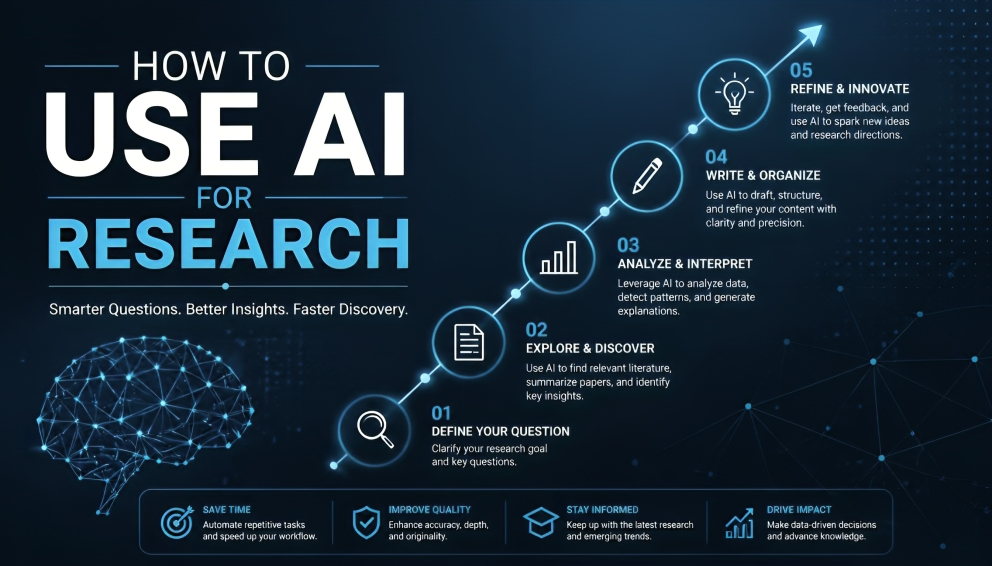
1. Define a clear research question.
When appropriate, provide a clear definition of key elements and formulate your inquiry in terms of population/intervention/comparison/outcome (PICO). Vague prompts produce vague answers. AI is guided well by strong questions.
2. Discover and collect sources.
Start collecting papers or web sources by using Semantic Scholar, Elicit, Consensus or Perplexity. Request key papers, recent reviews, or studies matching some criteria. Export or save the results.
3. Screen and extract information
Upload an array of promising papers or employ tools that mine for structured data (method, results, limitations). Findings pertinent to your question are drawn up in tables or notes. For any significant claims, always click through to the original PDF.
4. Synthesise and identify gaps
Ask the AI to catalogue findings by theme, record points of agreement and disagreement, and highlight potential research gaps. Compare the synthesis against the actual papers
5. Verify every important claim and citation.
Never take a generated citation or quote at face value. Go to the source, verify it, and make sure the interpretation is correct. This step is nonnegotiable.
6. Analyse, interpret, and write
Use AI for drafting outlines, clarifying language, or generating alternative perspectives. Keep authorship, critical evaluation, and conclusions firmly in human hands. Disclose AI assistance according to journal or institutional rules.
7. Iterate and refine
Incorporate discoveries into the system. Good research is seldom linear, and AI speeds up iteration.
Best Practices and Ethical Considerations
Treat AI as a capable research assistant, not an autonomous expert.
- Always verify sources and data. Hallucinated citations and subtle misinterpretations remain real risks.
- Prefer tools that ground answers in retrievable documents or papers.
- Disclose AI use clearly in methods, acknowledgements, or cover letters as required by journals and institutions (many updated policies in 2025–2026 emphasise transparency).
- Maintain responsibility for the final work. AI cannot be listed as an author.
- Watch for bias in training data and in how results are ranked or summarised.
- Protect sensitive data. Avoid uploading confidential or proprietary material to public tools unless the platform offers appropriate security and data-handling guarantees.
- Build your own expertise. Overreliance can weaken the very judgement needed to evaluate AI output.
Real-World Applications
But academic researchers still employ Elicit and Consensus to speed up their systematic reviews before manually confirming key papers. Perplexity or Deep Research agents are used to conduct rapid environment scans before the analysis of primary sources by market and policy analysts. One approach — where scientists conduct experiments using multiagent systems (sometimes referred to as AI coscientists) — includes generating and critiquing hypotheses before designing the most promising ideas for experimentation. Students repurpose document-grounded tools to sense-make complex articles and keep notes but do so alongside reading the original papers.
In all these cases, the same thing holds: AI does volume and speed; humans do meaning, novelty, and accountability.
Common Challenges and How to Overcome Them
Hallucinations and fake references occur more frequently. The solution is systematic verification against sources. A second hurdle is a tendency to trust neat summaries without verifying methods or limitations. The antidote to this is to examine figures, methods sections, and sample details for load-bearing papers. Finally, tool limits and shifting free tiers call for flexibility—keep a small arsenal of interoperating tools as opposed to relying on 1.
Latest Trends in AI for Research
In 2026, multiagent systems that search and critique many ideas in a multi-step manner are gaining steam. Streamlining and just-in-time sources are still increasing the reliability of all document-only tools. Graph: Citation context analysis and streamlined reference manager integration are in the works. Simultaneously, institutions and journals are explicitly stating disclosure requirements and making it abundantly clear that human responsibility cannot be offloaded. The most prolific researchers view these algorithms as tools that augment their expertise, not substitutes for it.
Summary and Recommendation
Employing AI for research successfully is the art of matching speed with rigour. Begin with a sharp question, select appropriate grounded, non-paper tools for each step of the process, extract and synthesise at pace, and double-check all key assertions against primary sources. Human judgement should remain at the heart of interpretations, what is new, and conclusions. Be transparent about the assistance and treat AI as an amazing assistant that enables time for deeper thinking.
The more a researcher writes or cites, the better they make; they will make huge gains in 2026. It is these people who apply such tools to formulate better questions, scrutinise evidence, and deliver work that continues to sustain a degree of trust. Focus on utilising 1 or 2 niche tools, create a habit of verifying results, and make the AI an extension—but not a substitute—of your knowledge.