
The social media game is faster than most teams can handle. With Instagram, TikTok, LinkedIn, X, and more demanding constant attention—and algorithms rewarding consistency over creativity—audiences expect new content every day. This is where AI for social media marketing plays a vital role. By 2026, almost all social media teams will use AI tools habitually—often daily—for ideation, drafting, scheduling, analytics, and even ad optimisation.
This guide shows you exactly how to apply AI effectively. You will learn what works, which tools deliver results, a clear step-by-step workflow, and how to keep your brand authentic. The goal is not to replace human creativity but to multiply it so you can focus on strategy and community.
What is AI for Social Media Marketing?
AI for social media marketing is about delivering artificial intelligence tools and systems that help marketers plan, create, publish, analyse, and optimise content across social platforms. They leverage large language models, computer vision, and machine learning to create captions & images/short videos, suggest posting times, identify trends, perform sentiment analysis, and automate tedious tasks.
Modern platforms are not just basic text generators. It is now common that even these come with agentic functionality that can write content for a week, suggest variants, highlight new conversations, or support live ad campaign optimisation. AI works best in high-volume, repeatable work, but humans should maintain final say over brand voice, strategy, and sensitive interactions.
Key Benefits of Using AI
Marketers report clear advantages in 2026:
- Faster content production (often the top-cited benefit, helping teams produce more posts without proportional increases in headcount)
- Significant time savings on drafting, research, and reporting
- Better personalisation of messages for different audience segments
- Improved A/B testing of creative variants at scale
- Stronger data-driven decisions through automated insights and trend detection
- Cost efficiency by reducing reliance on external freelancers for routine assets
While AI-assisted posts can be mixed in with purely manual ones, they often deliver higher engagement and click-through rates if carefully edited to align with the brand’s guidelines. Pure artificial intelligence output with little human refinement may fail to deliver, however.
Practical Ways to Apply AI Across the Social Workflow
Content ideation and research
Feed AI tools your previous high-performing posts, content pillars, or the most recent news from the industry. Get 20–50 ideas grouped by theme, format & platform. Additionally, tools can also reveal budding trends before they get popular.
Caption and copywriting
Generate first drafts tailored to each platform’s style and length limits. Provide your brand voice guidelines, examples of strong past posts, and target audience details for better results. Always edit for authenticity and accuracy.
Visual and video creation
AI image generators and design tools to create carousels, graphics, and product shots. These short-form video tools will turn your scripts or existing footage into Reels, TikToks, or Shorts. They now describe multimodal systems that, in connected workflows, will handle text, images, and basic video.
Scheduling and optimisation
AI evaluates your past engagement data in order to provide recommendations around your posting times and frequencies. Most scheduling platforms come with built-in assistants that rewrite captions or repurpose content from channel to channel.
Social listening and analytics
AI scans conversations, sentiment, and competitor activity at scale. It is the summarisation of performance reports, flagging what is working and early signs of anything that may be required as bee to buzz. It transforms raw data into actionable insights much faster than any human can review data.
Advertising support
Platforms such as Meta Advantage+ and TikTok Smart+ use artificial intelligence for targeting, budget allocation, and creative testing. Marketers still set goals and review results, but the systems handle much of the day-to-day optimisation.
Community management assistance
AI can respond to frequently asked questions or manage large quantities of comments. Human in the loop: Be sure to keep humans when responding to nuanced or emotional situations, or if it is a crisis.
Recommended Tools in 2026
A practical stack often includes:
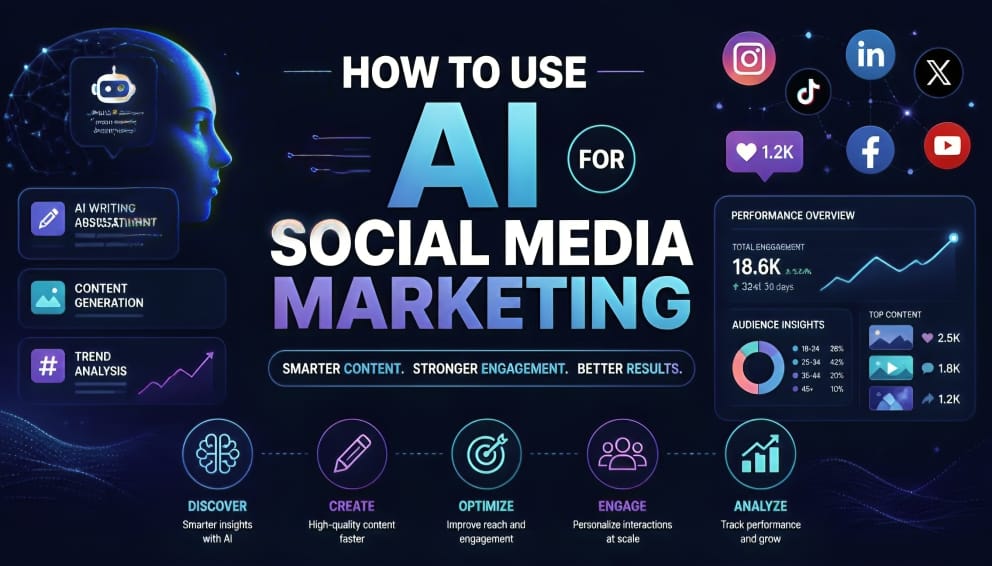
- General AI assistants (ChatGPT, Claude, or Gemini) for ideation, drafting, and analysis
- Design platforms with AI features (Canva Magic Studio, Adobe Firefly)
- Scheduling and management tools with AI (Buffer, Hootsuite, Sprout Social, Later, Metricool)
- Specialised creative tools for images and video (Midjourney or similar, Runway, CapCut)
- Listening and advanced analytics platforms for larger teams
Start simple. Many teams begin with a general artificial intelligence model plus Canva and a free or low-cost scheduler, then expand as needs grow. Integrated platforms reduce tool-switching and keep brand context consistent.
Step-by-Step Guide to Getting Started
1. Define clear goals.
Pick whether to increase content volume, increase engagement, collect better insights, have faster response times, or bring in the ad performance. Clear goals drive tool choice and measurement.
2. Audit your current process.
Pay attention to the area of maximum effort and the box that has a bottleneck with your team. This is where to start with AI
3. Build a brand voice and claims reference.
Remember the most engaging posts and key messaging rules; collect 8–12 examples of each. Draft a generic prompt or document outlining your tone, audience, and words/subjects to avoid. Do this for every request in generations → passing to AI tools.
4. Establish content pillars.
Limit yourself to 3–5 core themes that you write on. Learn how to train AI to brainstorm ideas and formats for each pillar so that your calendar never becomes lopsided.
5. Generate and refine content in batches.
Create a batch of ideas and first drafts once a week. Edit each piece for voice, accuracy, and platform fit. Human review remains essential.
6. Create or adapt visuals.
Create or edit images and short videos, then apply brand colours, fonts, and consistency.
7. Schedule strategically
Use AI recommendations for timing but with a human-approved calendar. Restructure stronger content pieces into several different formats across the channels, but do not just dump them as they are on each channel.
8. Measure, learn, and iterate.
Review performance with artificial intelligence-assisted reports. To improve, you can take winning patterns and feed them back into future prompts
Best Practices for Quality and Trust
- Always keep a human in the final approval loop for public content.
- Train artificial intelligence on your actual brand examples rather than generic instructions.
- Disclose AI use when required by platform policies or when transparency builds trust with your audience.
- Prioritise quality and authenticity over pure volume. Audiences notice low-effort “AI slop”.
- Start with low-risk, high-volume tasks such as idea generation and first drafts before expanding to more complex areas.
- Protect data privacy and follow platform guidelines on automated posting and AI-generated media.
- Continuously test prompts and measure outcomes so your process evolves.
Latest Trends Shaping AI Use in 2026
Within many of the large social platforms, agentic AI systems that plan and execute multi-step workflows with little supervision are becoming more common. Multimodal capabilities enable more seamless generation of text, images, and video. Many brands have already seen that short-form video keeps producing high ROI. As a result, consumer response to overly synthetic content has also become more pronounced – as such, human curation and true brand personality are more precious than ever.
Strong Summary and Recommendation
AI for social media marketing has transitioned from the experimental stage to operational. The best teams use it to create more relevant content, trend faster, and build relationships — freeing time for strategy. The best-performing strategy marries AI’s speed and volume with human judgement on voice, creativity, and community nurturing.
Go on and define one single goal, create a simple reference for your brand voice, and generate your batch of ideas with artificial intelligence. Authority to count on — starting today. Edit with a scalpel, plan wisely, and track outcomes. Then, expand the tools and automate more mundane work over time while preserving authentic connection that lasts.
Used thoughtfully, AI is a trustworthy companion that assists you in keeping up with regular posting on social media creatively as well as competitively.