
Today, everyone running a business fights the battle to do more with less without losing the plot in real time. Manual processes create bottlenecks. Traditional automation is helpful; however, it falls apart when the info gets a bit wobbly or the choice requires judgement.
AI workflow automation solves these by complementing AI with multistep business processes. It is capable of reading emails, extracting information from invoices, classifying support tickets, making routing decisions, and triggering actions between systems … all with far less human intervention.
In 2026, nearly nine out of ten organizations say they use AI regularly in at least one business function, and just under half (44 per cent) have widespread enterprise-scale AI. Organisations make the biggest strides in productivity by re-architecting workflows around AI rather than buying isolated tools.
In this guide, we will cover AI workflow automation – what it is and why it matters; how workflow automation with AI works in practice; identify trends that have been proven useful by the tools; and practical steps to implementation.
- What is AI workflow automation?
- How It Differs from Traditional Automation and RPA
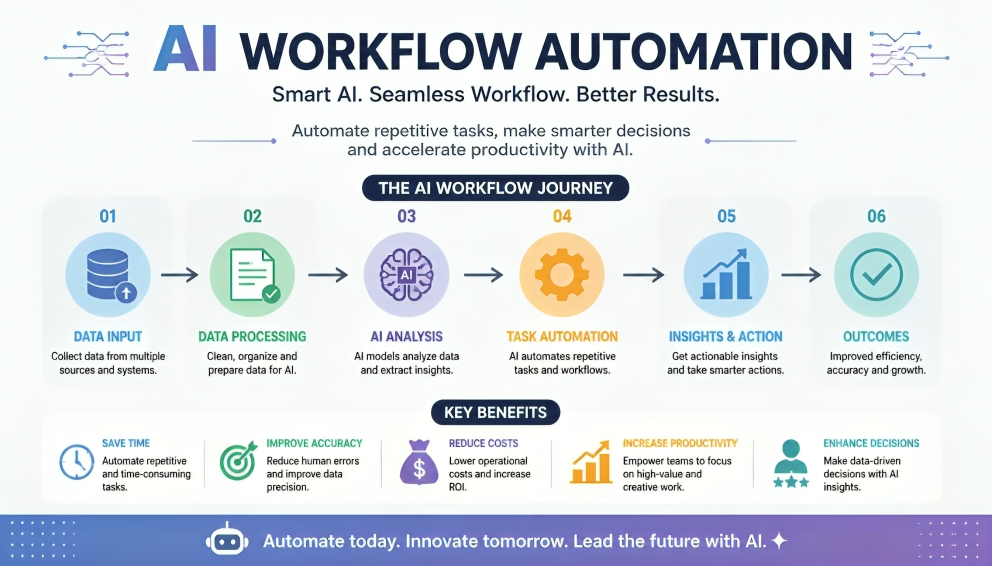
- Key Benefits of AI Workflow Automation
- Real-World Applications Across Departments
- Popular AI Workflow Automation Tools in 2026
- Latest Trends Shaping AI Workflow Automation in 2026
- Best Practices and a Practical Implementation Path
- Common Challenges and How to Address Them
What is AI workflow automation?
AI workflow automation leverages artificial intelligence—in the form of large language models, machine learning, and autonomous agents—to create, execute, track, and optimise end-to-end business processes.
Unlike basic rule-based systems that follow fixed “if this, then that” logic, AI-powered workflows can:
- Interpret unstructured data (emails, PDFs, chat messages, images).
- Make context-aware decisions
- Handle exceptions and variations.
- Learn from outcomes and improve over time.
- Coordinate actions across multiple applications.
Traditional AI workflow begins with a trigger (for example, a new support ticket, an invoice file uploaded to the system, or a form submission). AI inspects the input, determines what should be done next, carries out actions in interconnected systems, and only escalates when a human decision is required.
How It Differs from Traditional Automation and RPA
and robotic process automation targets high-volume, low-complexity tasks where structured data can be leveraged. Scripts afford fluidity, but unbelievably they box in ambiguity.
It can process structured and unstructured inputs with the help of AI workflow automation. It aims at a target of thought rather than following rules. For example, a system should intelligently adapt or self-correct or, of course, successfully route the case when an unexpected something appears instead of simply failing.
The shift—away from rigid scripts to adaptive, goal-driven processes—is one reason so many organizations are evolving past simple automation in 2026.
Key Benefits of AI Workflow Automation
Organizations that redesign processes around AI report meaningful gains:
- Higher efficiency — Routine work moves faster and runs continuously.
- Lower operational costs — Reduced manual effort and fewer errors cut cost per transaction significantly in suitable processes.
- Better scalability — Handle growing volume without proportional headcount increases.
- Improved accuracy and consistency — AI applies the same standards every time.
- Faster response times — Customers and internal teams get quicker resolutions.
- Employee focus on higher-value work — People spend less time on repetitive tasks and more on judgement, creativity, and relationships.
- Data-driven insights — Every automated step generates usable analytics for continuous improvement.
McKinsey research consistently reveals that organizations with the most significant bottom-line impact from AI do not just add new technologies to existing processes; they redesign the workflows themselves.
Real-World Applications Across Departments
Here are practical examples teams are running successfully:
Customer Support
Incoming tickets are classified by topic and urgency. AI generates responses to frequently asked questions, extracts pertinent information related to customers, and intelligently forwards complex cases with context to the appropriate representative. Most of the teams experience faster first response times and increased agent satisfaction.
Sales and Marketing
It enriches, scores, and routes new leads automatically against ideal customer criteria. The engagement signals can be used to draft followup emails. In Webinar and Content Workflows, you can offer more nurture to prospects without the need for constant manual management.
Finance and Operations
Extracts, validates, matches invoices against purchase orders and routes for approval. Exceptions are flagged. Inventory agents observe stock levels across systems to determine whether replenishment is required.
HR and IT
Requests made by employees through Slack or email are categorised, prioritised and resolved either by providing suggestions or converted to tickets that can be tracked. Onboarding sequences leverage information from various systems to keep everyone up-to-date.
Engineering and Product
Code-related agents facilitate testing, documentation, and routine maintenance tasks, even while process mining tools pinpoint places in the workflow that are bottlenecks for more automation.
These patterns work with high-throughput processes and well-defined outcomes as well as low exception rates.
Popular AI Workflow Automation Tools in 2026
The market offers options for different needs and technical comfort levels:
- Zapier — Broad app integrations and accessible AI steps; strong for nontechnical teams.
- Make — Visual builders with sophisticated branching logic.
- n8n — Open-source flexibility, self-hosting options, and strong AI/LangChain support for technical teams.
- Microsoft Power Automate — Excellent for Microsoft-centric environments with Copilot integration.
- Workato, UiPath, and ServiceNow — enterprise-grade platforms with governance, RPA, and agent capabilities.
- Salesforce Agentforce and similar agent platforms — focused on autonomous agents within CRM and related systems.
The best teams will couple a core orchestration tool with more advanced AI models for specific functions. Pick using your ecosystem, security requirements, and whether you need no-code simplicity or immersive control.
Latest Trends Shaping AI Workflow Automation in 2026
Several shifts stand out this year:
- Agentic AI — Systems that plan multistep actions, use tools, and operate with greater autonomy. Large enterprises are scaling agents faster than smaller organizations.
- Hyperautomation — Combining AI, RPA, process mining, and orchestration for end-to-end process coverage.
- No-code and low-code AI builders — making intelligent automation accessible beyond specialist teams.
- Process mining and continuous improvement loops — Tools that discover bottlenecks and suggest or build improvements.
- Stronger human-in-the-loop controls and governance — confidence thresholds, approval gates, and audit trails remain essential.
- Multimodal inputs — Workflows that handle text, voice, images, and documents in the same flow.
The focus has shifted from pilots in isolation to deployed systems offering measurable ROI.
Best Practices and a Practical Implementation Path
Success depends more on process design and governance than on any single tool. Follow these steps:
1. Map current processes — Identify high-volume workflows with clear outcomes, measurable pain points, and moderate exception rates. Avoid starting with the most complex process.
2. Define success metrics — Track time saved, error rates, cost per transaction, or customer response times before and after.
3. Start small and measurable — Automate one well-defined process. Include human review for low-confidence cases and irreversible actions.
4. Ensure data quality and system access — Clean inputs and reliable integrations are foundational.
5. Build in oversight — Use confidence scores, approval steps, logging, and clear escalation paths.
6. Iterate and expand — Measure results, refine prompts and logic, then extend to related processes.
7. Address governance early — Security, compliance, audit trails, and change management prevent later problems.
Teams that treat automation as an ongoing process redesign rather than a one-time project see the strongest results.
Common Challenges and How to Address Them
Challenges include the messiness of data, integration complexity, resistance to change, unclear ROI measurement, and overautomation of judgement-heavy work.
Mitigate them by starting with clean, high-volume processes; engaging end users early; measuring rigorously; ensuring humans are in the loop for mission-critical decisions; and selecting tools that meet your technical and compliance requirements.
Strong Summary and Recommendation
AI workflow automation has ceased to be a subject of experiments. It helps organizations simplify complexity while freeing people for higher-value work. AI works best when you build processes from scratch with the technology in mind, rather than treating it as a bolted-on extension of existing steps.
In 2026, the top companies marry agentic capability with robust orchestration tools, precise metrics, and careful human supervision. This results in a few things: quicker operations, reduced costs, improved consistency, and scalable growth.
Begin with one high-volume process of high volume that is currently a heavy manual effort and is also measurable. Map it all out, deploy with thresholds and human review, measure the effectiveness, then scale from there. This disciplined approach helps ensure that AI workflow automation can be turned from a great concept into a proven source of advantage.