
In India, more people are becoming aware of mental health, leading to a growing need for trained professionals. If you’re interested in helping others understand their thoughts, feelings, and actions, a career in psychology might be very fulfilling. This guide will show you how to become a psychologist in India, outlining the steps, current rules, and useful tips based on the latest from the Rehabilitation Council of India (RCI).
Understanding the Role of a Psychologist in India
Psychologists explore how people think, feel, and behave. They might work in areas like counselling, clinical assessments, education, and business, or run their own practice.
It is important to note the difference between roles:
- Counselling or general psychologists usually help with daily stress, relationships, career decisions, or mild emotional issues. Many start working after earning a master’s degree.
- Clinical psychologists deal with more serious mental health issues. They can diagnose problems, perform tests, and offer special therapies. This role has strict regulations.
To legally work as a clinical psychologist in India, you need an RCI-recognised qualification and must be registered on the Central Rehabilitation Register (CRR).
Educational Pathway: How to Become a Psychologist Step by Step
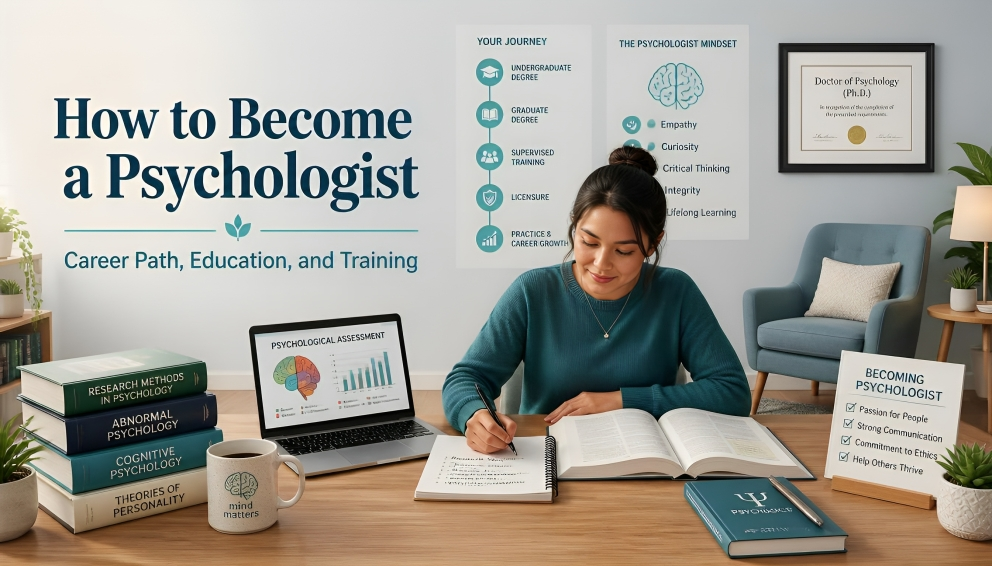
The journey usually takes six to eight years after Class 12, depending on the specialisation you choose.
Step 1: Complete Class 12
Pass Class 12 in any stream – Arts, Science, or Commerce – with at least 50% marks. While taking psychology can be helpful, it’s not a must. Having good English skills is beneficial for further studies.
Step 2: Earn a Bachelor’s Degree in Psychology
Consider pursuing a BA or BSc in psychology, which usually lasts three years, though some programmes now extend to four. It’s helpful to aim for at least 55% marks to stay competitive. Some popular universities are Delhi University, Christ University, and various state universities.
There’s also a new option for a four-year B.Sc. in Clinical Psychology (B.Clin.Psy) approved by RCI at some institutions, offering clinical training from the get-go, which can lead to professional practice.
Step 3: Complete a Master’s Degree
Once you have your undergraduate degree, you can go for an MA or MSc in Psychology, which is a two-year programme. You can focus on areas like Clinical, Counselling, Applied, Organisational, or Educational Psychology. Renowned institutions like TISS Mumbai, Christ University, Jamia Millia Islamia, and Delhi University offer these programmes.
A master’s degree sets you up for roles in counselling, school psychology, corporate wellness, or even research. It’s also a stepping stone for clinical training.
Step 4: Pursue RCI-Recognised Professional Training (for Clinical Practice)
If you want to become a clinical psychologist, you need a professional qualification approved by the RCI. In the past, people did a two-year M.Phil. in Clinical Psychology from places like NIMHANS in Bengaluru, CIP in Ranchi, IHBAS in Delhi, or PGIMER in Chandigarh.
However, changes have been announced. Starting from the 2025-26 and 2026 academic years, the RCI will move to a two-year Master in Clinical Psychology (M.Clin.Psy) or an MA in Clinical Psychology. These will be available only at institutions recognised by the RCI.
To apply for these programmes, you usually need a four-year bachelor’s degree in Psychology. If you have a three-year degree, you may need a bridge course or the first year of a master’s programme. Typically, you need at least 55% marks if you’re in the general category. Since admission is competitive and often involves a test and interview, prepare well in advance, as only a few seats are available.
Step 5: Register with the Rehabilitation Council of India
To register as a clinical psychologist, first finish a RCI-certified course. Then, sign up on the official RCI website to get your Central Rehabilitation Register (CRR) number, which lets you work legally. Remember to renew your registration regularly and join Continuing Rehabilitation Education (CRE) activities.
Without registration, you can’t call yourself a “clinical psychologist” or handle diagnoses and treatments on your own.
Other Career Paths in Psychology
Not everyone needs to become a clinical psychologist. Many rewarding options exist:
- Counselling in schools, colleges, or private practice (master’s level is often sufficient)
- Organisational or industrial psychology in human resources and workplace wellness
- Educational psychology
- Research and academia (PhD preferred)
- Rehabilitation psychology (separate RCI pathways available)
- Forensic or sports psychology (specialised training required)
Doing a supervised internship or practicum during or after your master’s boosts your skills and job prospects.
Skills and Qualities That Help You Succeed
Academic qualifications alone are not enough. Successful psychologists develop:
- Strong listening and empathy skills
- Emotional resilience and self-awareness
- Clear communication and ethical decision-making
- Observation and analytical ability
- Patience and cultural sensitivity
Internships at hospitals, clinics, NGOs, or schools offer great hands-on experience. Many students also volunteer with mental health groups to gain practical exposure.
Latest Trends and Practical Tips (2026)
The need for mental health support in India is much larger than the number of available professionals. This means there are good job prospects, especially in cities, smaller towns, online counselling, and businesses.
Tips for success:
- Always verify that any clinical programme is currently RCI-recognised before applying.
- Check the official RCI website (rehabcouncil.nic.in) and registration portal for the latest norms, lists of approved institutions, and CRR guidelines.
- Prepare early for competitive entrance exams for professional courses.
- Build a network through workshops, conferences, and supervised practice.
- Consider additional short courses in specific therapies (such as CBT) once you have the core qualifications.
- Stay updated on the Mental Healthcare Act, 2017, which defines the role of clinical psychologists.
Pay can differ a lot. Beginners in counselling might earn less, but seasoned RCI-registered clinical psychologists working in hospitals, their own practices, or special clinics can make quite a bit more, particularly if they have a good name and extra training.
Strong Summary and Final Recommendation
To become a psychologist in India, start by studying psychology for your bachelor’s and master’s degrees. For clinical work, finish an RCI-approved professional program (soon changing from M.Phil to Master/MA in Clinical Psychology) and sign up on the Central Rehabilitation Register. This ensures safety for both you and those you help.
Starting a career that makes a real difference in people’s lives involves dedication, steady study, and real-world training. Begin by selecting a solid undergraduate course, get practical experience as soon as you can, and always check up-to-date RCI guidelines from trusted sources. With the right skills, a thirst for learning, and a true concern for others, you can create a rewarding and respected path in psychology.