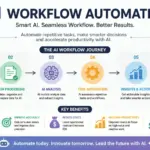

Time is one of the most precious resources in a dynamic working environment. Many professionals spend hours on repetitive tasks, searching for information, managing emails, or switching between apps. AI tools for productivity are where the difference is made. These smart systems aim to automate mundane tasks, speed up idea generation, help in organising information, and free up mental energy for high-value work.
AI tools can save you multiple hours a week while also improving the quality of your output, regardless of whether you are a freelancer, knowledge worker, manager, or business owner. This guide will tell you: What are these tools? Why do they matter? The main categories that, in 2026, will be available. Where you can use them with practical examples. How to choose what best suits your needs. ds and how to effectively use them.
What are AI tools for productivity?
AI tools for productivity are software applications powered by artificial intelligence, specifically large language models and automation, that assist people in performing a task faster and with less effort. Modern AI tools do much more than just organise tasks like the earlier productivity apps — they can draft content, summarise meetings, schedule your day of work, research topics with citations for what it finds, connect different apps to automate workflows — and even execute multistep processes with supervision or queries.
From ChatGPT and Claude for general chat assistants to more specialised tools for calendar management or note-taking, project tracking and automation. Many now seem “agentic”, which is where you take a goal and perform a sequence of actions rather than just respond to one prompt.
Key Benefits of Using AI Tools for Productivity
The advantages go beyond simple speed. Here are the most common gains reported by users and organisations in 2026:
- Significant time savings — many knowledge workers recover several hours per week by letting AI handle drafting, summarising, and routine coordination.
- Reduced context switching — AI can pull information from multiple sources or keep related tasks in one place.
- Higher quality output — better first drafts, clearer summaries, and a consistent tone.
- Better focus — automated scheduling and prioritisation protect deep work time.
- Scalability for teams — shared knowledge bases and automated handoffs reduce bottlenecks.
- Accessibility—free tiers and intuitive interfaces make advanced capabilities available to individuals and small teams.
Adoption has grown rapidly. The majority of organisations have at least one or more business functions using AI within them, and those that deploy AI across a range of different tasks see the greatest productivity benefits.
Main Categories of AI Tools for Productivity
1. General AI Assistants
These are the most versatile starting points.
ChatGPT — Excellent all-rounder for writing, brainstorming, analysis, coding help, and custom workflows. Strong free tier and paid plans with advanced models.
Claude—particularly strong for long documents, careful reasoning, and natural-sounding writing.
Google Gemini — Best when you already work inside Google Workspace (Gmail, Docs, Sheets, Drive).
Microsoft Copilot — Deeply integrated into Word, Excel, PowerPoint, Outlook, and Teams.
Perplexity — Ideal for research because it provides answers with clear citations.
2. Knowledge and Document Tools
Notion AI — Works inside your notes, wikis, and databases. It can summarise pages, generate action items, and answer questions across your workspace.
3. Scheduling and Task Management
Motion and Reclaim.ai — Automatically protect focus time and replan your calendar when meetings shift.
Tools such as Todoist or ClickUp with AI features help prioritise and break down tasks.
4. Meeting and Transcription Assistants
Fireflies.ai, Otter.ai, and similar tools record meetings, generate transcripts, extract action items, and make conversations searchable.
5. Automation Platforms
Zapier, Make, and n8n connect thousands of apps. Newer AI agent features can move information, trigger follow-ups, or complete multi-step processes with less manual setup.
6. Writing and Communication Helpers
Grammarly improves clarity, tone, and correctness.
Specialised tools such as Jasper support brand-consistent content at scale.
7. Presentation and Visual Tools
Gamma and Canva’s AI features turn outlines into polished slides or graphics quickly.
Latest Trends in 2026
There are a number of changes that stick out this season. Enter autonomous agents capable of doing multistep work instead of just chatbots – a place where AI is evolving. Integrations have become deeper — AI is embedded within the tools one already uses instead of constantly switching back and forth. The time savings are quantifiable, with research indicating that regular users see real benefits each week. However, the breadth of use matters: only individuals who manage a number of tasks with AI see larger benefits than those who use it for one or two activities.
Privacy and data control remain important considerations, especially for enterprise teams. Many platforms now offer stronger security features and clearer data-handling policies.
How to Choose and Start Using AI Tools for Productivity
Follow these practical steps:
- Identify your biggest time drains (email, meetings, research, writing, scheduling).
- Start with one or two tools that address those pain points — often a general assistant plus a meeting or scheduling tool.
- Prefer tools that integrate with your existing stack (Microsoft 365, Google Workspace, Notion, etc.).
- Test free tiers thoroughly before upgrading.
- Set clear guidelines: decide what the AI should draft versus what you must review.
- Measure results after two to four weeks — track time saved or output quality.
- Expand gradually. Add automation once the basics feel natural.
Best Practices and Actionable Tips
- Write clear, specific prompts. Context improves results dramatically.
- Always review AI-generated content before sharing or publishing.
- Use AI for first drafts and idea generation, then apply your own judgement and expertise.
- Combine tools thoughtfully rather than collecting dozens of overlapping subscriptions.
- Protect sensitive information — avoid pasting confidential data into public tools unless the platform offers appropriate enterprise controls.
- Treat AI as a collaborator, not a replacement. The best results come from human-AI partnerships.
Real-World Applications
A marketing manager improves campaign messaging with Claude, finds competitor data using Perplexity, keeps a knowledge base up to date with Notion AI, and routes new leads by Zapier automatically. With a meeting assistant, a consultant might log client calls, create summaries, write follow-up emails in ChatGPT or Copilot, and coordinate next actions with an AI calendar tool. Freelancers usually will depend on a general assistant plus the assistance of Grammarly and a basic automation setup so that they can acquire additional clients without working longer hours.
Strong Summary and Recommendation
AI tools for productivity have come a long way from theoretical playthings to useful everyday companions. It helps in providing people with time back by automating their repetitive work and getting them to think through decisions instead (2026). The best way is to pick a narrow set of the very best tools that map simply onto your real workflow — typically a strong general assistant (ChatGPT or Claude), an ecosystem-based tool if you live on Microsoft or Google, a meeting/knowledge tool, and light automation where it adds value.
Start small, measure the impact, and expand only when the value is clear. Used thoughtfully, these tools do not replace human judgement; they amplify it. The professionals and teams seeing the biggest gains are those who treat AI as a reliable partner rather than a magic solution. Choose the tools that fit your work, stay curious about new capabilities, and keep the final decision-making firmly in human hands.