
With the emergence of artificial intelligence, search engine optimisation (SEO) can look very different from what it did before. It shifted from focusing on human-led research and guesswork to relying on smart, data-driven systems that identify patterns, generate insights, and even write fully optimised content at scale. If you are a small business owner, content creator, or expert marketer, AI tools for SEO will help you work smarter so you save time and get better rankings.
In this article, we look at how these work, select the five best tools in 2026, and provide you with some practical integration tips for your strategy.
Understanding AI in SEO
Traditional SEO is all about keywords, backlinks, and technical items. This is further amplified by AI, which processes countless large data points in seconds—identifying trends and predicting future algorithm shifts with high levels of precision for hyper-personalised recommendations. Modern AI tools for SEO don’t just stop at optimising your content to rank; they tackle “Generative Engine Optimisation” (GEO), which allows your content to be pulled in as an answer in search results by an AI-powered tool like Google’s AI Overviews, Perplexity, and ChatGPT.
These tools use machine learning to:
- Analyse search intent more accurately.
- Optimise on-page elements like headings, readability, and semantic relevance.
- Track performance across both traditional search and AI-generated answers.
- Automate repetitive tasks such as keyword research and content briefs.
Key Benefits of Using AI Tools for SEO
Adopting AI doesn’t replace human creativity—it amplifies it. Here are some standout advantages:
- Efficiency and Speed: Generate keyword clusters, content outlines, or full drafts in minutes instead of hours.
- Data-Driven Decisions: Get real-time insights into competitor strategies, backlink opportunities, and ranking factors.
- Improved Content Quality: Tools score content against top-ranking pages and suggest improvements for better user engagement and EEAT (Experience, Expertise, Authoritativeness, Trustworthiness).
- Scalability: Perfect for agencies or large sites managing hundreds of pages.
- Future-Proofing: With AI search engines growing, these tools help maintain visibility in evolving landscapes.
Top AI Tools for SEO in 2026
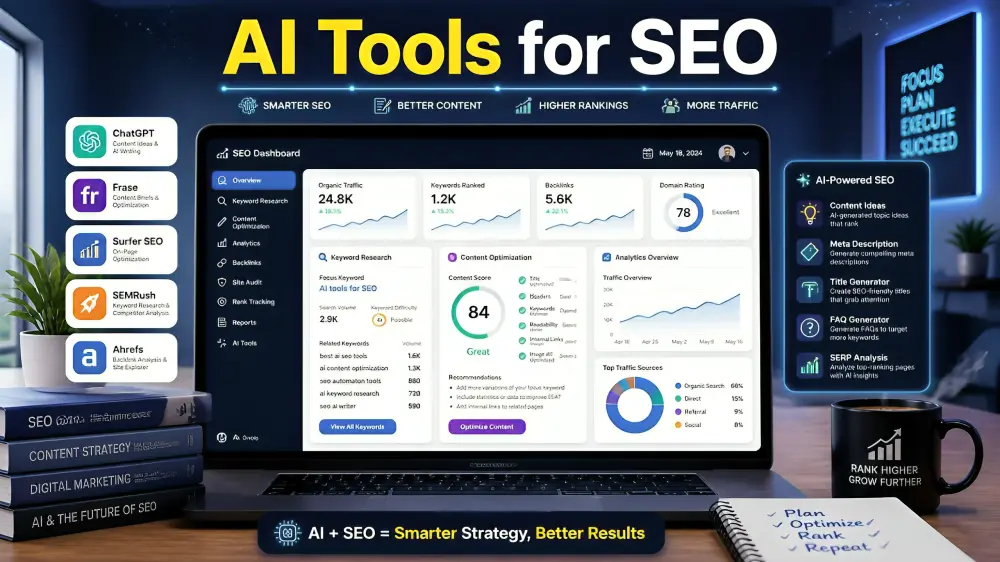
The market offers specialised and all-in-one solutions. Here are some highly regarded options based on recent reviews and testing:
1. Surfer SEO
Surfer excels at on-page optimisation. It does an analysis of SERPs (Search Engine Results Pages) in real time and offers you content scores, keyword suggestions, and structure/length/entities guidelines. It then uses AI to write or polish the articles that best match searchers’ (and algorithms’) needs. Fantastic for bloggers and content teams.
2. Semrush
All-in-one with strong AI integrations. Semrush — AI content brief, keyword magic tools, position tracking, and visibility monitoring in AI-generated search results. Copilot provides tailored recommendations. Ideal for end-to-end SEO management.
3. Ahrefs
Ahrefs is known for analysing backlinks, but it has added more AI features for keyword research, content gap analysis, and competitor insights. It helps in tracking rank changes effectively as well as in identifying high-potential opportunities.
4. Clearscope and Similar Content Optimizers
Clearscope focuses on content optimisation with data-backed guidance on topics, terms, and readability. Tools like it excel at building topical authority and ensuring content performs well in both traditional and generative search.
5. Emerging and Specialized Tools
- Jasper AI or similar writing assistants with SEO modes for fast, optimised content creation.
- SE Ranking for budget-friendly, versatile AI features, including AI overview tracking. Platforms like Ryze AI or AirOps for more autonomous workflows and scaling content operations.
Many of these tools now focus on implementing AI visibility tracking – monitoring how your brand shows up in LLM-powered results.
How to Choose and Integrate AI Tools for SEO
Consider your needs, budget, and team size:
- Beginners: Start with user-friendly options like Surfer or a free trial of Semrush.
- Enterprises: Look for all-in-one suites with robust analytics and team collaboration.
- Budget-Conscious: Explore affordable alternatives with strong core features.
Best Practices:
- Combine tools (e.g., keyword research from Ahrefs + optimisation in Surfer).
- Always review AI-generated content for accuracy, originality, and brand voice.
- Monitor results with analytics and iterate based on performance data.
- Stay up to date on search engine guidelines to avoid overreliance on automation.
Conclusion: Embrace AI for Sustainable SEO Success
AI tools for SEO allow marketers to be confident in customising strategies according to the complexity of algorithms and to keep up with ever-changing user behaviours. They make research easier, improve content quality, and deliver data-driven insights that level the playing ground for big as well as small businesses alike.
The secret sauce for success is to leverage AI as a strategic partner – not as a replacement for considerate and thoughtful strategy or human checks on oversight. Experiment with a few tools right now, track your results, and fine-tune. Intelligence will be the only option that triumphs in the science of search. The future of SEO will be AI-assisted, and it’s an exciting time for those ready to embrace it!
FAQ’s
Q1. Can ChatGPT do SEO?
Ans. Yes, you can use ChatGPT for SEO! It generates content filled with keywords, suggests meta titles/descriptions, outlines strategies, and generates blog ideas. But this is a smart assistant, not a full replacement—real tools and real experience alongside it will be needed to get proper rankings.
Q2. Is AI better than SEO?
Ans. No, AI isn’t better than SEO—they’re powerful allies.
AI accelerates SEO keyword research, content creation, and optimisation. Difference between SEO and SEM: Simple. Utilise AI to enhance SEO, not replace it. Combining both of them brings better rankings and traffic!
Q3. Will SEO be replaced by AI?
Ans. No, AI won’t replace SEO.
AI has the power to assist with keyword research, content ideas and optimisation, but human strategy, creativity and user empathy can never be replaced. The best results will come from using AI tools with sensible human guidance. Embrace AI to work smarter!