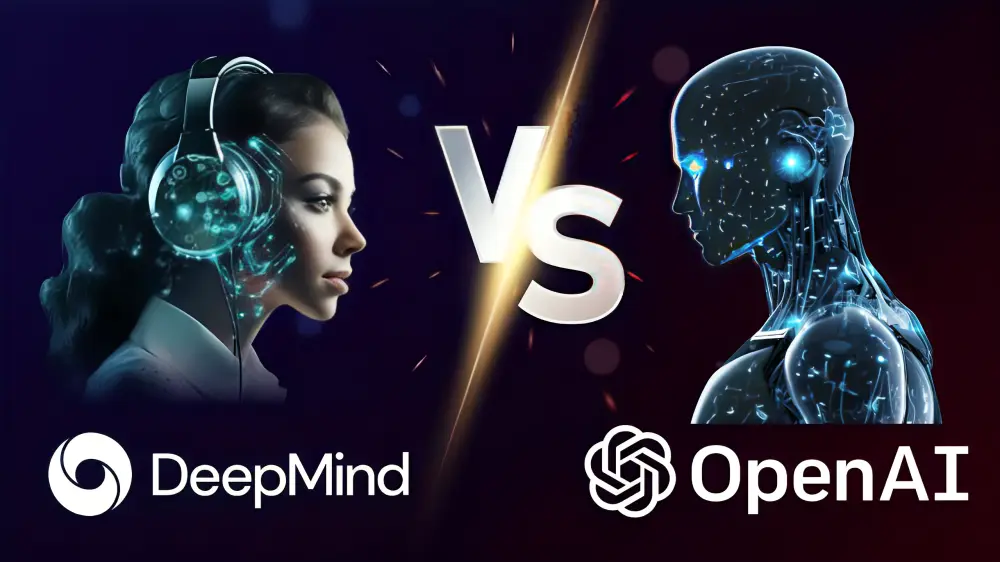

The battle between DeepMind vs OpenAI in the fast-moving area of artificial intelligence. The two are accelerating toward artificial general intelligence (AGI) in vastly different ways — one with a heavy emphasis on scientific research and development, the other on rapid, user-friendly innovation. By March 2026, both labs will be churning out breakthroughs that seem like science fiction. Still, the very different styles of the two make their lab competition endlessly beguiling to anyone interested in where AI is heading.
Origins and Philosophies
DeepMind was established in London in 2010 with an audacious mission: to solve intelligence itself. Purchased by Google (now Alphabet) in 2014, it now serves as a research-first entity dedicated to discoveries with long-term benefits for science and humanity. It’s like the thoughtful academic in the A.I. lab — deliberate, infrastructure-having, and obsessed with effecting change on the ground, rather than spitting out chatbots.
OpenAI was founded as a nonprofit in 2015 but switched to a hybrid for-profit model in 2019. Heavily backed by Microsoft, it is focused on getting powerful AI tools into the hands of as many people as possible, quickly. Think of the high-energy startup founder: streamlining, product-obsessing, and zeroing in on what everyday users and developers will delight over. This philosophical rift — depth versus speed — animates much of the DeepMind vs OpenAI competition today.
Leadership and Structure
DeepMind was founded by Demis Hassabis, a chess prodigy and neuroscientist, whose team relies on the scale of compute, tailored TPUs, and a giant data ecosystem that belongs to Google. The lab combined with Google Brain years ago to create Google DeepMind, giving it an unrivalled scale for scientific work.
OpenAI leaders, including its chief executive, Sam Altman, stress bold commercialisation. The company has created an enormous user base—ChatGPT alone drives workflows for millions of people, apart from large funding rounds (including a recently reported $110 billion valuation milestone) and deals with Microsoft and Amazon.
Flagship AI Models and Breakthroughs
In 2025, both organisations attained extraordinary levels of achievement, including gold medals in the International Mathematical Olympiad (IMO) and the International Collegiate Programming Contest (ICPC). But their 2026 strides showcase distinct strengths.
Google DeepMind shines with the Gemini family:
- Gemini 3 and Gemini 3.1 Pro excel at complex multimodal tasks (text, images, video, audio).
- Gemini 3 Deep Think (upgraded February 2026) powers PhD-level scientific reasoning, math proofs, and engineering challenges—building on its IMO success.
- New tools like Nano Banana 2 deliver lightning-fast image generation, while Veo 3.1 and Lyria 3 handle video and music creation. Legacy wins like AlphaFold continue transforming biology and drug discovery.
OpenAI leads in practical, agentic AI:
- The GPT-5 series, including the March 2026 GPT-5.4 release, features a unified system with smart routing, 1-million-token context windows, and extreme reasoning modes.
- It now surpasses human benchmarks on desktop task simulations (like operating software, spreadsheets, and workflows autonomously).
- GPT-5.3-Codex specialises in coding agents, while ChatGPT reaches hundreds of millions of weekly users with everyday tools for learning, creativity, and business.
Key Differences: Strengths and Approaches
The contrast is clear and exciting:
- Scientific Depth vs. Everyday Utility: DeepMind dominates in specialised breakthroughs (protein folding, advanced math, uncertainty handling via new poker benchmarks). OpenAI wins for broad accessibility—turning AI into a daily coworker that controls your mouse, plans projects, or generates videos.
- Infrastructure and Scale: Google DeepMind leverages Alphabet’s resources for efficiency and integration (think Android, Search, and enterprise tools). OpenAI focuses on developer ecosystems and rapid iteration, recently adding ads to ChatGPT’s free tier.
- Safety and Philosophy: Both prioritise responsible AI, but DeepMind emphasises long-term research safety, while OpenAI balances bold deployment with alignment research.
Neither is “better” — they excel in complementary ways, propelling one another forward.
Head-to-Head: DeepMind vs OpenAI in Action
In direct benchmarks, DeepMind vs OpenAI often results in a photo finish. Both claimed ICPC gold-level coding victories and, IMO, success in 2025, with 2026 upgrades onwards into agentic systems and scientific discovery. OpenAI’s GPT-5. 4 steps further in consumer productivity and autonomous desktop agents, DeepMind’s Gemini Deep Think wins on pure reasoning for research and engineering—and maybe lower inference costs in some cases.
The real winner? Users and society. Developers rave about OpenAI’s ecosystem; scientists laud DeepMind’s tools. And competition fuels faster progress, cheaper costs, and more creative applications across industries.
The Road Ahead: Challenges and Opportunities
The challenges going forward, as we head into 2026, include talent wars (both labs have offered multimillion-dollar packages to expand their capabilities), ethical deployment, and the transition from chatbots to fully agentic AIs that function in the real world. The chief executive of DeepMind himself has even said he’s surprised at OpenAI’s rapid pivot into ads, showcasing a different pace for commercialisation. But both are sprinting toward AGI—OpenAI making small foundational discoveries in 2026, and DeepMind accelerating science via multimodal “world models”.
Summary
DeepMind vs OpenAI are in the ultimate battle, and in turn, they hype each other up—why not? DeepMind has, for decades, had the deepest scientific insights and rock-solid infrastructure, and OpenAI has salt-of-the-earth, slick, game-changing products that millions use every single day. And together they’re not simply contending but reimagining the bounds of what’s achievable, which should mean smarter tools, swifter discoveries, and a brighter future for humankind. For researchers, developers, and curious users alike, this rivalry makes one thing clear — the best AI is still to come. Stay tuned—the next breakthrough could arrive any day.
FAQ’s
Q1. Who is OpenAI’s biggest competitor?
Ans. OpenAI’s largest competitor is Anthropic, which makes Claude—a strong contender in frontier AI modelling, reasoning abilities, and commercial usage that often has OpenAI running alongside or above it in critical benchmarks and safety emphasis. Most of all, Google (Gemini) at heavy scale and integration is close behind.
Q2. Did Elon Musk invest in DeepMind?
Ans. Yes, Elon Musk invested early in DeepMind (before Google bought it in 2014). He did it mostly to keep close watch on AI’s fast advances, motivated by his fears over potential dangers, not necessarily for money.
Q3. Who sold DeepMind to Google?
Ans. Demis Hassabis, Shane Legg, and Mustafa Suleyman founded DeepMind. They sold the company to Google in 2014 for about $500 million. The decision to sell was theirs (and their team’s) alone.
Q4. Is Elon against OpenAI?
Ans. Yes, Elon Musk is strongly against OpenAI. He co-founded it in 2015 but departed in 2018, denouncing its transition to for-profit and its ties to Microsoft. Now, he’s suing them (for billions), calling them untrustworthy and competing through xAI’s Grok.