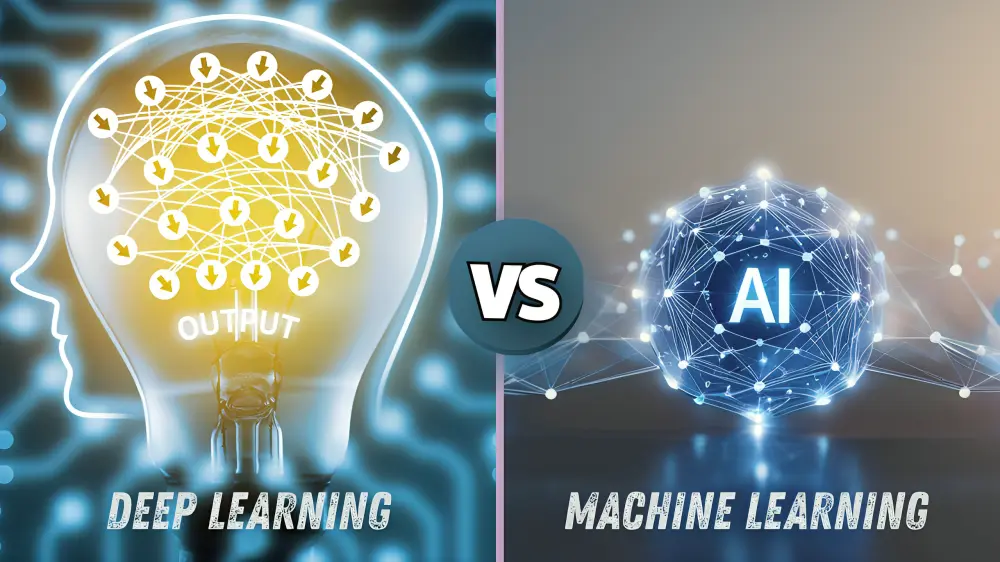

Even in a world driven by artificial intelligence today, the deep learning vs machine learning comparison creates curiosity among learners, professionals, and business owners. Though both are key branches of AI that allow systems to learn from and improve with data, they work quite differently and require different types of data, not to mention how they perform optimally. Even in 2026, these technologies keep evolving at a breathtaking pace, providing the backbone of everything from tailored recommendations to state-of-the-art scientific breakthroughs.
What is deep learning?
Deep learning (DL) is a specialised domain of machine learning employing multilayered artificial neural networks formed on the human brain. These “deep” architectures automatically learn hierarchical features from the raw, unstructured data—images, audio, text, or video—without labour-intensive feature engineering.
Due to their complexity, deep learning models need a lot of data (typically millions of examples) as well as high computational performance that may come from GPUs or specialised hardware like TPUs. They excel at learning complex, nonlinear patterns and have made stunning advances in areas once thought out of reach for machines.
What is machine learning?
Machine learning (ML) is a branch of AI that aims to develop algorithms that can learn from and make predictions based on data. Traditional ML models, like decision trees, random forests, support vector machines, and linear regression, require a lot of feature engineering guided by human experts – the intelligence to manually identify and prepare the most significant variables for prediction from the data.
ML is more suited for structured, small to medium datasets (often hundreds to thousands of examples). It is interpretable, which means people can often tell why a model made a specific decision, an important feature in regulated industries like finance or health care. Training is fast enough, and such training can be run on regular CPUs, so all of this makes it relatively easy in terms of access to computing power for many real-life applications.
Key Differences: Deep Learning vs Machine Learning
The core distinctions make it easier to choose the right approach:
- Data Requirements: Machine learning does better with small, structured datasets. For deep learning to achieve peak and sustained performance, it requires vast amounts of raw/unstructured data.
- Feature Engineering: ML typically requires humans to handcraft features. DL uses a layered architecture, where it can learn representations of the data by itself.
- Interpretability and Transparency: ML models can be explained better. While deep learning models are frequently termed “black boxes” and less interpretable, techniques such as attention mechanisms and explainable AI (XAI) have made strides towards interpretability in 2026.
- Computational Resources: ML is less heavy and faster to train. DL requires time, energy, and powerful hardware; however, efficiency gains (such as optimised transformers and edge ML) are helping it become more accessible.
- Performance on Tasks: For tabular data or simpler predictions, traditional ML algorithms (e.g., gradient boosting machines like XGBoost or CatBoost) often beat or at least match deep learning in benchmarks. Deep learning reigns supreme for perceptual tasks characterised by complexity and scale.
To summarise in very simple terms, deep learning vs machine learning is the trade-off between depth and automation and simplicity versus control.
Real-World Applications
Both are reshaping industries, frequently in concert:
Machine Learning Applications:
- Fraud detection in banking (using ensemble methods to flag suspicious transactions in real time).
- Recommendation systems on platforms like Netflix or Amazon.
- Predictive maintenance for manufacturing equipment.
- Customer churn prediction and credit scoring.
Deep Learning Applications:
- Computer vision in self-driving cars (recognising pedestrians, signs, and obstacles).
- Natural language processing powers chatbots, translation tools, and generative AI like large language models.
- Medical image analysis for detecting diseases from scans with high accuracy.
- Speech recognition in virtual assistants and generative content creation (images, video, music).
“By 2026, trends are likely to combine the two approaches into three classes of operations: agentic AI (autonomous agents), multimodal models (text + image + video), and edge machine learning (running models directly on devices). Conventional ML is still playing a role, and deep learning largely underlies generative AI, which means in business workflows, powerful solutions will emerge as these two continue to converge.
When to choose one over the other
- Choose machine learning when you have limited data, require very high interpretability from the model, need faster deployment, and are working in tabular or structured information
- Use deep learning for complex, unstructured data (e.g., images, text, or audio), achieving state-of-the-art accuracy in perceptual tasks, or developing sophisticated generative or autonomous systems.
- Many real-world projects use a hybrid: traditional ML for baseline models or interpretability and deep learning for heavy-lifting components.
The still-growing strength of AutoML tools and the efficiency with which architectures are implemented are also blurring some lines for even smaller squads as we approach 2026.
Summary
Instead, deep learning vs machine learning is more a comparison of two powerful, yet complementary, AI tools. On one hand, machine learning allows for practical, interpretable solutions that can be implemented with a minimal amount of resources while still providing stellar performance. On the other hand, deep learning provides unparalleled performance for handling complexity or raw data at scale. Together they are powering the innovations that are shaping our future — from everyday recommendations to revolutionary breakthroughs in healthcare, transportation, and much more.” Knowing their strengths enables businesses, developers, and learners to make better decisions and ensures AI provides genuine added value in a responsible, effective manner. It’s about mastering both because the future is for those who do.
FAQ’s
Q1. Is ChatGPT a deep learning model?
Ans. Yes, ChatGPT is indeed a deep learning model. It’s based on GPT (Generative Pre-trained Transformer), a large neural network with billions of parameters that has been trained on tonnes of text data using deep learning techniques. Hence, it learns human-like responses and generates them.
Q2. Is DL harder than ML?
Ans. No, deep learning (DL) is not generally more difficult than machine learning (ML). DL is a specialised subset of ML that involves neural networks. ML, by contrast, has fewer (e.g., decision trees) and less demanding data, computing power, and tuning requirements, while DL is simply built on top of ML fundamentals. Start with ML fundamentals first!
Q3. Is LLM AI, ML or DL?
Ans. An LLM (Large Language Model) is a subtype of deep learning (DL) models. Deep Learning (DL) is a part of machine learning (ML), which is a part of AI. So the LLMs are AI, and they are powered by ML & DL techniques.