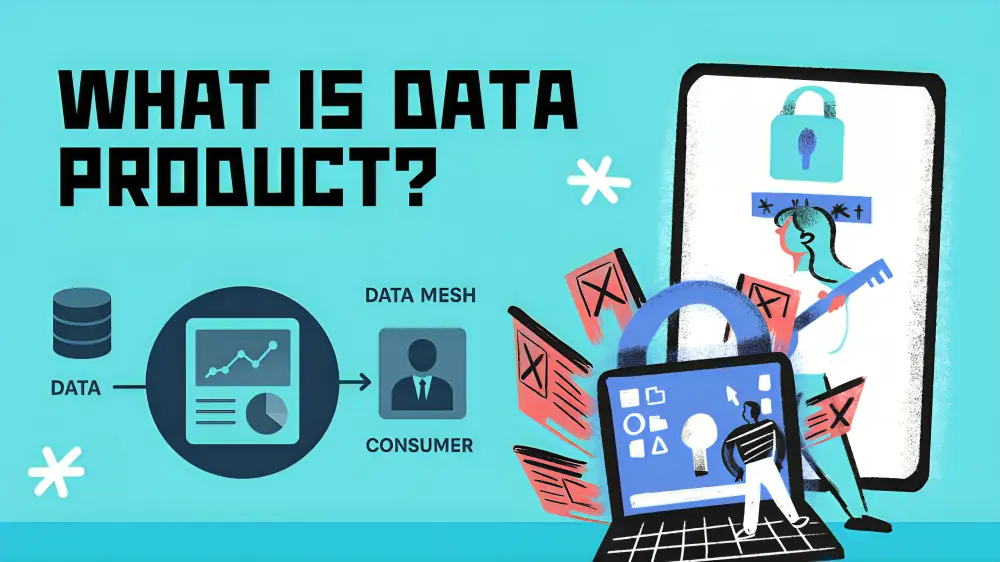

The question, ‘What is a data product?’ is heard more frequently than ever before. In short, a data product is a reusable and trustworthy package of data—along with accompanying metadata, documentation, and quality controls—that’s been prepared for and packaged to solve particular business needs in order to provide actionable value to users, teams, or AI systems. Raw datasets are locked away in warehouses, whereas data products have been designed with the end-user in mind so they can be discovered, trusted, and reused across different scenarios.
Understanding what a data product is has become so important that leaders, analysts, and engineers are shifting more toward treating data as if it were a product rather than a byproduct.
What Exactly Is a Data Product?
A data product is much more than just an Excel spreadsheet or a database table. It is a self-contained, governed asset that includes:
- Curated data — cleaned, enriched, and transformed for reliability.
- Metadata and context — Clear descriptions, lineage, quality metrics, and business definitions.
- Defined interfaces — APIs, dashboards, or queries that make consumption straightforward.
- Governance and SLAs — Ownership, security, compliance, and service-level guarantees.
This ideal is known as a high-quality, consumable dataset — one that multiple teams can access and reuse, avoiding having to reinvent the wheel. (Experts like those at McKinsey have described how.) Others focus on its product-like attributes: discoverable, trust-lined, reusable, and tethered to clear business outcomes.
So what is a data product in practice? It’s data, but it’s treated with the same level of care as any customer-facing product – with owners, roadmaps, user feedback loops, and measurable impact.
Key Characteristics
To stand out from raw data assets, strong data products typically share these traits:
- Discoverable — Easily found via data catalogues with rich search and documentation.
- Trustworthy — Backed by automated quality checks, lineage tracking, and certification.
- Reusable — Built once and applied across reporting, analytics, machine learning, or operational decisions.
- Governed — Compliant with privacy rules, security policies, and business standards.
- User-Centric — Designed for specific consumers (e.g., marketers, data scientists, or executives) with intuitive access methods.
Shifting from messy data lakes to scalable value generation assets through a product mindset — based on data mesh principles and modern data practices — helps teams.
Types and Real-World Examples
Data products come in many forms depending on the use case:
- Analytical — Curated datasets or domain marts for business intelligence (e.g., a unified “Customer 360” view combining demographics, transactions, and support history).
- Operational — Real-time APIs or feeds that power applications (e.g., fraud detection signals in banking).
- AI/ML — Enriched datasets or feature stores that train and serve models (e.g., recommendation engines like those used by Netflix or Amazon).
- Decision Support Products — Dashboards, reports, or predictive tools (e.g., GPS navigation with live route optimisation or revenue forecasting models).
Real-life impact is impressive. One large national bank built a single customer data product that served more than 60 use cases—from credit risk scoring to AI chatbots—resulting in an additional $60 million of annual revenue and avoidance of $40 million in losses. Fast-moving consumer goods companies have launched dozens of data-driven products to drastically increase efficiency and EBITDA.
Why Matter in 2026
Finally, in times ahead, data products will be the foundation of AI initiatives and digital transformation. They connect the dots between data engineering teams and business users, enabling less duplication of effort, greater trust in the insights generated, and faster time-to-insight.
Data-as-a-product organisations experience higher adoption, improved governance, and a clearer ROI on their data investments. As generative AI and agentic systems proliferate, the need for high-calibre, cleanly documented data products has never been greater—they act as compliant, explainable fuel for models.
How to Get Started?
Successful behavioural data products are when product management thinking is applied to the data:
- Start with a clear business problem and defined users.
- Assign ownership (data product owners) responsible for quality, usability, and outcomes.
- Incorporate metadata, SLAs, and feedback mechanisms.
- Use modern tools for catalogues, orchestration, and quality monitoring.
- Measure success through adoption, business impact, and reuse rates rather than just project delivery.
This shift turns data from a cost centre into a strategic asset.
Summary
So, what is a data product? A well-defined, reusable, and governed data product that produces a defined value — similar to any other amazing product out there. It is how organisations set themselves up to drive faster insights, stronger AI capabilities, lower waste, and measurable business outcomes by treating data like a product. The rise of data products: In 2026 and beyond, mastering data products isn’t just an upgrade in how we deliver technical capabilities — it’s a competitive advantage enabling every team to make smarter, faster decisions.
Whether you are building your very first Customer 360 view or extending AI across the enterprise, giving data products to businesses is the best way forward. The future will belong to those who don’t just capture, say, data but productise it.
FAQ’s
Q1. Is an API a data product?
Ans. An API is (not) a data product. An API can be defined as a technical interface that systems use to talk and exchange data. On the other hand, a data product is an entire package (a dashboard, app, or dataset) packaged in a way that it’s usable by end users and provides actionable insights/real value.
Q2. What is a data product in AI?
Ans. An AI data product is an intuitive user-facing application or tool that delivers insights or actions from raw data through the use of AI.
Examples: recommendation systems, fraud detection, or chatbots. It addresses actual challenges by integrating data, AI models, and intuitive interfaces for average users.
Q3. How to identify a data product?
Ans. A data product is a user-facing (app, dashboard, API) solution you build using data to address a problem or provide some value. Check: Does it use data as core input? Is it accessible to end-users? Is it the driving force behind decisions or actions? If yes, it’s a data product.