
In the fast-paced academic world of today, students must contend with pressures from all sides—the heavy course loads and tight deadlines coupled with a deep understanding needed in complex subjects. Luckily, we have artificial intelligence coming to our rescue as a frontrunner. Students who are doing their homework: AI tools for students change the ways we study, research, write and manage time — making education faster and easier to access (and enjoy).
When you use these tools carefully and with critical consciousness, they do not supplant your own work. Whether you are a high school learner who has to write groans of essays or a university scholar finding yourself lost in thesis research, the right AI will not only help you learn better but also give back hours of your life too. Now, let’s take a look at some of those top picks in 2026.
AI Tools for Research and Information Gathering
Students often struggle with the abundance of information available. AI-powered search and summarisation tools excel here.
- Perplexity AI: This tool stands out for research because it provides answers with real-time sources and citations, reducing the risk of hallucinations. Upload documents or ask complex questions—it acts like a smart research assistant that grounds responses in verifiable data.
- NotebookLM (by Google): A favourite for many students, NotebookLM lets you upload lecture notes, PDFs, or articles and generates summaries, study guides, FAQs, and even audio “podcasts” discussing the material. It’s excellent for deep, source-grounded understanding without fluff.
- Elicit or Consensus: Ideal for academic papers, these tools help find relevant studies, summarise findings, and answer research questions based on scholarly sources.
AI Tools for Students (Writing and Editing)
Writing assignments can be stressful, but there are ways you can use AI to brainstorm and draft ethically and polish your work.
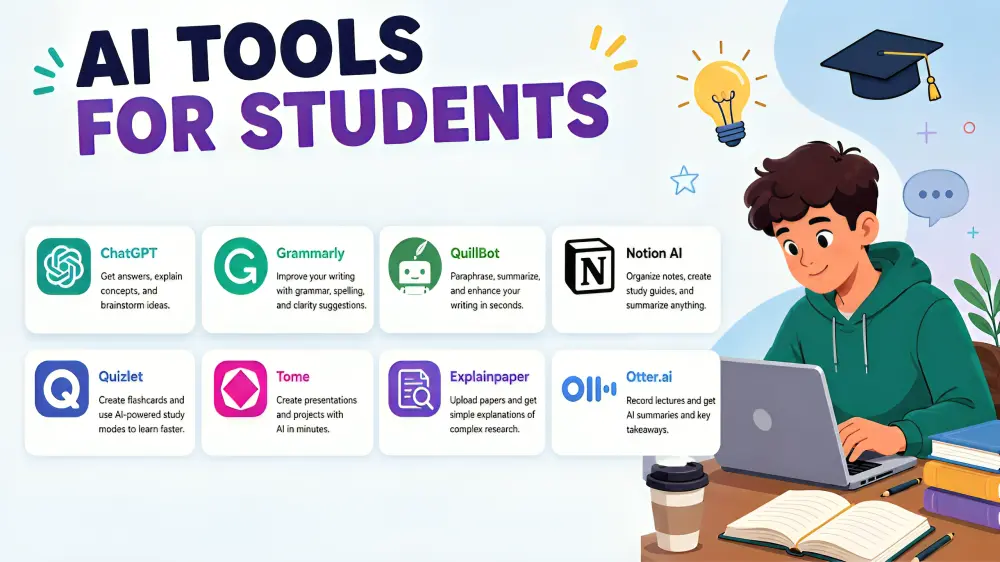
- ChatGPT and Claude: These general-purpose models shine as tutors and writing partners. Use them to explain concepts in simple terms, outline essays, or generate ideas. Claude is often praised for nuanced, thoughtful responses, while ChatGPT offers broad versatility. Always review and cite your use appropriately.
- Grammarly: Beyond basic grammar checks, its AI features now suggest improvements in tone, clarity, and academic style. The premium version integrates deeply with word processors for real-time help.
- Quillbot or Jenni AI: Great for paraphrasing, overcoming writer’s block, or expanding on points while maintaining your voice.
Pro Tip: Treat these as collaborators. Put in your own ideas first, and let AI refine them afterwards to show you have the knowledge.
AI Tools for Note-Taking, Studying, and Productivity
Retention and organisation are key to academic success.
- Otter.ai or Notta: These transcribe lectures in real-time and generate summaries, action items, and searchable notes. Perfect for busy students juggling classes.
- Notion AI: Turns your notes into structured databases, generates study plans, and even creates mind maps or quizzes from your content.
- Knowt or Thea: Flashcard and adaptive learning apps that use AI to create personalized quizzes and track progress. Knowt is a strong free alternative to traditional tools like Quizlet.
Applications like Motion AI assist with scheduling and making a list of what to do first along the course of deadlines and give suggestions for study blocks.
Specialized Tools: Coding, Visuals, and More
- GitHub Copilot or Cursor AI: Essential for computer science students, offering code suggestions and explanations.
- Canva Magic Studio: Quickly creates presentations, infographics, and visuals with AI assistance—no design skills required.
- Google Gemini: Integrated into Google Workspace, it’s handy for students with .edu access, helping inside Docs, Sheets, and more.
Most tools provide free-tier options and premium features for heavier use.
Best Practices for Using AI Tools Ethically
Students should use AI tools as a supplement for learning but not as solutions. Read your institution’s policies on using AI, credit AI help when required, and focus on learning the material. Don’t rely too much on it – that is, it should help you fill in the gaps and speed up your path to mastery.
Keep an eye on the new features that are released every so often—play around in good faith (together with tools as needed) to get started fast (for example, research with Perplexity and summarise it with NotebookLM).
Conclusion: Empowering Your Academic Journey
AI tools for students are not just productivity hacks — they are an evolution to more adaptive, efficient personalized learning. These innovations allow you to study more effectively and with less stress, be it streamlining your research with Perplexity or NotebookLM or polishing your writing with Grammarly and Claude.
The key is to find balance: harness the power of technology, but develop your own talents and imagination. Begin small, test out a few tools that align with your greatest pains, and see your academic game—and confidence—skyrocket. The future of learning is now here; embrace it but be mindful, and you will be prepared to succeed in school and life.