
By 2026, job hunting will be an even more competitive sport. Jobs have hundreds of applications, and most companies use Applicant Tracking Systems (ATS) to screen the candidates before a human reads the file. Even in the AI age, a strong resume is still invaluable to your job-hunting efforts — and with an AI resume builder, you can create one quickly and more efficiently.
These tools leverage AI to write, format, optimise and customise your résumé. They save time, increase keyword matches and create neater documents that perform better with both software and hiring managers when used correctly.
- What is an AI Resume Builder?
- How an AI Resume Builder Works
- Key Benefits of Using an AI Resume Builder
- Essential Features to Look For
- Popular Approaches and Tools in 2026
- Latest Trends in AI Resume Technology
- Step-by-Step Guide to Building a Resume with AI
- Best Practices for Better Results
- Common Mistakes to Avoid
- Final Recommendation
What is an AI Resume Builder?
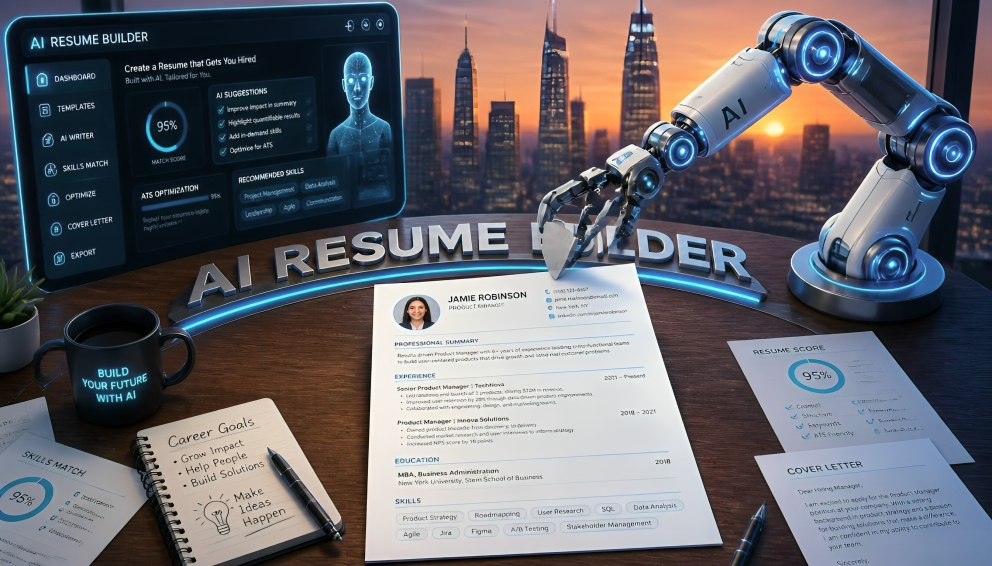
An AI resume builder is an online platform that merges templates, writing help, and optimisation using artificial intelligence. Rather than starting with a blank slate in Word or Google Docs, you enter your experience, skills, and education. It then provides you with professional vocabulary, formats the sections, ensures that your CV is ATS-compliant, and lets you tailor it according to job descriptions.
Unlike template sites of the past, modern AI versions can analyse a job description, suggest keywords to target in your resume, rewrite wordy bullet points for maximum impact, and rate how well your resume matches the role.
How an AI Resume Builder Works
Most tools follow a similar process:
- You create an account and enter basic details or import from LinkedIn.
- The AI generates or improves a professional summary and work experience bullets.
- You paste a job description, and the system highlights missing keywords or skills.
- The platform suggests stronger wording, quantifiable achievements, and cleaner formatting.
- You download a polished PDF or Word file ready for applications.
The top systems provide even more, with real-time ATS scores, job-matching insights (not just resume scoring), and cover letter generation.
Key Benefits of Using an AI Resume Builder
- Speed — Build a solid first draft in minutes instead of hours.
- ATS Optimisation — Clean formatting and keyword alignment help your résumé pass automated screening.
- Tailoring Made Easier — Quickly adapt one master resume for multiple job applications.
- Stronger Writing — AI helps turn vague duties into achievement-focused statements with measurable results.
- Professional Design — Access modern, readable templates without design skills.
- Cost-Effective — Many tools offer useful free tiers or affordable plans compared to professional résumé writers.
Essential Features to Look For
When choosing a tool, prioritise these capabilities:
- Real-time ATS compatibility checks and scoring
- Job description matching and keyword gap analysis
- AI-powered bullet point rewriting that emphasizes results
- Clean, single-column templates that parse well in most systems
- Easy export to PDF and Word formats
- Ability to create and save multiple versions
- Optional job tracking or application management features
Steer clear of tools that utilise lots of glitzy graphs, multi-column layouts, or icons because these are prone to fail in ATS software.
Popular Approaches and Tools in 2026
AI resume platforms generally fall into a few categories:
- ATS-focused tools (such as Rezi or Jobscan) emphasise keyword matching and scoring against specific job postings.
- All-in-one platforms (like Teal) combine resume building with job tracking and match scores.
- Design-orientated builders (Kickresume, Enhancv, and Resume.io) focus on clean templates and strong first drafts.
- Specialised or hybrid options offer deeper tailoring, LinkedIn optimisation, or interview preparation alongside resume features.
Most of these services boost free versions with restricted downloads or features, which makes it easy to try before you buy.
Latest Trends in AI Resume Technology
In 2026, the best tools have reached well beyond basic generation. Instead of including generic templates, they are now focusing on tailoring to suit different types of jobs. Hiring managers have become increasingly adept at identifying content that is entirely produced by AI, and as a result, leading platforms are now focusing on supporting the user to highlight factual achievements with numbers and context.
Other trends are tighter job board integration, resume scoring with live posting matching via browser extension, or being able to maintain a personal voice while increasing clarity. The best systems use AI as a partner in writing instead of replacing the user completely.
Step-by-Step Guide to Building a Resume with AI
- Gather your information — job titles, dates, responsibilities, achievements, skills, and education.
- Choose a reputable AI resume builder and select a simple, professional template.
- Input your details and let the AI generate a first draft of the summary and experience sections.
- Paste a target job description and review the suggested keywords and gaps.
- Edit every AI suggestion carefully. Keep only accurate information and add specific metrics (percentages, dollar amounts, time saved, team size, etc.).
- Run an ATS check if available and adjust formatting or wording as needed.
- Export the file and test it by uploading to a free ATS simulator or reviewing the text version.
- Create tailored versions for different roles rather than sending one generic resume everywhere.
Best Practices for Better Results
Always regard AI output as the initial stage. Hiring managers love good old-fashioned authenticity and direct proof of impact. The AI can help get around writer’s block and improve how things flow, but rewrite it in your own voice.
Quantify results wherever possible. Ditch “managed social media” for “redesigned content strategy that grew Instagram engagement 42% in six months”.
Keep the design simple. Standard section headings and the same formatting across the document make it easier for both software and people to read your CV.
Keep your resume updated and have a master version with all the experiences you might need so that when an opportunity arises, you can easily customise it.
Common Mistakes to Avoid
- Accepting AI text without editing – generic language stands out to experienced recruiters.
- Overloading the resume with keywords – natural integration works better than stuffing it.
- Using complex designs that break ATS parsing.
- Listing only responsibilities instead of achievements.
- Submitting the same resume for every application.
Final Recommendation
An AI resume builder is a viable solution for many job seekers in 2026. Assisted CV writing improves document clarity and focus while saving time, which maximises your chance of clearing the initial screening. The trick is to keep being active: provide accurate data, correct errors, and focus on what has really been accomplished.
Any free or low-cost tool with solid ATS functionality and job-matching abilities. Keep a good master resume and edit it for each application. When paired with real-world experience and professional polish, this approach gives you the edge in even the busiest job markets.
Your resume remains your story. All AI does is help you communicate it better, more clearly.