
Search has changed. Sure, people still type queries into Google, but they also seek direct answers from ChatGPT, Perplexity, Gemini, and Google AI Overviews. Visibility now works through classic rankings and AI-generated responses.
These two are the major dual problems, and the best AI tools for SEO have become a necessity. They speed up keyword research, improve content quality, automate technical fixes, and track mentions using large language models. In this guide to the best AI content generation tools, you will learn what these tools do, the major types available, top options in 2026, how you can use them, and how to choose which ones are right for your needs.
What are AI tools for SEO?
AI tools for SEO use machine learning and natural language processing to analyse search data, competitor pages, and user intent faster than traditional methods. They help with:
- Finding high-opportunity keywords and content gaps
- Creating optimised outlines and drafts
- Scoring content against top-ranking pages
- Running technical audits
- Monitoring brand mentions across AI platforms (often called Generative Engine Optimisation or GEO)
These tools do not replace human strategy. They handle repetitive analysis so marketers can focus on original insights, brand voice, and user experience.
Key Benefits of Using AI in SEO
Teams that adopt AI SEO tools typically see three clear advantages:
- Speed and scale — Research that once took hours can finish in minutes. Content briefs, competitor analysis, and site audits become faster.
- Better decision-making — Tools surface data-driven recommendations based on current SERPs and AI answer patterns instead of guesswork.
- Futureproof visibility—Many platforms now track citations in ChatGPT, Perplexity, Gemini, and Google AI Overviews, helping brands appear in the growing share of AI-powered results.
Real-world application is straightforward. For example, you have a content team that can utilise an AI tool and use it to generate a detailed brief, create a first draft version, optimise the page score, and publish. One team could monitor AI visibility every day and modify pages that are seldom cited.
Main Types of Best AI Tools for SEO
Understanding categories helps you build an effective stack.
Content optimisation tools
These analyse other pages that rank highly and provide real-time feedback on structure, keywords, headings, and semantic terms. Just a few leading examples are Surfer SEO, Clearscope, and Frase. They’re most handy when writing or editing.
All-in-one SEO platforms with AI features
Semrush, Ahrefs & SE Ranking tend to give you a combination of keyword research, site audits, backlink analysis, rank tracking, and some of the latest AI visibility modules. They are ideal for teams desiring most of the functions in one location.
AI visibility and GEO trackers
Profound, Peec AI, and Semrush’s AI Visibility Toolkit are specialised tools that measure how often brands appear in responses generated by artificial intelligence. Following the advent of generative search, this category quickly grew in 2025–2026, with adoption growing among users.
AI writing and research assistants
Claude, ChatGPT, Gemini, and formal copywriters for ideation, outlines, and drafts. Your best results come from humans doing significant editing for accuracy, domain expertise, and brand voice.
Automation and technical tools
Platforms like Alli AI can even push certain on-page fixes live. Some concentrate on crawling, schema, or indexing enhancements that benefit both classic and AI search.
Leading Best AI Tools for SEO in 2026
No single tool wins every use case. Here is a practical overview based on current capabilities and common team needs:
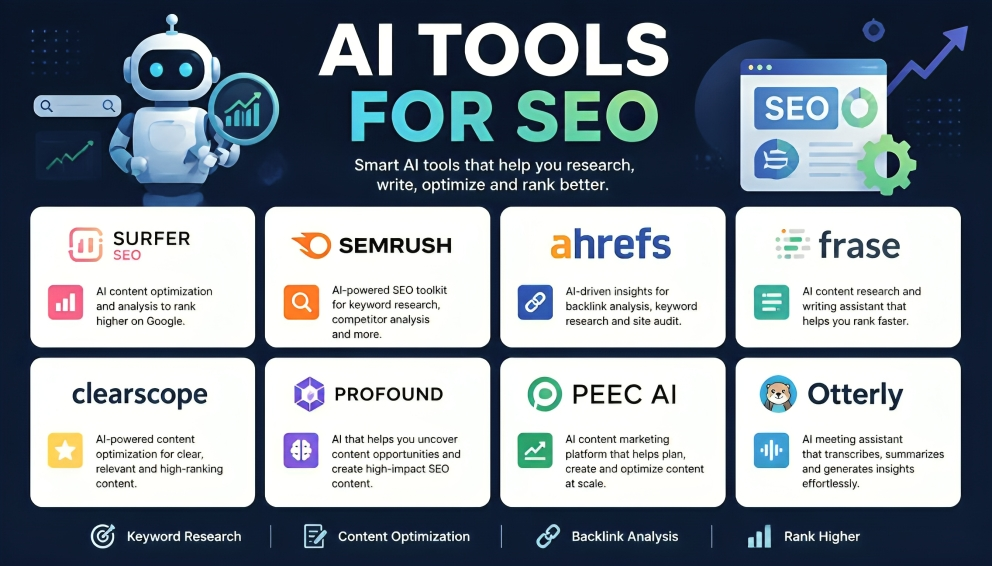
- Surfer SEO — Strong for real-time content scoring and optimisation. Many teams use its Content Editor to match the structure and terms of top-ranking pages while also supporting AI search readiness.
- Semrush — A broad platform with keyword data, audits, competitor insights, and an AI Visibility Toolkit that tracks mentions across major generative engines.
- Ahrefs — Excellent for backlink and keyword data, with growing AI features such as Brand Radar for monitoring visibility in AI results.
- Frase — Popular for fast research, content briefs, and combined SEO + GEO scoring at a more accessible price point.
- Clearscope — Favoured by editorial teams that want clean, writer-friendly grading and high-quality recommendations.
- Specialised GEO trackers (Profound, Peec AI, Otterly) — Useful when the main goal is measuring and improving citations inside AI answers.
Prices vary. Most often, entry-level content tools start at around $49–$99 a month and go up from there for full suites and truly enterprise GEO platforms. Many have trials for you to test fit.
Latest Trends Shaping AI SEO in 2026
Several shifts stand out:
- Generative Engine Optimisation (GEO) is now a core discipline alongside traditional SEO. Brands track not only rankings but also how often their content is cited by AI systems.
- Quality and expertise matter more than volume. Search systems and AI models favour accurate, original, experience-backed content.
- AI agents are beginning to handle multistep workflows — research, brief creation, and even some technical recommendations — with human oversight.
- Structured data, clear answers, and strong topical authority help pages perform in both Google and AI overviews.
These trends favor teams who have decent fundamentals and intelligently use the tools, as opposed to relying only on automation.
How to choose and use AI tools effectively
Follow these practical steps:
- Define your main goal — content production, technical health, AI visibility, or full-funnel reporting? Match the tool category to that goal.
- Start small — pick one or two tools that solve your biggest bottleneck. Test with real pages or keywords.
- Combine human judgement with AI output — use AI for research and first drafts, then add original insights, examples, and fact-checking. This supports EEAT signals.
- Integrate into your workflow — Connect tools to Google Search Console, your CMS, or writing platforms where possible.
- Measure results — Track organic traffic, rankings, engagement metrics, and AI citation frequency. Adjust based on data.
- Stay current — Free tiers and features change often. Review your stack every few months.
Many teams’ starting stack is as simple as a content optimiser (e.g., Surfer or Frase) plus an all-in-one platform with AI visibility tracking. So solo creators might start with an amazing writing assistant and a budget content tool.
Best Practices for Better Results
- Prioritise user intent and helpfulness over keyword density.
- Create clear, structured content with headings, lists, and direct answers that AI systems can easily extract.
- Build topical authority by covering related subtopics thoroughly rather than publishing isolated articles.
- Keep technical foundations strong — fast-loading, mobile-friendly pages, and accurate schema still matter.
- Regularly audit for outdated information so both search engines and AI models treat your content as reliable.
- Treat AI suggestions as starting points, not final answers. Add real experience and unique perspectives.
Strong Summary and Recommendation
The best AI tools for SEO now make up the rough toolkit for today: SEO experts on how you know how to achieve results. They boost research, relevance of content, technical well-being, and brand presence in AI-generated replies. The best way to do this in 2026 is to combine established platforms like Surfer SEO, Semrush, Ahrefs, or Frase with appropriate human monitoring, as well as a strategy around quality and user value.
First, clarify your main purpose — content optimisation, competitive data, or AI visibility tracking — and then use the trial of one or two tools to experiment. Track impact in terms of rankings, traffic, and citations. These tools — when used wisely — free up time for higher-value work and improve your content across traditional search results as well as growing areas such as generative answers. The teams that pair intelligent technology with real expertise will continue to attract the highest levels of visibility.