
In 2026, running a business means splitting time between product development, marketing, sales, customer support, and operations—all with a limited team or even as a solopreneur. With the right technology, you can turn that chaos into focused progress. AI tools for entrepreneurs have become an essential partner in productivity, handling repetitive work, generating ideas, interpreting data, and saving huge chunks of time so you can focus on high-value decisions.
This document contains a brief overview of these tools (what they are), their significance, the main categories, actionable recommendations, how to get started with them, and recent trends. This entire thing is based on actual adoption patterns & the tools founders are using in 2026.
- What are AI tools for entrepreneurs?
- Why Entrepreneurs Need AI Tools in 2026
- Main Categories of AI Tools for Entrepreneurs
- Practical Recommendations: Useful AI Tools in 2026
- How to Choose and Start Using AI Tools
- Best Practices and Common Mistakes to Avoid
- Current Trends Shaping AI for Entrepreneurs
What are AI tools for entrepreneurs?
AI tools for entrepreneurs are software applications that automate tasks, generate content, analyse information, or assist with decision-making and are powered by artificial intelligence. Since these tools aren’t hard-coded software applications with fixed rules, they learn patterns and can interpret the natural language voice prompts that you choose to speak in.
These can be general assistants that respond to queries and write documents, all the way to specialised tools focusing on design, code, customer chat or workflow automation. Most now have agentic capabilities: AI that can perform multi-step actions across apps with little human guidance.
Entrepreneurs at every stage use them – validating ideas, building products, attracting customers, and managing daily operations.
Why Entrepreneurs Need AI Tools in 2026
Adoption has transitioned from experimentation to business as usual. According to new data, approximately 77% of small and midsize businesses (SMBs) in the United States regularly use AI. The majority report tangible benefits such as increased employee productivity levels, improved customer experiences, and a clearer line of sight into financial performance. Firms that save substantial hours every week with AI are a much bigger bet for revenue growth.
Key benefits include:
- Time savings — Draft emails, summarise meetings, or research competitors in minutes instead of hours.
- Cost efficiency — Reduce the need for additional hires or freelancers for routine work.
- Faster execution — Launch marketing campaigns, prototypes, or support systems more quickly.
- Better decisions — Pull insights from data, market trends, and customer feedback with greater speed and clarity.
- Levelling the playing field—Solopreneurs and small teams can compete with larger organizations on content, design, and responsiveness.
The real key advantage is when tools slot seamlessly into current workflows instead of creating additional layers of complexity.
Main Categories of AI Tools for Entrepreneurs
Here is how the landscape breaks down by the jobs entrepreneurs actually need done.
General AI Assistants and Research
These serve as thinking partners for brainstorming, writing, analysis, and strategy.
Popular options: ChatGPT, Claude, Gemini, and Perplexity (especially strong for cited research).
Content and Marketing
Tools that create or optimise written and visual assets.
Examples: Jasper for on-brand marketing copy, Canva Magic Studio for graphics and social posts, and specialised SEO helpers.
Design, Video, and Audio
Generate visuals, short videos, or voiceovers without specialised skills.
Notable tools: Canva, Adobe Firefly, Midjourney, Runway or similar video generators, and ElevenLabs for natural-sounding voice.
Building and Coding
No-code or AI-assisted development platforms that turn ideas into working products faster.
Key players: Bubble or Lovable for prompt-to-app building, Cursor for AI-native coding, and tools like v0 for UI components.
Automation and Operations
Connect apps and handle repetitive processes.
Leaders: Zapier or Make for workflows, Notion AI for internal knowledge and docs, and meeting tools such as Fireflies or Fathom for notes and action items.
Sales, CRM, and Customer Support
Manage leads, personalise outreach, and handle enquiries.
Examples: HubSpot AI features, specialised AI CRMs for solopreneurs, and chatbots or virtual receptionists like Tidio.
Practical Recommendations: Useful AI Tools in 2026
No single stack fits everyone, but these tools consistently deliver value for founders and small teams:
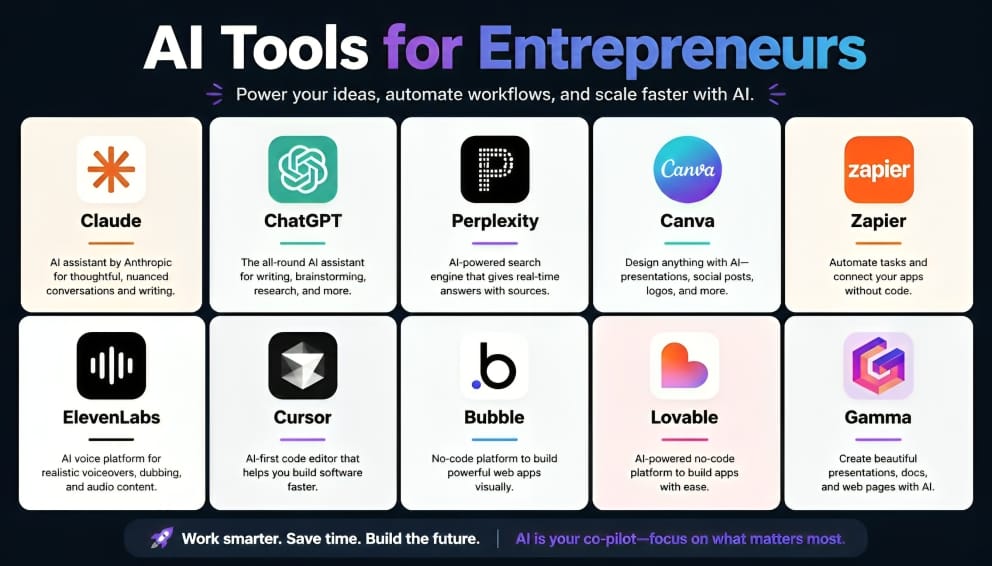
- Claude or ChatGPT — Daily workhorse for writing, strategy, research, and problem-solving. Start here if you pick only one.
- Perplexity — Reliable research with sources; useful for market analysis and competitive intelligence.
- Canva (with AI features) — Quick, professional designs for social media, presentations, and marketing materials.
- Cursor—Especially valuable for technical founders who want faster coding and iteration.
- Zapier or similar automation platforms — Glue that connects your other tools so data moves without manual effort.
- Gamma or similar — Fast, polished pitch decks and presentations.
- ElevenLabs — High-quality voice for videos, podcasts, or product demos.
- No-code builders (Bubble, Lovable, or equivalents) — Turn ideas into functional apps or landing pages without a full development team.
Most will give you a free tier or low-cost entry point to try things out before you invest. Individual pro plans typically start at around $15–25 per month.
How to Choose and Start Using AI Tools
Follow these steps for a practical rollout:
- Identify your biggest bottleneck — is it content creation, research, customer replies, or building the product? Start with one high-impact area.
- Match tools to the job — choose based on the specific outcome you need rather than the most hyped name.
- Test with real work — Spend a week using free versions on actual tasks. Measure time saved and quality of output.
- Integrate carefully — Connect tools through automation platforms so they work together instead of creating new silos.
- Add human oversight — review AI-generated content, especially for brand voice, accuracy, and legal or sensitive topics.
- Track results — Note hours saved, content produced, or leads generated. Expand only when the return is clear.
- Scale gradually — Add specialised tools as your business grows rather than adopting everything at once.
A basic starter stack will cost you less than $50–70 per month and consists of writing, design, research, and simple automation for most solopreneurs.
Best Practices and Common Mistakes to Avoid
Successful entrepreneurs treat AI as a capable assistant, not a full replacement for judgement. Feed tools clear context and examples of your preferred style. Keep sensitive data private and review terms of service around training and ownership.
Common pitfalls include:
- Collecting too many overlapping tools and creating subscription clutter.
- Accepting outputs without editing or fact-checking.
- Expecting perfect results on the first try without refining prompts.
- Ignoring integration, so information stays trapped in separate apps.
Do a few things each day, consistently with a few strong tools, rather than do many things occasionally with many.
Current Trends Shaping AI for Entrepreneurs
Here, we highlight various changes in 2026. Such agentic systems that are capable of performing multi-step tasks (research + draft + schedule) are more feasible. No-code and low-code continue to transform the barrier to constructing software. Gradually, tools are embedded within existing software, such as Google Workspace, Microsoft 365, or various CRMs, instead of sitting in isolation as separate destinations.
Tools for solopreneurs that are all-in-one bins of CRM, invoicing, and AI assistance are also on the rise as well. In that way, the focus has shifted from a response to “What can be generated by AI?” to “How do I trust AI with elements of my business?”
Final Takeaways and Recommendation
I believe AI tools for entrepreneurs provide leverage to small teams and solo founders that were previously only available to large organizations. Max returns come from seizing tools that target real pain points, building those tools into your daily workflows, and quality/strategy always being upheld through a human lever to help ease automation ever so slightly.
The simplest way to start off is, take one solid general assistant like Claude or ChatGPT, pair it with a design tool like Canva, and hook them up via very basic automation. Time and results will tell you how much to scale, slowly. Fast forward to 2026, and the entrepreneurs who are treating AI as a practical productivity partner—and not a magic solution—are slowly pulling ahead.
Begin with the area that currently consumes most of your time or energy. The right tool, consistently applied, can free up hours every week and help you hone in on the work only you are capable of doing.