
Marketing has changed dramatically. Tasks that would take many individuals days or weeks to pull off can now happen in minutes with the right help. AI tools for marketers are used to produce content, analyse data, customise campaigns, and optimise ads and customer relationships more than ever.
In 2026, the vast majority of marketers are already on board with generative AI in at least one aspect of their work. Recent surveys indicate adoption rates are somewhere between 75% and 87% in the industry. The successful teams and those that fail — it often just comes down to platform selection and using these tools with strategy and gut feel.
This guide covers what these tools are, their importance, and the main categories you can find today. Practical examples, use cases, trends, and how to make better use of them starting now!
What are AI tools for marketers?
AI tools for marketers are software applications that leverage artificial intelligence—generative AI, machine learning, and automation in particular—to do marketing tasks for marketers. They can write copy, create images and videos, suggest keywords, score leads, personalise emails, optimise ad spend, and extract insights from vast amounts of data.
These include open-ended assistant-like tools (ChatGPT, Claude) and bespoke verticals specialised for SEO, ad creative, email flows, and social publishing. The top ones are the computer analogue to a force multiplier: They do the busy work, or take care of repetitive or time-consuming tasks, giving marketers space to strategise as well as connect with stakeholders and customers.
Key Benefits of Using AI Tools for Marketers
Marketers who adopt AI thoughtfully typically see clear gains:
- Faster content production without sacrificing quality when human editing is applied
- Better personalisation at scale based on customer data and behaviour
- Improved campaign performance through smarter bidding, creative testing, and targeting
- Time savings on research, reporting, and routine tasks
- Stronger data-driven decisions instead of relying only on gut feel
- Ability for smaller teams to compete with larger ones
In practice, results vary, but most teams seem to report 30-60% faster content workflows and (when proper strategy is paired with AI) measurable increases in engagement or conversion.
Main Categories of AI Tools for Marketers
Here is a practical breakdown of the most useful categories in 2026:
1. General AI Assistants and Research Tools
These handle brainstorming, drafting, analysis, and research.
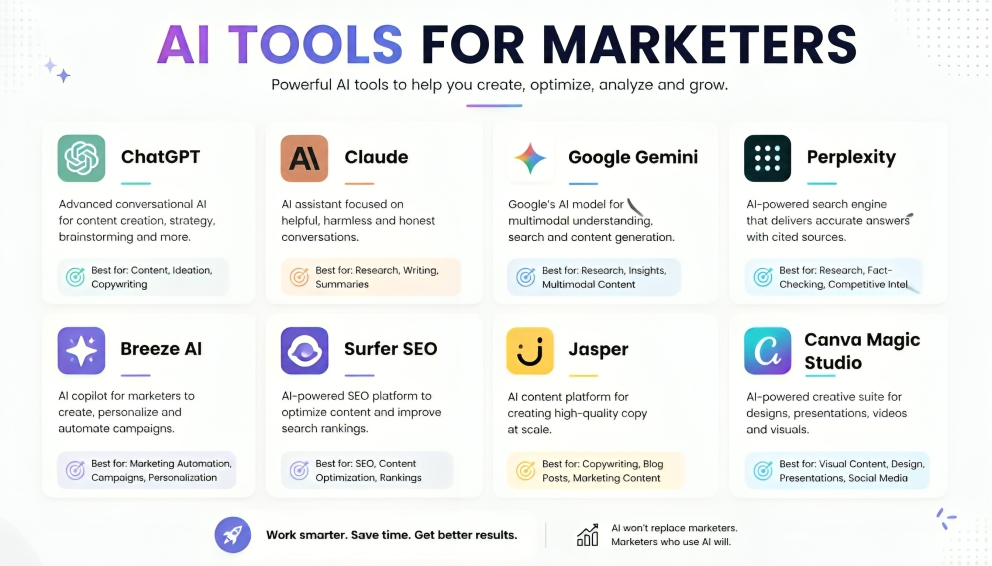
Popular options: ChatGPT, Claude, Google Gemini, and Perplexity. Claude is often noted for long-form, in-depth writing and matching the tone of a brand voice. Perplexity is very good at sourcing research with citations.
2. Content Creation and Copywriting Platforms
Specialised tools for marketing copy, blog posts, emails, and ads with brand voice controls.
Examples: Jasper (strong for campaign content and brand consistency) and similar writing platforms. Most teams are still reliant on these general assistants above, layering in specialist tools only as necessary.
3. SEO and Generative Engine Optimisation (GEO) Tools
These help content rank in traditional search and appear in AI-generated answers (Google AI Overviews, ChatGPT responses, Perplexity, etc.).
Leading options: Surfer SEO for content scoring (in real-time), Semrush for visibility tracking more broadly, including AI responses, then Clearscope and MarketMuse. GEO has become part of the tradition of classic SEO.
4. Design, Image, and Video Tools
Quick creation of visuals and short videos for social, ads, and websites.
Canva Magic Studio is still the most used by all teams. Illustration: For more daring or professional creative work, it is backed by Adobe Firefly, Midjourney, Runway, and Google Veo. Avatar and talking-head tools like HeyGen: primarily for explainers or product demos.
5. Social Media and Community Tools
Scheduling, caption generation, listening, and performance insights.
Buffer, Hootsuite, Sprout Social, and FeedHive all incorporate AI features for drafting, repurposing, and analytics.
6. Email, CRM, and Lifecycle Marketing
Personalisation, send-time optimisation, predictive scoring, and automation. HubSpot (Breeze AI) — deeply embeds AI across CRM and marketing workflows. Feb 12, 2023 | Ken Burbary. Klaviyo — Best for e-commerce email and SMS. Platforms like ActiveCampaign and Mailchimp also offer AI features.
7. Paid Advertising and Creative Optimisation
Tools that generate ad variations, predict performance, and automate bidding.
AdCreative.ai, platform-native AI (Google Performance Max and AI Max features, Meta Advantage+), and specialised optimisers help reduce wasted spend and speed up creative testing.
8. Analytics, Attribution, and Automation
Insight generation, reporting, and connecting tools.
Zapier and similar automation platforms connect AI tools into larger workflows. Advanced analytics and attribution platforms give teams insight into what really produces results.
Latest Trends Shaping AI Tools for Marketers in 2026
Several shifts stand out this year:
- From assistants to agents — tools are moving beyond simple prompts toward more autonomous systems that can plan and execute multi-step tasks with oversight.
- GEO alongside SEO — Optimising content so it gets cited or summarised by AI search engines is now a core activity.
- Hyper-personalisation at scale — AI uses first-party data to tailor messages, offers, and experiences more precisely.
- Integrated platform AI — Major platforms (HubSpot, Google, Meta, and Adobe) continue embedding AI directly into the tools marketers already use.
- Focus on governance and brand voice — Teams are putting more effort into guidelines, review processes, and training so AI output stays on-brand and accurate.
- Measurement maturity—More marketers are working to connect AI use to clear ROI rather than just time savings.
Best Practices and How to Get Started
Follow these practical steps to adopt AI effectively:
- Identify your biggest bottlenecks — content volume? Reporting? Ad creative testing? Research? Start where the pain is highest.
- Begin with one or two core tools—most teams do well with a strong general assistant (Claude or ChatGPT) plus one specialised tool for their main channel (for example, Surfer for content or Canva for design).
- Define brand voice and guidelines — feed examples of your best writing and create clear rules so AI stays consistent.
- Always keep a human in the loop — use AI for first drafts, ideas, and analysis. Edit for accuracy, tone, originality, and strategic fit.
- Measure what matters — track time saved, content quality scores, engagement, conversions, and overall campaign ROI.
- Train the team and set governance—provide simple prompt libraries, review checklists, and clarity on when AI can be used autonomously versus when human approval is required.
- Iterate and expand—once the first use cases work well, add tools for other parts of the funnel.
Common Challenges and How to Handle Them
AI is powerful but not perfect. Watch for:
- Generic or off-brand output → Solve with better prompts, brand guidelines, and editing
- Inaccurate information or hallucinations → Verify facts and prefer tools with strong sourcing
- Data privacy and compliance → Choose reputable platforms and follow your company’s policies
- Over-reliance that reduces original thinking → Treat AI as a collaborator, not a replacement for strategy and creativity
- Tool sprawl → Prefer tools that integrate well and limit the stack to what the team will actually use
Final Recommendation
AI tools for marketers work best when they are oriented toward goals, not as a goal unto themselves. Keep it simple: Focus on a single high-impact use case, select a stable tool, apply human judgement, and measure the results. Expand from there.
Winners in 2026 are not the teams with the most tools. They are the teams that fuse the speed and scale of AI to human intuition, brand continuity, and customer obsession. Start by solving high-effort bottlenecks and processes while keeping quality high, so technology can amplify the magic only humans can do best.