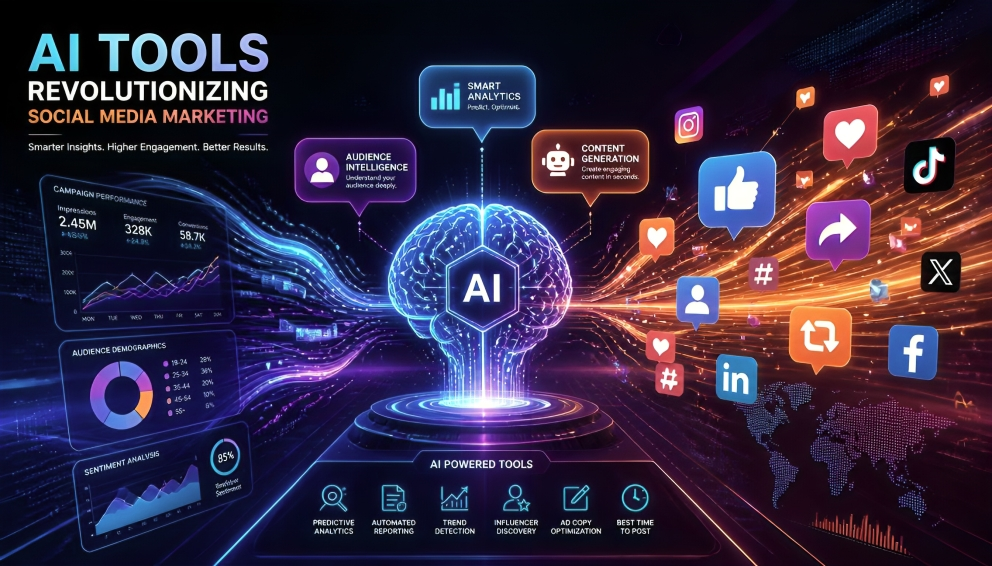

Social media marketing is faster than ever. Brands require content creation at a consistent pace, timely responses, and clear insights deployed on platforms such as Instagram, TikTok, LinkedIn, X, and Facebook. We can access all of this, but it takes a huge amount of time if we do this manually. This is the very reason why AI tools for social media marketing are used by most marketers these days to deal with monotony while human creativity stays in control!
These tools will allow you to create affordable captions, design them into visuals or short videos for social media, and schedule posts, as well as performance metrics and response automation with insights. Adoption is also soaring in 2026—approximately 95% of social media professionals are deploying AI, with most saving multiple hours each week. Having the right tools does not replace strategy or brand voice. They just speed up and prime the execution.
What are AI tools for social media marketing?
Powered by machine learning, natural language processing, and generative models, AI tools for social media marketing are used in content creation, scheduling, audience analysis, and engagement.
Others are narrowly designed, such as those that write captions for videos or transform long videos into bite-sized clips. Some serve as end-to-end tools that encompass planning, publishing, and reporting aspects. Modern versions go beyond that, also internalising your brand voice, recommending ideal posting times based on empirical evidence, and helping to identify trending topics.
Common capabilities include:
- Generating platform-specific captions and hashtags
- Creating or editing images and short videos
- Scheduling and auto-publishing posts
- Analysing engagement and sentiment
- Suggesting content ideas or repurposing existing material
Key Benefits of Using AI Tools
Here are three big benefits for marketers who jump on these tools.
Time savings
Activities that took 30–45 minutes per post will often fall to a few minutes. Teams win back hours every week for strategy and creative work.
Better consistency
AI aids in executing consistent posting at all times across channels while maintaining on-brand messaging.
Data-driven decisions
Advanced tools bring to light performance patterns, audiences’ feelings, and the best time of day to post that would be difficult for humans to pick up on.
AI-assisted posts tend to have higher engagement rates than totally manual ones, especially if the AI output is still reviewed and tweaked by a human team before publishing.
Main Types of AI Tools for Social Media Marketing
1. Content Creation Tools
These generate text, images, or video.
- General assistants such as ChatGPT, Claude, or Gemini excel at drafting captions, hooks, and content calendars.
- Design platforms like Canva Magic Studio create graphics, carousels, and simple videos from text prompts.
- Specialised tools such as OpusClip turn long videos into short, platform-ready clips with virality scoring.
- Avatar and UGC-style tools (for example, HeyGen) produce talking-head videos without a camera crew.
2. Scheduling and Management Platforms
These combine AI writing with publishing.
- Buffer offers an AI assistant for captions and repurposing on an affordable or free plan.
- Hootsuite includes OwlyWriter AI plus best-time scheduling and multi-account management.
- Metricool provides unlimited AI features on many plans and strong analytics.
- Sprout Social focuses on deeper listening, sentiment analysis, and team collaboration for larger brands.
3. Analytics and Listening Tools
These monitor conversations and performance.
- Platforms like Sprout Social and Brandwatch track mentions, sentiment, and emerging trends in real time.
- Many all-in-one tools now include AI-powered reports that highlight what content works and why.
4. Engagement and Automation Tools
Chatbots and reply assistants (ManyChat, native platform AI features, or tool-specific agents) handle routine comments and DMs while flagging important conversations for humans.
Latest Trends in 2026
Several shifts define the current landscape:
- AI agents that can draft, schedule, and sometimes publish with less manual input (often via connectors such as MCP).
- Stronger focus on brand voice training so generated content sounds consistent.
- Rapid growth in short-form video generation and automatic clip creation.
- Greater use of social listening and predictive insights rather than simple reporting.
- Continued emphasis on authenticity—audiences notice and reward human oversight.
Platforms have included native AI features, like auto-generated drafts of Reels or prompt suggestions for comment replies, making it even easier.
How to Choose and Use AI Tools Effectively
Follow these practical steps:
- Define your main need — is it caption writing, video clips, multi-platform scheduling, or deep analytics? Start with one or two tools that solve your biggest bottleneck.
- Test free or trial versions — Buffer, Canva, Metricool, and many others offer usable free tiers or trials. Generate sample content and check quality against your brand standards.
- Train the tool on your voice — upload past posts, brand guidelines, or style examples. Review and edit every piece of AI output before publishing.
- Combine tools smartly — use a general AI for ideation, Canva or a video tool for visuals, and a scheduler for publishing. Avoid tool overload.
- Measure results — Track time saved, engagement rates, and reach. Adjust prompts and workflows based on what performs best.
- Keep humans in the loop — Final approval, community replies that need empathy, and strategic decisions should stay with people.
Best Practices for Strong Results
- Write clear, detailed prompts that include audience, tone, platform, and goal.
- Always fact-check and personalise AI-generated content.
- Prioritise short-form video and authentic storytelling.
- Use AI insights for timing and topic selection, not just content production.
- Stay transparent with your audience when appropriate and respect platform rules around AI-generated media.
- Review privacy settings and data policies of every tool you connect to your accounts.
Strong Summary and Recommendation
From optional social marketing experiments to daily essentials, AI tools liberate marketers from mundane tasks and increase consistency while also surfacing useful insights—as long as they are treated as assistants rather than substitutes for humans.
For 2026, be choosy — find the right tools for your team and objectives (Buffer or Metricool for smaller teams, Hootsuite or Sprout Social for larger ones, and individual creators like Canva and OpusClip), teach them about your brand, but maintain human control over final outputs. Begin with small, measurable results and grow only what adds clear value.
The winning brands will be those that see AI as a collaborative co-pilot. They create more relevant content in a shorter time window, respond quicker, and still sound human. Pick a single high-impact tool this week, iterate it, and you’ll see the difference in both effectiveness and productivity very quickly.