
In India, being a chartered accountant is a highly regarded career path. If you’re thinking about how to become CA, this guide breaks down each step for you – starting with eligibility and registration, moving through exams and practical training, and ending with final membership.
Though the journey is challenging, it’s organised and accessible to students from any background after Class 12. With the latest ICAI New Scheme of Education and Training (rolled out in 2023 and continuing through 2026), the process is now simpler, featuring a two-year articleship and targeted exam phases.
What is a chartered accountant?
A Chartered Accountant (CA) is an expert in finance and accounting and belongs to the Institute of Chartered Accountants of India (ICAI). CAs take care of tasks like audits, taxes, financial reports, advising businesses, and ensuring rules are followed for various organizations and people.
In India, you can only call yourself a “CA” if you pass ICAI’s tough exams and complete hands-on training. The Chartered Accountants Act oversees this profession, which demands strong responsibility and ethics.
Why Pursue the CA Qualification?
The CA course offers strong career rewards:
- High demand across industries, firms, and startups
- Excellent starting salaries (often ₹6–12 lakh per annum for freshers, higher in metro cities or Big 4 firms)
- Opportunities in audit, tax, consultancy, corporate finance, and entrepreneurship
- Global recognition and the ability to practise independently
- Continuous professional development, including emerging areas like AI, data analytics, ESG, and forensic accounting
ICAI keeps refreshing its curriculum to ensure that future CAs remain important in a tech-focused world.
Eligibility Criteria
There are two main entry routes:
1. Foundation Route (after Class 12)
- Pass Class 10 (provisional registration possible)
- Appear in or pass Class 12 from a recognised board (any stream — Commerce, Science, or Arts)
- No minimum percentage required for foundation registration
2. Direct Entry Route (after graduation)
- Commerce graduates or postgraduates with at least 55% marks
- Non-commerce graduates or postgraduates with at least 60% marks
- Candidates who have passed the intermediate level of ICSI (CS) or ICMAI (CMA)
Direct entry students skip the Foundation exam and register directly for Intermediate.
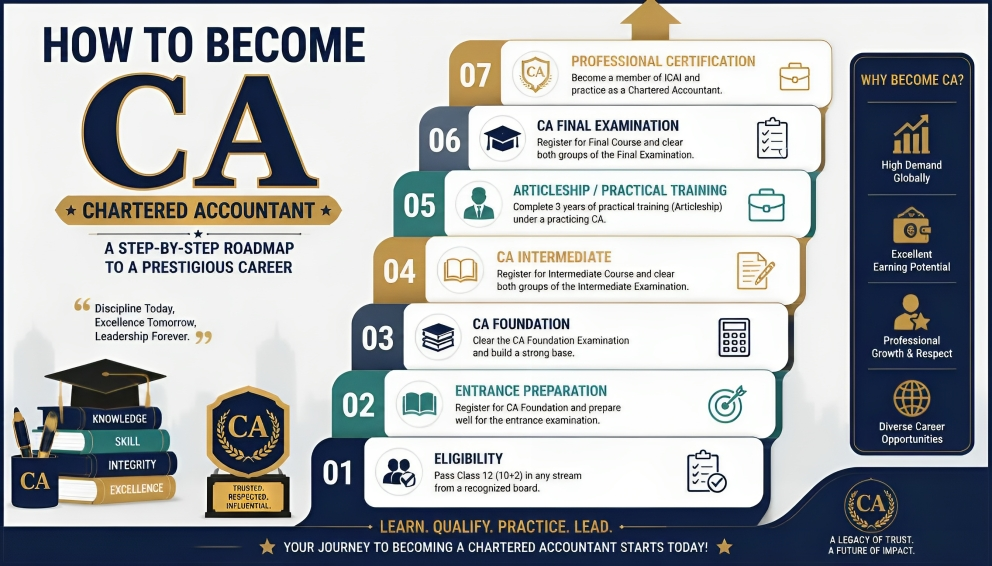
Step-by-Step Process: How to Become CA
Here is the clear sequence under the current ICAI scheme:
Step 1: Register for the CA Foundation (or Intermediate via Direct Entry)
Visit the ICAI Self Service Portal (eservices.icai.org). Set up an account, upload necessary documents like your Class 10/12 mark sheets or graduation certificates, and include a photo and signature. Don’t forget to pay the registration fee.
The fee for foundation registration is about ₹9,000, which covers study materials. For intermediate registration covering both groups, it’s around ₹18,000.
Step 2: Clear CA Foundation
- Four papers: Accounting, Business Laws, Quantitative Aptitude, and Business Economics
- Minimum 40% in each paper and 50% aggregate
- Exams are held three times a year (January, May, and September).
- A mandatory four-month study period after registration
Step 3: Register for CA Intermediate and Clear Both Groups
- Six papers in two groups of three each
- Group I: Advanced Accounting, Corporate and Other Laws, Taxation
- Group II: Cost and Management Accounting, Auditing and Ethics, Financial Management and Strategic Management
- Same 40%/50% passing criteria
- An eight-month study period is required before the first attempt.
- Exams are also held three times a year.
Step 4: Complete ICITSS
Once you’ve passed both intermediate exams, join the four-week Integrated Course on IT and Soft Skills (ICITSS). You have to do this before you start any practical training.
Step 5: Undergo Two-Year Articleship
Sign up as an articled assistant with a chartered accountant. This training lasts for 24 months if you’re in the New Scheme. You’ll get real-world experience in auditing, taxes, accounting, and advisory work. Stipends are set and depend on the city size.
You can choose industrial training for part of the time after completing a year of your articleship.
Step 6: Complete Advanced ICITSS and Self-Paced Online Modules
Either during your articleship or afterward, complete the Advanced Integrated Course on IT and Soft Skills (Advanced ICITSS). You also need to finish the four Self-Paced Online Modules (SPOM) required in the new scheme.
Step 7: Clear CA Final
- Six papers in two groups
- Group I: Financial Reporting, Advanced Financial Management, Advanced Auditing, Assurance and Professional Ethics
- Group II: Direct Tax Laws & International Taxation, Indirect Tax Laws, Integrated Business Solutions (multidisciplinary case study)
- Passing criteria remain 40% per paper and 50% aggregate.
- Final exams are currently held twice a year (May and November).
- You must complete the required training period and Advanced ICITSS before appearing.
Step 8: Apply for ICAI Membership
Once you’ve passed all final exams and finished your training and modules, you can apply to become an ICAI member. When accepted, you’ll be a qualified chartered accountant and can use “CA” after your name.
How long does it take?
If you pass everything on the first try, it generally takes about 4.5 to 5 years after Class 12. But most students need 5 to 7 years since they often require multiple attempts.
Approximate Fees (ICAI Official Components)
- Foundation registration + exam: around ₹10,500–11,000
- Intermediate registration + exams: around ₹20,000–25,000
- Final registration + exams: around ₹25,000–30,000
- ICITSS and Advanced ICITSS: additional course fees
- Total official ICAI fees for the full course usually fall in the ₹80,000–100,000 range (excluding coaching, which is optional but widely used).
Practical Tips for Success
- Start early and follow a disciplined study schedule.
- Use only the latest ICAI study material and Revision Test Papers (RTPs).
- Practise writing full answers under timed conditions.
- Choose your articleship firm carefully — the quality of training matters more than the stipend.
- Stay updated through the ICAI Self Service Portal and official announcements.
- Build soft skills and technology awareness; ICAI is increasingly emphasising AI, data analytics, and ESG.
Career Opportunities After Qualifying
Qualified CAs work in:
- Public practice (audit and tax firms)
- Industry (finance controllers, CFOs, internal audit)
- Consulting and Big 4 firms
- Banking, capital markets, and startups
- Government and regulatory bodies
Many also start their own practice or pursue further specialisations.
Final Thoughts
How to become CA is a clear but rigorous journey of exams, practical training, and continuous learning. The new scheme has made the process smoother while keeping up the high standards that make the CA credential valuable.
If you’re dedicated, focused, and ready to work hard, this qualification is one of the top professional credentials in India. Start by visiting the ICAI’s official website (icai.org) to find the latest info on registration, fees, and eligibility, and take your first step today. The field needs skilled, ethical, and forward-thinking chartered accountants – and you could be one of them.