
Blogging has changed. The top-performing creators in 2026 are no longer spending hours behind a blank page. Smart systems are used for researching, drafting, optimising, and polishing content whilst still maintaining their own unique voice.
You were one of the first to help, and you know AI tools for bloggers have come a long way, from experimental chatbots to practical assistants that do the heavy lifting. In the right context, they free you to focus on expertise, narrative, and audience. This guide explains exactly what these tools do (others just talk about them), who is best right now, and how to choose the good one for you, with a workflow that will give you better results than totally manual writing or using AI alone.
What are AI tools for bloggers?
AI tools for bloggers are software platforms built upon large language models (LLMs) that aid in various aspects of content creation. They can create outlines, give content drafts to expand on those ideas, provide SEO suggestions, check grammar, create images, do image creation and even assist with keyword research or a content brief.
The best tools do not replace the blogger. They act as collaborators. You own the content knowledge, the personal anecdotes, and the overall decisions. The AI manages structure, speed, and data-based recommendations.
Why Bloggers Rely on AI in 2026
Several clear benefits stand out:
- Speed without quality loss — Draft a 1,500-word post in a fraction of the time it once took.
- Consistent structure and SEO — Tools analyse top-ranking pages and recommend headings, keywords, and length.
- Better research—Some platforms pull current sources and cite them, reducing time spent hunting for data.
- Brand voice control — Advanced options learn from your previous posts so the output sounds more like you.
- Multichannel efficiency — Turn one blog post into social captions, email newsletters, or video scripts.
- Visibility in AI search — Newer tools help content perform not only on Google but also in AI Overviews, ChatGPT answers, Perplexity, and Gemini.
The key is balance. AI-generated content often gets low rankings and sounds generic — hence, quality suffers. AI-supported, human-edited content — works better every time.
Types of AI Tools Bloggers Actually Use
Not every tool serves the same purpose. Successful bloggers usually combine two or three categories:
1. General-purpose writing assistants
These handle ideation, outlining, and long-form drafting.
Examples: Claude, ChatGPT, Gemini.
2. Specialised content platforms
Built for marketing and brand consistency with templates and team features.
Examples: Jasper, Copy.ai, Writesonic.
3. SEO and optimization tools
These score your content against search results and suggest improvements for both traditional SEO and AI search visibility (GEO).
Examples: Surfer SEO, Frase, NeuronWriter, Scalenut.
4. Research and fact-checking tools
Useful for pulling current information with sources.
Example: Perplexity.
5. Editing and polishing tools
These catch grammar issues, improve clarity, and adjust tone.
Example: Grammarly.
6. Supporting tools
Image generators (Canva AI, Midjourney), publishing helpers, and workflow automation platforms.
Top AI Tools for Bloggers Right Now
Here is a practical breakdown based on current performance and real-world use:
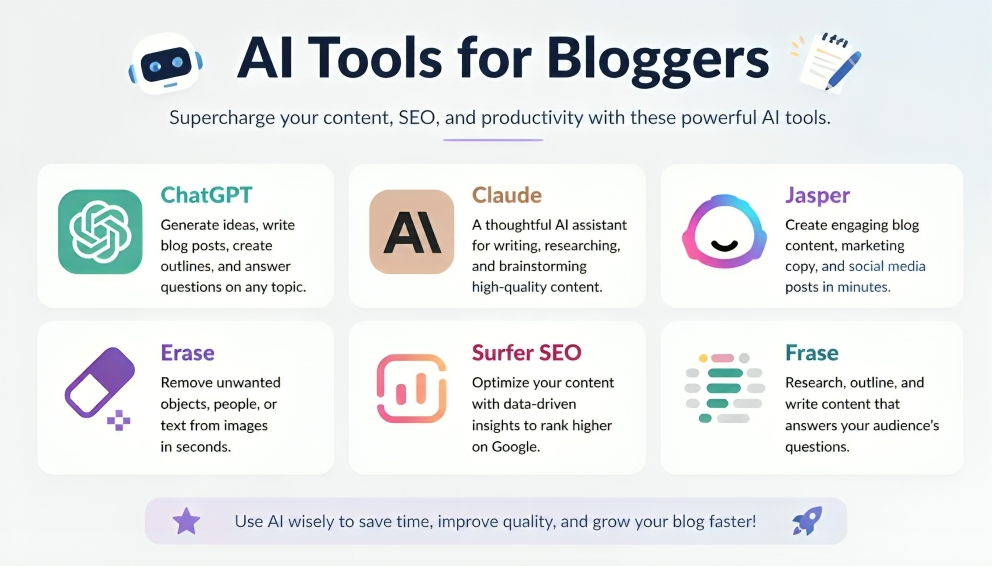
Claude (Anthropic)
Frequently lauded for the closest to natural, human-sounding long-form writing. The big context window allows you to input older posts, style guidelines, and research notes so the draft remains consistent. Ideal for quality-focused solo bloggers. Paid plans start at approx. $20 per month.
ChatGPT (OpenAI)
The versatile all-rounder. Great for brainstorming, outlining in detail, researching a topic, generating images in the same interface, and iterating quickly. Many bloggers start here. The Plus plan is normally $20 per month.
Jasper
Strong choice for teams or anyone who wants a fairly uniform brand voice across many bits of content. This includes templates, training in your brand voice, and collaboration features. I suggest you use it with whatever blogs are focused on high traffic or marketing purposes. Pricing typically starts around $39— $69.
Surfer SEO
The go-to optimization layer. It examines high-ranking content and provides live scores and recommendations as you’re writing or editing. Also becoming more valuable for AI search visibility too. Compare with a writing model not used by itself.
Frase
SERP research, content briefs, and writing support combined. Good when you need a very clear blueprint before writing.
Other solid options
- Writesonic and Koala for faster SEO-focused articles
- Grammarly for final polishing
- Perplexity for research with citations
- Rytr for budget short-form work
No single tool wins every category. Most experienced bloggers run a small stack rather than relying on one platform.
How to Choose the Right AI Tools
Ask yourself these questions:
- How many posts do you publish per month?
- Do you write solo or as part of a team?
- Is ranking in search (and AI answers) your main goal?
- How important is maintaining a distinct personal or brand voice?
- What is your monthly budget?
Simple recommendations:
- Beginner or low volume: Claude or ChatGPT Plus + free Grammarly.
- SEO-focused solo blogger: Claude or ChatGPT + Surfer SEO or Frase.
- Team- or brand-heavy content: Jasper + Surfer.
- Tight budget: Free tiers of Claude/ChatGPT + free SEO tools, upgrading only when needed.
Always test free trials or free tiers with your actual topics before committing.
A Practical Workflow That Works in 2026
- Research and planning — Use Perplexity or ChatGPT for topic angles and current data. Create a content brief with Frase or Surfer.
- Outline — Generate a detailed H2/H3 structure that matches search intent.
- Draft — Feed the outline, your notes, and examples of your writing style into Claude or ChatGPT. Request a first draft.
- Optimise — Run the draft through Surfer or a similar tool and adjust headings, keywords, and depth.
- Edit for voice and accuracy — Rewrite sections that feel generic. Add personal stories, examples, and unique insights. Fact-check claims.
- Polish — Use Grammarly or a similar editor for clarity and flow.
- Add visuals and publish — generate or edit images, then schedule the post.
This process typically cuts writing time significantly while producing content that feels more original and ranks better than pure AI output.
Best Practices and Common Pitfalls
Do this:
- Always add your own experience and opinions.
- Fact-check statistics and claims.
- Edit thoroughly so the final piece sounds like you.
- Update older posts with fresh AI-assisted research.
- Track what performs in both Google and AI search platforms.
Avoid this:
- Publishing unedited AI drafts.
- Relying on one tool for everything.
- Ignoring brand voice and audience needs.
- Keyword stuffing or chasing trends without substance.
Google and AI platforms continue to favour helpful, experience-backed content. Tools that help you deliver that value win; tools used as shortcuts usually underperform.
Latest Trends Shaping AI Blogging
In 2026, three shifts stand out. First, GEO (Generative Engine Optimisation) has come to rival modern SEO. The content should be ideally structured in a way that can easily be referenced or summarised by AI systems. New brand voice and consistency features are especially good – so much better than before. Third, the winning recipe is clearly hybrid (AI to fast-track things and human judgement as a guarantee/measure of quality + trust).
Final Recommendation
Start simple. Most bloggers find that a combination such as Claude or ChatGPT Plus for drafting paired with a single SEO tool like Surfer SEO or Frase when ranking is the most important. Grammarly for Polish and your own knowledge to make it sound more human.
AI tools for bloggers are great when they add to your knowledge rather than replacing it. Deploy them to eliminate friction, then reinvest that time in doing better foundational research, honing your storytelling craft, and connecting with readers on a human level. It is this combination that establishes authority and traffic and results in the lunar year 2026 and other years to come.
Try out a tool or two this week with an actual post. Keep refining your process, keeping your voice front and centre, and you will write better than before.